


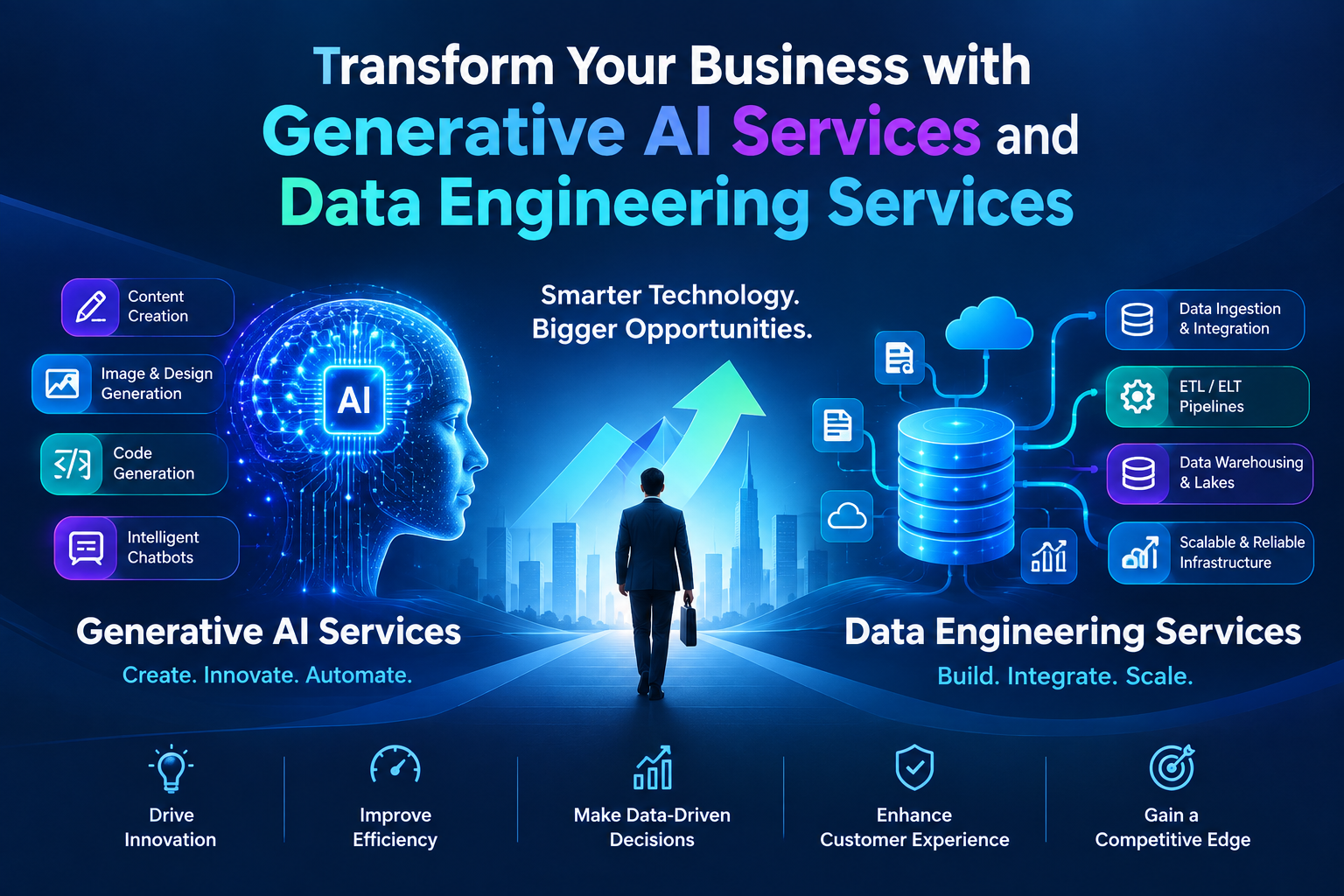
In today’s competitive digital landscape, businesses are constantly looking for smarter ways to improve productivity, understand customers, automate operations, and make better decisions. Two technologies playing a major role in this transformation are Generative AI services and Data engineering services. When combined effectively, they can help organizations turn large volumes of data into valuable insights, intelligent applications, and scalable business solutions.
What Are Generative AI Services?
Generative AI services use advanced artificial intelligence models to create new content, analyze information, automate repetitive tasks, and support business processes. Unlike traditional software that follows predefined rules, generative AI can work with natural language and generate outputs based on patterns learned from large datasets.
Businesses can use generative AI for content creation, customer support, document processing, software development, personalized recommendations, research assistance, and internal knowledge management.
For example, an organization can implement an AI-powered assistant that answers employee questions using company documents, while customer service teams can use AI to summarize conversations and provide relevant responses.
The Importance of Data Engineering Services
AI systems are only as effective as the data behind them. This is where Data engineering services become essential. Data engineering focuses on collecting, processing, organizing, integrating, and managing data so businesses can access reliable information when they need it.
Professional data engineering solutions can help organizations build data pipelines, data warehouses, data lakes, ETL and ELT workflows, and cloud-based data platforms. These systems ensure that information from different sources is transformed into a structured and usable format.
High-quality data provides the foundation required for analytics, machine learning, and artificial intelligence applications.
How Generative AI and Data Engineering Work Together
The real business value comes from combining AI capabilities with a strong data foundation. Generative AI services can use properly prepared organizational data to deliver more relevant and useful results, while Data engineering services ensure that the required information is available, accurate, secure, and scalable.
For instance, an e-commerce company may collect customer interactions, purchase histories, product information, and website activity. Data engineering can organize this information into a unified platform. Generative AI can then use the processed data to support personalized product recommendations, automated customer responses, and business insights.
Key Business Benefits
1. Improved Decision-Making
Well-engineered data combined with AI can help decision-makers identify trends, summarize complex information, and discover opportunities more efficiently.
2. Greater Operational Efficiency
Generative AI can automate repetitive activities such as drafting documents, summarizing reports, generating responses, and assisting employees with routine tasks.
3. Better Customer Experiences
Businesses can use AI to create personalized interactions, intelligent virtual assistants, and faster customer support while using reliable data to improve relevance.
4. Scalable Data Infrastructure
Data engineering services help organizations develop scalable architectures that can handle growing volumes of structured and unstructured information.
5. Faster Innovation
With accessible data and AI-powered tools, teams can experiment with new products, services, workflows, and customer experiences more quickly.
Practical Applications Across Industries
The combination of Generative AI services and Data engineering services can benefit numerous industries.
Healthcare: Organizations can use AI to summarize documents, support administrative workflows, and analyze information while data engineering platforms organize information from multiple systems.
Finance: Financial companies can use AI for document analysis, customer assistance, reporting, and knowledge management supported by structured data pipelines.
Retail: Businesses can combine customer and product data with AI to improve personalization, inventory insights, marketing, and customer engagement.
Manufacturing: AI can assist with documentation, operational analysis, and knowledge management, while data engineering connects information from production systems and sensors.
Technology: Software teams can use generative AI for coding assistance, documentation, testing, and research while engineering teams build reliable data infrastructure.
Building a Future-Ready Business
Successful AI adoption requires more than simply implementing an AI model. Businesses need a clear strategy, reliable data, appropriate infrastructure, security controls, and continuous monitoring.
By investing in Generative AI services alongside Data engineering services, organizations can create a strong technology foundation for intelligent automation and data-driven growth. This approach enables companies to move beyond basic automation and develop solutions that continuously support employees, customers, and business decision-makers.
Conclusion
Digital transformation is increasingly driven by the ability to use data intelligently. Generative AI services provide powerful capabilities for automation, content generation, analysis, and intelligent assistance, while Data engineering services provide the reliable data infrastructure needed to make these capabilities effective.
Together, they can help businesses improve efficiency, enhance customer experiences, accelerate innovation, and make more informed decisions. Organizations that build a strong data foundation while strategically adopting generative AI can position themselves for sustainable growth in an increasingly AI-driven business environment.

 Arabic
 French
 Spanish
 Portuguese
 Deutsch
 Turkish
 Dutch
 Italiano
 Russian
 Romaian
 Portuguese (Brazil)
 Greek