


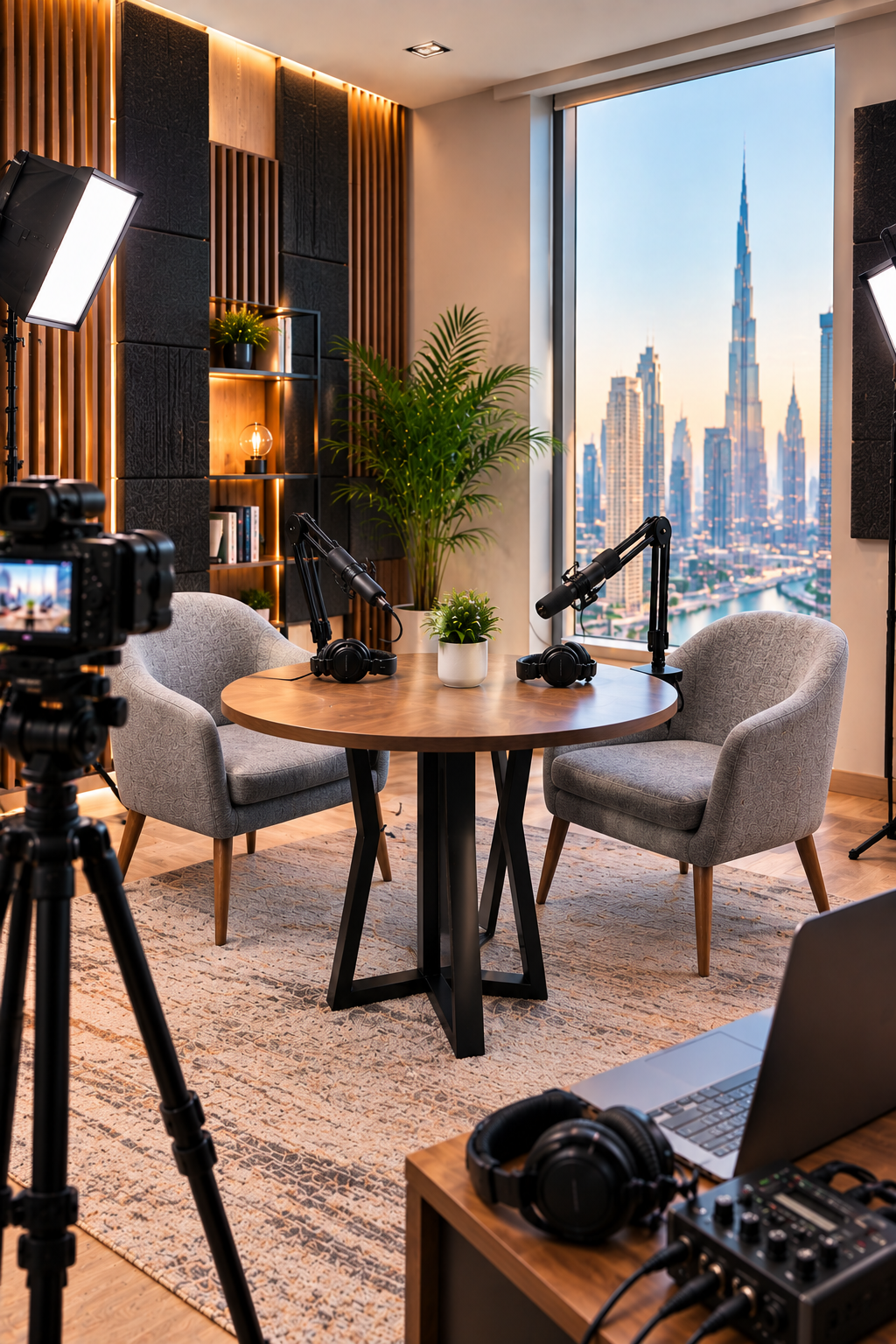
Plenty of Dubai hosts start in a spare room and stay there longer than they should. A Dubai podcast studio costs money, so the fair question is when it pays for itself in better sound, better video and fewer hours lost to fixing problems. This article compares the two routes using real conditions in the city and real prices.
Why Home Recording Struggles in Dubai
Apartments and villas here are built for cooling and views, not for sound. Glass walls, tiled floors and bare ceilings create echo, air-conditioning units hum through every take, and building work or traffic can leak in without warning. Rugs, curtains and a dynamic microphone reduce all of it, but a clap test in most rooms still shows a ringing tail that no plug-in fully removes.
Video raises the bar further. YouGov’s 2026 UAE report found that 60% of podcast consumers prefer video podcasts to audio only, against 20% who prefer audio. Home video usually means one camera, window light that shifts through the afternoon and a laptop fan whirring in the background. Viewers forgive a lot, but not lighting and sound that change from one episode to the next.
Neighbours matter more than most hosts expect. In a shared building, a drill, a lift or a child running upstairs can ruin a take, and the only fix is to stop and repeat the answer. Hosts often end up recording at odd hours to dodge the noise, which is hard to sustain over a full season. A purpose-built room has that problem solved by design.
What a Professional Room Changes
A treated room fixes the basics in one step. Absorption on the walls controls echo, the noise floor is low, and every speaker gets a matched microphone, so tracks stay separate for the editor. The payoff shows up later, because cleaner files generally mean fewer hours of repair. A common rule of thumb among editors is two to four hours of work per finished hour of speech.
Gulf Podcast Studios in Business Bay shows what that looks like: three 4K cameras, broadcast microphones, a mixer, professional lighting and a studio manager who runs the controls. A podcast studio like this also gives guests a proper destination, which many prefer to a host’s living room. They arrive to a prepared set, not a borrowed one.
Backup is another quiet benefit. Recording on a single laptop means one crashed app can erase an hour of conversation. In a staffed session you leave with raw audio and video files rather than one mixed file, which gives you room to fix mistakes later, including a guest who spoke too softly.
Consistency is the other gain. When every episode is recorded in the same room with the same cameras, listeners and viewers notice a stable look and sound, and your editor can reuse settings instead of rebuilding them each time. That repeatability is hard to match with a setup that changes whenever you move furniture.
Rental Rooms, Staffed Studios and Full-Service Teams
Not every studio works the same way, and the labels blur. These are the three models you will meet:
-
Self-service rooms: you get a space and equipment but run everything yourself. Published rates start around AED 150 an hour.
-
Staffed studios: an operator runs audio and cameras. Listed rates run from about AED 350 to AED 500 an hour, and Gulf Podcast Studios charges AED 450.
-
Full-service production: a team that also plans episodes, books guests, edits and distributes.
That last group is where podcast production studios earn their fees. They suit brands and executives who want a finished series without managing the process, though the monthly cost is considerably higher than renting a room and editing separately.
Pricing structures differ as well. Self-service rooms are typically billed by the hour with few extras, staffed studios often sell editing as an upgrade, and full-service teams tend to quote per episode or per month. Ask each provider for a total that includes VAT, since the UAE standard rate is 5% and some quotes leave it out.
Match the Option to Your Stage
A simple rule helps. If you publish audio only, have a genuinely quiet room and record less than once a month, home recording is fine and a studio is a luxury. If you publish video, record several episodes a month or interview guests in person, the studio starts paying back quickly. The 10-hour bundle costs AED 2,995, or AED 299.50 an hour, and can be used across six months.
Teams with a series to launch, such as a company podcast with six guests and a distribution plan, are the usual candidates for podcast production studios that manage the whole process. Everyone else can combine a staffed room with editing. Book one hour first, compare the files against your home recordings, and let the difference decide.
Be honest about your own time. If you spend three hours fixing the audio of every episode, that cost is real even though no invoice shows it. Put a value on those hours before you decide, and an hourly rate may look far more reasonable than it first appeared.
Conclusion
Home setups are a fine start, but they cap how far your sound and picture can go. A Dubai podcast studio removes that ceiling for a predictable hourly cost, and a trial hour shows you the gap without commitment. Decide by listening to your own files, not by reading a price list. The packages page sets out each option, and larger teams may also want to talk to podcast production studios about full-service support.
FAQs
1. Can I improve a home setup enough?
Partly. Thick curtains, rugs, a dynamic microphone and a quiet time of day help audio a lot. Video lighting and multi-camera work are much harder to solve at home.
2. Do I need video?
If you can, yes. A majority of UAE podcast consumers prefer video in the YouGov data, and video also gives you clips for social media.
3. How long does a typical recording take?
Plan 90 minutes to two hours for a 45-minute interview, including setup and retakes.
4. Do studios also edit?
Many do. Here, recording is AED 450 an hour and recording with professional editing is AED 900 an hour.

 English
 Arabic
 French
 Portuguese
 Deutsch
 Turkish
 Dutch
 Italiano
 Russian
 Romaian
 Portuguese (Brazil)
 Greek