


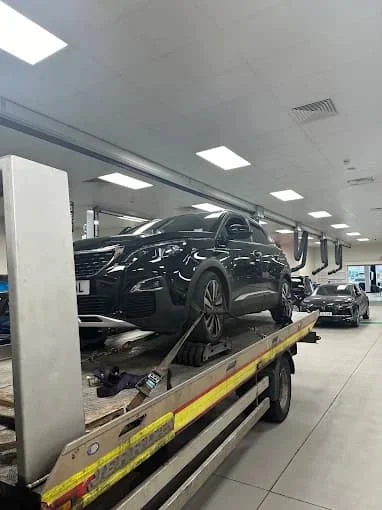
Heavy rain can make driving a commercial truck challenging, especially on busy highways and major roads throughout Atlanta, GA. Reduced visibility, slippery pavement, standing water, and poor road conditions can increase the risk of accidents and mechanical problems. When a semi-truck breaks down during heavy rain, drivers must prioritize their safety, protect other motorists, and arrange appropriate roadside assistance.
Knowing what steps to take during a rainy-weather breakdown can help truck drivers avoid additional risks and get their vehicles transported or repaired safely.
1. Move the Semi-Truck to a Safe Location
If the truck is still operational and can be moved safely, the driver should carefully steer toward the nearest safe shoulder, designated truck parking area, or highway rest area. Avoid stopping in active traffic lanes whenever possible.
Heavy rain can make it difficult for other motorists to see disabled vehicles. Moving away from traffic reduces the possibility of a collision and gives roadside assistance professionals a safer location to approach.
2. Turn On Hazard Lights Immediately
Once the semi-truck is safely stopped, activate the hazard warning lights to alert approaching drivers. Poor visibility during heavy rainfall can make a disabled commercial vehicle difficult to identify, particularly at night or on highways.
If conditions allow, follow applicable commercial vehicle safety requirements for reflective warning devices. Drivers should never put themselves in danger by placing warning triangles in active traffic or unsafe weather conditions.
3. Stay Inside the Truck When It Is Safer
Getting out of a disabled semi-truck during heavy rain can expose drivers to passing traffic, slippery surfaces, and dangerous roadside conditions.
If the vehicle is safely positioned away from traffic, remaining inside with the seat belt fastened may be the safest option. If the truck is in an immediately dangerous position, follow emergency instructions and move to a safer location only when it is safe to do so.
4. Identify the Cause of the Breakdown
Understanding what caused the breakdown can help determine the appropriate roadside assistance or towing equipment.
Common problems that may occur during heavy rain include:
-
Engine problems caused by existing mechanical issues.
-
Electrical system malfunctions.
-
Tire damage or loss of traction.
-
Brake system problems.
-
Overheating or cooling system failures.
-
Water-related engine or electrical damage.
Drivers should avoid attempting complicated roadside repairs in heavy rain, especially near moving traffic.
5. Contact Professional Heavy-Duty Towing Assistance
A disabled semi-truck may require specialized towing equipment that ordinary passenger vehicle tow trucks cannot provide. Heavy-duty towing operators have equipment designed to handle commercial trucks, tractor-trailers, and other large vehicles.
When contacting a towing provider, explain the truck's location, vehicle type, approximate weight or load information, and the nature of the mechanical problem. This information helps the operator determine what equipment and recovery services may be necessary.
6. Be Careful Around Standing Water and Flooded Roads
Heavy rainfall can create dangerous water accumulation around highway shoulders, underpasses, and low-lying roads throughout the Atlanta area.
Truck drivers should avoid attempting to drive through deep standing water or flooded sections of road. Water can conceal road damage, debris, and other hazards. If a truck becomes stranded in floodwater, drivers should prioritize personal safety and contact emergency services when necessary.
7. Provide Accurate Location Information
When requesting roadside assistance, provide clear location details so the towing operator can find the disabled vehicle without unnecessary delays.
Useful information includes:
-
Highway or interstate number.
-
Direction of travel.
-
Nearest exit or mile marker.
-
Nearby landmarks.
-
Truck type and trailer configuration.
-
Whether the vehicle is carrying a load.
-
Details about the mechanical problem.
For example, a driver stranded along I-285 should provide the nearest exit, direction of travel, and available mile marker information.
8. Arrange a Safe Inspection Before Returning to the Road
After the truck has been recovered or transported, it should receive an appropriate mechanical inspection before returning to service. Heavy rain and roadside conditions can make existing problems worse or reveal damage that was not immediately noticeable.
Drivers and fleet managers should pay particular attention to tires, brakes, electrical connections, engine components, and other safety-critical systems.
Get Heavy-Duty Towing Assistance in Atlanta, GA
A semi-truck breakdown during heavy rain can create serious safety concerns and disrupt commercial transportation schedules. Taking the right precautions, communicating accurate location information, and contacting professional towing assistance can help drivers manage these unexpected situations.
For commercial truck drivers and fleet operators who need heavy-duty towing assistance in Atlanta, GA, drwrecker is a service provider to contact when a semi-truck or other large commercial vehicle cannot safely continue its journey. Professional heavy-duty towing support can help transport disabled vehicles and get them to an appropriate repair facility.

 Arabic
 French
 Spanish
 Portuguese
 Deutsch
 Turkish
 Dutch
 Italiano
 Russian
 Romaian
 Portuguese (Brazil)
 Greek