


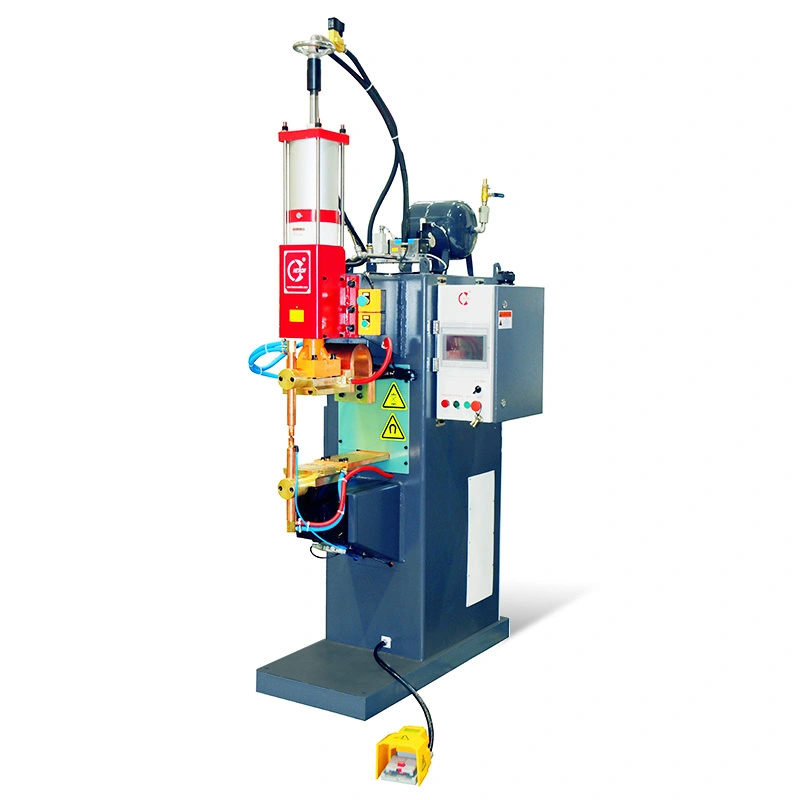
A projection welder is an advanced resistance welding machine designed to join metal components through controlled heat and pressure. It is widely used in modern manufacturing industries where strong, consistent, and precise metal joints are essential. This welding technology uses specially designed projections on metal components to concentrate electrical current in specific areas, allowing manufacturers to create reliable welds with excellent consistency.
As industrial production continues to evolve, manufacturers are increasingly looking for welding solutions that improve productivity, accuracy, and operational efficiency. Projection welding meets these requirements by providing a controlled welding process suitable for different metal components and production applications. Heron Welder offers professional welding solutions designed to support industrial manufacturers with dependable equipment and advanced welding technology.
2. How Does a Projection Welder Work?
The working principle of a projection welder is based on resistance welding technology. During the welding process, two metal components are positioned between specially designed electrodes. One or both components contain small raised projections that concentrate electrical current at predetermined welding points.
When electrical current passes through the components, resistance generates heat around these projections. At the same time, the welding electrodes apply controlled pressure to bring the metal surfaces together. The concentrated heat softens the material at the welding points, allowing the components to form strong metallurgical bonds.
Once the welding cycle is completed, the welded components can be removed for further production processes. This controlled approach makes a projection welder particularly suitable for applications requiring multiple welding points or repeatable joining quality.
3. Important Features of Modern Projection Welders
Modern projection welding equipment combines electrical control, mechanical precision, and automated operation to deliver consistent manufacturing results.
Key features include:
-
Controlled Welding Current: Accurate electrical current management helps generate suitable heat at designated welding points.
-
Adjustable Welding Pressure: Controlled electrode pressure supports reliable contact between metal components.
-
Precise Welding Cycles: Programmable welding parameters help maintain consistent production quality.
-
Multiple Welding Points: Projection welding can accommodate components designed with several welding projections.
-
Industrial Automation Compatibility: Modern systems can be integrated into automated manufacturing processes.
-
Reliable Performance: Industrial-grade construction supports continuous production requirements.
With its focus on industrial welding technology, Heron Welder provides solutions that help manufacturers improve their production capabilities and achieve dependable welding results.
4. Major Advantages of Using a Projection Welder
A projection welder provides several important advantages for manufacturers looking to improve metal joining operations. Its ability to concentrate welding energy at specific points makes it an effective solution for high-volume industrial production.
Higher Production Efficiency: One of the biggest advantages of projection welding is its ability to complete multiple welds during a single welding cycle. This helps manufacturers increase production output while maintaining consistent joining quality.
Strong and Reliable Welded Joints: Concentrated heat and controlled pressure create dependable connections between metal components. This makes projection welding suitable for applications where joint strength and structural reliability are important.
Reduced Energy Consumption: Projection welding focuses electrical energy on designated welding locations. This efficient distribution of heat can help reduce unnecessary energy consumption and support more economical manufacturing operations.
Longer Electrode Service Life: Properly designed projection welding processes distribute welding pressure and heat across the intended contact areas. This can help reduce electrode wear and support longer equipment service life.
Consistent Welding Quality: Programmable controls and adjustable welding parameters help manufacturers maintain repeatable results across large production batches.
5. Industrial Applications of Projection Welders
Projection welding technology is used across numerous industries because of its ability to join different metal components efficiently. Its versatility makes it particularly valuable for manufacturers handling repetitive production operations.
Automotive Manufacturing: The automotive industry uses projection welders to attach nuts, bolts, studs, brackets, and other metal components to vehicle assemblies. These applications require reliable joints that support product strength and manufacturing consistency.
Home Appliance Production: Manufacturers of refrigerators, washing machines, water heaters, and other household appliances use projection welding to join metal components. The process helps create durable connections while supporting efficient assembly operations.
Electrical Equipment Manufacturing: Electrical cabinets, circuit breakers, connectors, and other electrical components often require accurate metal joining. Projection welding provides a practical solution for producing dependable connections in these applications.
Hardware Manufacturing: Metal brackets, fasteners, structural fittings, and specialized hardware products can benefit from projection welding. Its repeatable operation makes it suitable for manufacturers producing large quantities of similar components.
Compressor Manufacturing: Compressor production involves various metal parts that require secure and consistent joining. Projection welding supports efficient manufacturing processes for compressor housings and associated components.
6. Heron Welder: Professional Projection Welding Solutions
Heron Welder is an established manufacturer of intelligent metal joining equipment, specializing in resistance welding, clinching, riveting, and automated production solutions. Founded in 1991, Heron has developed extensive experience in providing industrial welding technologies for different manufacturing requirements.
The company offers multiple resistance welding solutions, including medium-frequency direct-current (MFDC) welders, capacitor discharge (CD) welders, and AC projection welding equipment. These technologies provide manufacturers with different options according to their materials, component designs, and production requirements.
Heron's equipment portfolio includes customizable machines and integrated production systems designed to support applications across automotive manufacturing, home appliances, compressors, electrical equipment, and general hardware production.
With a strong focus on engineering development and industrial automation, Heron Welder aims to make metal joining simpler, more efficient, and more reliable for manufacturers around the world.
7. Why Choose Heron Welder for Projection Welding Equipment?
Choosing the right equipment manufacturer is an important step toward establishing an efficient production environment. Heron Welder combines industrial experience, engineering capabilities, and a broad equipment portfolio to support different metal joining applications.
More Than Three Decades of Experience: With a history dating back to 1991, Heron has developed extensive knowledge of resistance welding technology and industrial manufacturing requirements.
Customized Equipment Solutions: Different industries have different welding requirements. Heron provides modular and customized equipment configurations to help manufacturers select solutions that match their production processes.
Advanced Welding Technology: Its MFDC and capacitor discharge technologies offer different approaches to controlling welding energy and producing consistent joints.
Automation Integration: Heron provides automated production lines and intelligent manufacturing equipment that can support improved production efficiency and reduced manual workload.
Global Manufacturing Experience: Heron serves customers across international markets and provides metal joining solutions for a broad range of industrial applications.
8. How to Select the Right Projection Welder
Selecting a suitable projection welder requires understanding the specific requirements of the manufacturing application. Several important factors should be considered before choosing industrial welding equipment.
Material Compatibility: Identify the materials that need to be joined, including low-carbon steel, stainless steel, galvanized steel, and high-strength steel. Different materials may require different welding parameters and equipment configurations.
Component Design: The size, thickness, shape, and number of welding projections influence the equipment requirements. Understanding component geometry helps determine the appropriate electrode arrangement and welding capacity.
Production Volume: Manufacturers with high production demands may benefit from automated systems capable of completing multiple welding operations efficiently.
Power and Welding Capacity: Select equipment with suitable power capacity, welding current, and pressure capabilities for the intended application.
Automation Requirements: Consider whether manual operation, semi-automatic production, or a fully automated welding line is most suitable for the manufacturing environment.
Working with an experienced manufacturer such as Heron Welder can help businesses evaluate these factors and identify an appropriate welding solution.
9. The Role of Projection Welding in Modern Manufacturing
Modern manufacturing increasingly depends on precision, consistency, and efficient production processes. Projection welding contributes to these objectives by providing a controlled method for joining metal components.
As automotive structures, electrical products, and household appliances become more sophisticated, manufacturers need welding equipment capable of supporting different material combinations and component designs.
Advanced projection welding systems can also work alongside robotic equipment, automated feeding mechanisms, programmable controllers, and quality monitoring technologies. These integrations help create more organized manufacturing workflows and improve production repeatability.
Heron Welder continues to develop intelligent metal joining solutions that support the changing needs of industrial manufacturers. Its combination of resistance welding equipment and automation technology provides businesses with opportunities to modernize their production capabilities.
10. Benefits of Investing in Modern Projection Welding Technology
Investing in a modern projection welder can provide long-term value for manufacturing businesses. The technology supports efficient production while helping companies maintain reliable product quality.
Some important benefits include:
-
Improved Productivity: Multiple welding points can be completed in one cycle, supporting faster manufacturing operations.
-
Better Joint Consistency: Controlled welding parameters help produce repeatable results.
-
Efficient Resource Utilization: Concentrated heat generation supports effective energy use.
-
Manufacturing Flexibility: Different equipment configurations can accommodate a wide range of component designs.
-
Automation Opportunities: Integration with automated production systems supports modern manufacturing strategies.
-
Reliable Product Quality: Consistent welding processes help manufacturers achieve dependable finished components.
These benefits make projection welding a valuable technology for businesses seeking to improve production performance and strengthen their manufacturing capabilities.
11. Final Thoughts
A projection welder is an important piece of industrial equipment for manufacturers seeking accurate, efficient, and reliable metal joining solutions. Its ability to concentrate welding energy, produce strong joints, and complete multiple welding points makes it suitable for automotive manufacturing, home appliances, electrical equipment, compressors, and numerous other industries.
Choosing an experienced equipment manufacturer is essential for achieving the best results. Heron Welder brings more than 30 years of industry experience, advanced resistance welding technologies, customized equipment capabilities, and intelligent automation solutions to the metal joining industry.
For businesses planning to improve production efficiency, maintain consistent welding quality, and develop modern manufacturing operations, Heron Welder represents a professional partner in industrial welding technology. Investing in the right projection welding solution can help manufacturers build stronger products, optimize production workflows, and support long-term industrial growth.

 Arabic
 French
 Spanish
 Portuguese
 Deutsch
 Turkish
 Dutch
 Italiano
 Russian
 Romaian
 Portuguese (Brazil)
 Greek