


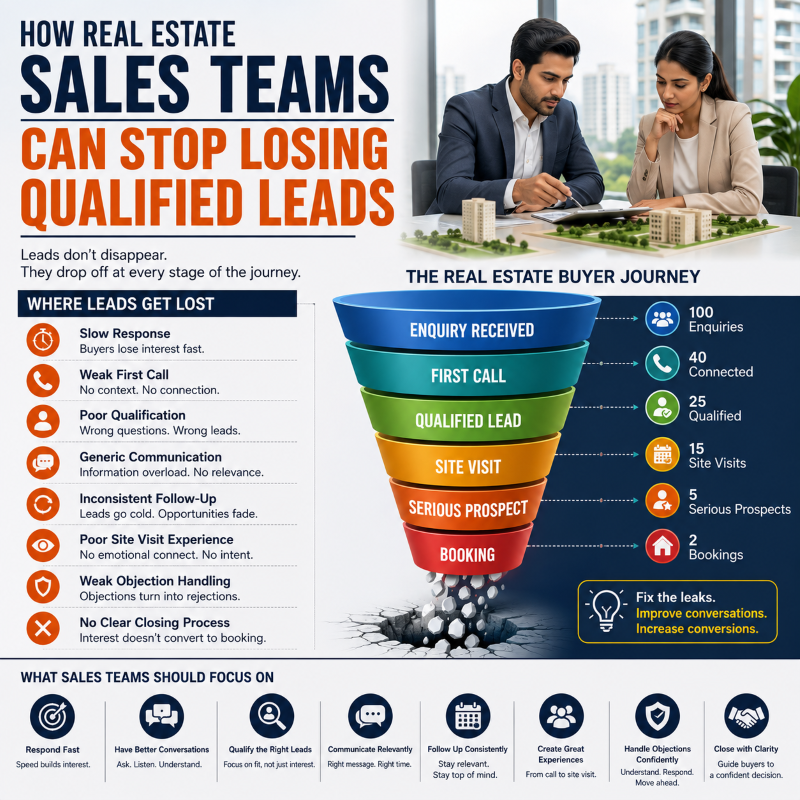
Many real estate businesses don't actually have a lead-generation problem. They have a lead-conversion problem.
Marketing generates enquiries. Some of those enquiries are genuinely relevant — the right budget, the right configuration, the right location, the right timeline. And yet, a large share of these qualified buyers simply disappear somewhere between the enquiry form and the booking.
It's tempting to treat this as an individual performance issue "the salesperson didn't follow up" or "the telecaller wasn't convincing enough." But lead leakage is usually a system, process, communication, and skill problem, not a single person's failure. It happens in small, specific ways at specific stages: a slow first response, a generic first call, a follow-up that adds no new value, an objection that gets argued with instead of understood.
This article looks at exactly where qualified real estate leads get lost, how sales managers can diagnose that leakage, and what practical systems reduce it — stage by stage.
Quick Answer
Q: How can real estate sales teams stop losing qualified leads?
Answer: The majority of leakage occurs at predictable points: sluggish first response, weak first call, shallow qualification, generic follow-ups, and unresolved objections. Sales teams lower this by responding fast, using a structured discovery process rather than a script, personalizing follow-up based on buyer intent, addressing concerns rather than dismissing them, and tailoring site visits to what the unique buyer is interested in. The solution is rarely to "generate more leads"; rather, it is to identify where the current funnel is leaking and address that issue first.
Why Qualified Real Estate Leads Still Get Lost
It helps to separate three distinct stages that often get treated as one:
Lead Generation → Lead Qualification → Lead Conversion
Creating a lead indicates that someone is interested. Qualifying a lead entails confirming that interest is genuine, relevant, and short-term. Converting a lead entails transforming that qualified curiosity into a meaningful discussion, a site visit, and, eventually, a booking. A lead can pass the first two stages smoothly but fail at the third — and the third stage is when the majority of the value is lost.
Common reasons qualified leads don't convert:
- Slow response after receiving the inquiry
- A generic first call that sounds like a screenplay being read aloud.
- Weak qualifier that never indicates the actual intent or date.
- Feature dumping rather than relevant positioning.
- Inconsistent messaging among several salesmen
- Follow-up that repeats the same information without adding any value.
- Objection handling that argues instead of listening
- There is no established sales process to fall back on if a conversation pauses.
Each of these does not feel disastrous on its own. Together, hundreds of leads form a funnel that appears busy but converts badly.
What Is Lead Leakage in Real Estate Sales?
Lead leakage is the steady loss of potential buyers as they progress thru the sales funnel – from original inquiry to first call, qualification, follow-up, site visit, and close with each stage losing a part of buyers who could have converted if handled properly.
A simplified illustration of how this compounds:
100 enquiries
   ↓
40 qualified
   ↓
25 meaningful conversations
   ↓
15 site visits
   ↓
5 serious prospects
   ↓
2 bookings

These figures are only for illustrative purposes; actual ratios vary greatly depending on project type, pricing range, market, and lead source. The point is not the specific figures, but the pattern. Leakage isn't one huge failure — it's little drop-offs at every stage, and by the time a developer sees a booking problem, the harm has usually already happened three or four stages earlier.
The 8 Places Where Real Estate Teams Lose Qualified Leads
1. Slow First Response
Before a single word is spoken, response speed sets the tone. A customer who has inquired about a project is typically comparing two or three possibilities at the same time; whomever responds first and well controls the dialog. A message like "Hello sir, you filled out an inquiry form" indicates a transactional, low-effort process. A response that acknowledges what the consumer actually asked about and begins with useful context rather than a script indicates the contrary.
2. Weak First Call
The first contact frequently devolves into a brochure-reading exercise — configuration, pricing, and amenities, in that sequence, regardless of what the customer truly wants to learn. A stronger first call begins with permission ("Is this a good time to talk for a few minutes?"), establishes context (what triggered the inquiry), and allows buyer intent to steer the remainder of the conversation rather than a predetermined script.
3. Poor Lead Qualification
Qualification is frequently simplified to a single question: "What's your budget?" That's only one of several inputs. A comprehensive qualification conversation also looks into purpose (end-use vs. investment), configuration requirements, geographical preference, timing, who else is engaged in the choice, financing plans, and what's driving the search right now. Skipping the majority of these suggests the salesperson is pitching a project to a buyer they don't yet understand.
4. Feature Dumping
Listing a clubhouse, pool, gym, and covered parking does not guaranty interest; it only counts if it relates to something the customer cares about. The distinction is feature → benefit → buyer relevance. "The project has a clubhouse" is a highlight. "It has a clubhouse with a kids' play area" is an advantage.Given that you indicated that your children are young, the clubhouse's children's section may be important to you in the evenings" ties it to this buyer. Most sales conversations end at the first step.
5. Generic WhatsApp Follow-Ups
Sending the same brochure PDF three times in two weeks tends to lower rather than improve engagement. Buyers notice when a message isn't tailored to what they said during the previous conversation. A follow-up that addresses a specific concern voiced by the buyer—possession timescale, a comparison highlighted, a configuration question—reads quite differently than a repeated general broadcast.
6. Weak Objection Handling
Price, location, "I need to think about it," "I'm comparing other projects," "I'll discuss with my family," EMI worries, and time are all common arguments in real estate transactions. Arguing directly against these issues causes purchasers to become defensive and disinterested. Understanding and addressing the concern behind the objection keeps the conversation going rather than shutting it down.
7. Poor Site-Visit Preparation
A site visit does not begin when the buyer arrives at the project; rather, it begins with advance confirmation and expectation-setting. Who will be in attendance? What's most important to them: nearby schools, connection, or a certain unit orientation? A site visit based on generic project touring, without knowing what this customer is specifically interested in, wastes the funnel's peak intent moment.
8. Inconsistent Follow-Up
"Just checking if you are interested" is not a follow-up technique because it provides no new information and gives the buyer no reason to respond. Structured follow-up is based on customer intent and stage: a buyer who viewed the site need a different follow-up than one who merely made the initial call. Follow-up should always include something new – an answer to a question they asked, updated inventory, or a relevant comparison point.
How to Build a Lead-Converting Real Estate Sales Process
A structured process gives every salesperson a consistent path to follow, regardless of experience level:
- Respond — acknowledge the enquiry quickly and professionally
- Understand — identify intent and context before pitching anything
- Qualify — establish fit, timeline, motivation, and decision process
- Position — connect specific project benefits to what this buyer needs
- Engage — communicate relevantly instead of overloading with information
- Follow Up — maintain a structured, intent-based cadence
- Visit — build genuine intent before the buyer arrives at the site
- Handle Objections — understand the concern before responding to it
- Close — help the buyer reach a confident decision, not a pressured one
This sequence matters more than any individual script — it's the structure that keeps a conversation moving forward instead of stalling at the first objection or going quiet after the first call.
How Sales Managers Can Identify Where Leads Are Being Lost
Most sales dashboards track volume: number of leads, number of calls, number of site visits, number of bookings. These numbers show that something is wrong, but rarely where.
To diagnose the actual leakage point, managers also need to look at:
- Lead response quality — not just response time, but what was actually said
- First-call quality — was there a real conversation or a script recital
- Qualification quality — was genuine intent established
- Follow-up consistency — is there a pattern, or is it reactive and sporadic
- WhatsApp and digital communication tone
- Objection-handling approach in real conversations
- Site-visit experience and preparation
- CRM discipline — is data actually being logged and used
This is what's sometimes called conversation-level performance analysis — reviewing actual conversations rather than just counting activities. A team can have perfectly healthy lead volume and still underperform, simply because the conversations themselves aren't converting intent into commitment.
Sales Funnel Leakage Audit
| Sales Stage | Warning Sign | Possible Problem | What to Improve |
|---|---|---|---|
| Enquiry | Low contact rate | Slow response | Response process |
| First Call | Short conversations | Weak opening | Call framework |
| Qualification | Poor lead quality flagged later | Weak questioning | Discovery process |
| Follow-Up | Leads go cold | Generic messaging | Follow-up system |
| Site Visit | Low show-up rate | Poor pre-visit communication | Visit preparation |
| Site Visit → Booking | High drop-off | Weak engagement or objection handling | Buyer conversation quality |
| Closing | Delayed decisions | Unresolved concerns | Closing process |
This table is best used as a starting checklist during a monthly or quarterly review; for each row, a manager can ask: Is this a current concern for our team, and if so, since when?
How to Improve Real Estate Lead Conversion
Practical approaches to address the aforementioned leakage sites without ensuring a certain outcome:
- Create a common first-call framework that can be tailored to different buyer categories.
- Train teams to detect buyer intent early, rather than merely budget.
- Create buyer personas specific to each project.
- Use organized discovery questions instead of unstructured talk.
- Align marketing and sales messaging to provide buyers a consistent story.
- Create individualized follow-up methods based on what the buyer actually stated.
- Track lead leakage at all stages, not just during the booking process.
- Review actual sales discussions, not simply activity statistics.
- Conduct mystery-call or sales-experience audits periodically.
- Coach the team on a continuous basis rather than in one-off sessions.
Each of them targets a specific leakage point discovered earlier; they are not broad sales advise, but rather solutions to the eight sites where leads are actually lost.
Why Sales Training Alone Is Not Enough
Training teaches or sharpens a skill. On its own, it rarely resolves a broken process. A well-trained salesperson operating in a delayed response system with no follow-up structure or CRM discipline will nonetheless lose qualified leads—because the leakage isn't a knowledge gap in that scenario, but a systems gap.
Training is more effective when supplemented by:
- A defined sales process.
- Measuring conversation quality, not just activity.
- Continuous coaching, not a single workshop.
- Periodic audits to detect drift.
- Scripts and playbooks that the team can really use
- CRM discipline captures what's happening at each stage.
- Continuous learning versus a one-time event
Where PitchPerfect Fits In
PitchPerfect handles real estate sales enablement with structured learning, practical frameworks, sales performance audits, and buyer-conversation enhancement resources that are designed exclusively for the real estate sales journey, from first call to site visit and closing.
Frequently Asked Questions
Q: Why do qualified real estate leads go cold?
Answer: Usually due to a lapse in the process – a sluggish first answer, a generic follow-up that provides no new information, or an unresolved concern that was never fully addressed rather than just rejected.
Q: How can real estate companies improve lead conversion?
Answer: Instead of giving broad "sell better" advice, identify the specific step where leads are being lost — response time, first-call quality, qualifying, follow-up, or site-visit preparation — and address it.
Q: What is lead leakage in real estate?
Answer: The steady loss of potential customers as they progress throughout the sales funnel, from inquiry to booking, with each stage – first call, qualifying, follow-up, site visit — losing a percentage of buyers who could have converted with better handling.
Q: How should sales teams qualify property leads?
Answer: By looking beyond the budget to understand the goal, configuration requirements, location preference, timetable, decision-makers, finance, and motivation for the search, you can gain a more complete picture that will shape the rest of the conversation.
Q: How often should real estate sales teams follow up?
Answer: Based on buyer intent and stage rather than a set schedule – a buyer who has finished a site visit requires different follow-up timing and content than one who has simply made a first call.
Q: Why do real estate buyers stop responding?
Answer: Frequently because the interaction stopped delivering value for them – repeated generic messages, unanswered queries, or a follow-up that ignores anything specific they mentioned previously.
Q: How can sales managers identify weak sales conversations?
Answer: By reviewing actual calls and messages rather than just activity counts, we can assess call quality, qualification depth, follow-up customisation, and how objections are handled in real interactions.

 English
 Arabic
 French
 Portuguese
 Deutsch
 Turkish
 Dutch
Dutch
 Italiano
 Russian
 Romaian
 Portuguese (Brazil)
 Greek
Greek