


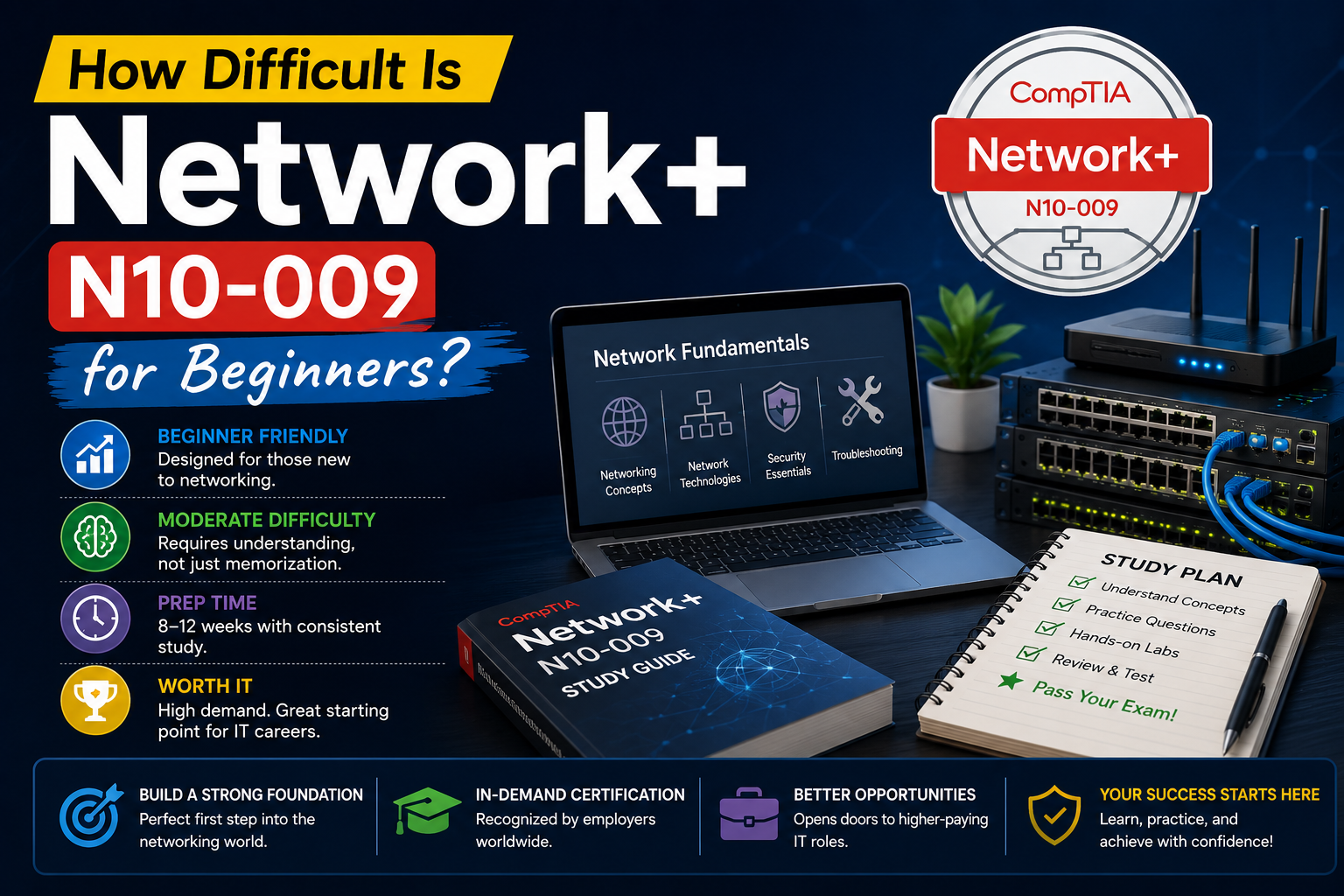
CompTIA Network+ N10-009 can feel difficult for beginners because it covers a wide range of networking concepts rather than one narrow technical area. A new learner may need to understand IP addressing, routing, switching, wireless networking, security, monitoring, cloud networking, and troubleshooting at the same time.
The key is to avoid treating Network+ as a memorization-only certification. Beginners usually make faster progress when they combine theory with subnetting practice, hands-on labs, troubleshooting exercises, and exam-style questions.
How Difficult Is Network+ N10-009 Overall?
For a complete beginner, Network+ N10-009 is best described as moderately challenging. CompTIA recommends 9–12 months of hands-on experience in a junior network administrator or network support technician role, although this is a recommendation rather than a formal prerequisite. The exam can contain up to 90 questions, includes multiple-choice and performance-based questions, and allows 90 minutes.
The challenge comes from the breadth of the objectives. Network+ expects candidates to understand both how networks are designed and how common problems are diagnosed. You may know what a router or VLAN is, but the exam can require you to identify where a failure is happening or select the best solution for a scenario.
What Does the N10-009 Exam Cover?
The N10-009 objectives are divided into five domains. Network Troubleshooting carries the largest weighting at 24%, followed closely by Networking Concepts at 23%. Network Implementation accounts for 20%, Network Operations for 19%, and Network Security for 14%.
| Exam Domain | Weight | Beginner Difficulty |
| Networking Concepts | 23% | Moderate to high |
| Network Implementation | 20% | Moderate |
| Network Operations | 19% | Moderate |
| Network Security | 14% | Moderate |
| Network Troubleshooting | 24% | High |
These percentages show why beginners should not spend all their study time memorizing terms. Troubleshooting, implementation, and operations together make up a large portion of the exam and require practical understanding.
Which Network+ Topics Are Hardest for Beginners?
Subnetting and IPv4 Addressing
Subnetting is one of the topics that often slows new learners. You need to understand network addresses, host ranges, subnet masks, CIDR notation, and how addresses are divided. IPv4 addressing, subnetting, VLSM, and CIDR are specifically included in the official objectives.
The good news is that subnetting becomes much easier through repetition. Beginners should practice small subnetting problems daily instead of trying to master the topic in one long session.
Ports and Protocols
N10-009 includes common services and protocols such as DNS, DHCP, SSH, HTTP, HTTPS, SNMP, LDAP, SMB, RDP, and others. Memorizing numbers alone is not enough. You should understand what each service does, where it is used, and what might happen when it fails.
Routing, Switching, and Wireless Concepts
Routing technologies, VLANs, switching features, wireless frequencies, channels, encryption, and network topologies can feel like separate subjects at first. The official objectives include areas such as OSPF, BGP, VLAN configuration, spanning tree, wireless frequencies, WPA2, and WPA3.
A beginner may find these topics easier by drawing simple network diagrams. Seeing how devices and traffic connect often makes technical definitions more meaningful.
Troubleshooting Scenarios
Troubleshooting is a major challenge because it combines several skills. Candidates may need to interpret symptoms, identify likely causes, choose a tool, or determine the best next action.
This requires reasoning rather than simple recall.
Why Performance-Based Questions Can Feel Difficult
Performance-based questions test how well you can apply networking knowledge in a practical or simulated situation. CompTIA confirms that N10-009 uses both multiple-choice and performance-based questions.
Beginners sometimes struggle because they understand a definition but have not practiced using it. For example, knowing what a VLAN does is different from recognizing an incorrect VLAN configuration in a scenario.
Hands-on practice helps reduce this gap.
Is Network+ N10-009 Beginner Friendly?
Network+ is suitable for motivated beginners, but it is not an introductory technology vocabulary exam. A candidate starting with no IT background may first need basic familiarity with computers, operating systems, command-line tools, and common network devices.
Network+ becomes more manageable if you already understand:
-
Basic computer hardware
-
Windows or Linux fundamentals
-
IP addresses and network devices
-
Simple command-line utilities
-
Basic security terminology
None of these skills need to be advanced before you begin. They simply give you a stronger foundation.
How Beginners Should Prepare for N10-009
A structured plan is more effective than reading one study guide repeatedly.
-
Download and review the official N10-009 objectives.
-
Learn core networking concepts such as the OSI model, TCP/IP, addressing, routing, and switching.
-
Practice subnetting until you can solve common problems without relying heavily on notes.
-
Build simple labs using virtual machines, network simulators, or available hardware.
-
Practice common commands such as ping, tracert or traceroute, ipconfig or ifconfig, and nslookup.
-
Study troubleshooting as a process rather than memorizing isolated fixes.
-
Use practice questions to identify weak objectives and return to those topics.
Candidates using https://certempire.com/exam/n10-009-exam-questions for extra exam-style practice can combine question review with targeted lab work so that missed concepts are reinforced practically.
Common Mistakes That Make Network+ Feel Harder
Many beginners make the exam more difficult through inefficient preparation.
Common problems include:
-
Memorizing definitions without understanding scenarios
-
Ignoring subnetting until the final week
-
Skipping hands-on practice
-
Studying outdated exam objectives
-
Avoiding troubleshooting questions
-
Learning port numbers without understanding services
-
Taking full practice exams too early
Instead, build knowledge in layers. Learn a concept, see how it works, practice it, and then test yourself.
Practical Tips to Reduce N10-009 Difficulty
Start with the topics that connect everything else. IP addressing, the OSI model, Ethernet, routing, switching, DNS, and DHCP form a foundation for many later objectives.
Use diagrams whenever possible. Draw traffic moving from a client through a switch, router, firewall, and server. Then ask what would happen if one component failed.
Also review mistakes carefully. A wrong answer is most useful when you can explain why your choice was wrong and why the correct option fits the scenario.
Conclusion
Network+ N10-009 is challenging for beginners, but the difficulty is manageable with consistent preparation. The largest obstacles are usually the breadth of topics, subnetting, troubleshooting, and applying knowledge to performance-based scenarios.
Beginners should focus on understanding how networks work rather than memorizing isolated facts. A study routine that combines official objectives, focused theory, labs, troubleshooting, and practice questions can turn Network+ from an intimidating exam into a realistic first networking certification goal.
FAQs
Can a complete beginner pass Network+ N10-009?
Yes. A complete beginner can pass, but extra preparation may be needed to build basic IT and networking foundations before tackling advanced troubleshooting and implementation topics.
How long should a beginner study for Network+?
There is no fixed study period because experience and study time vary. A beginner should focus on objective coverage and practical readiness rather than choosing an exam date based only on a calendar.
Is subnetting difficult on Network+ N10-009?
Subnetting can be challenging initially because it combines binary logic, address ranges, masks, and CIDR notation. Frequent short practice sessions usually make it much easier over time.
Is Network+ harder than A+?
For many beginners, Network+ feels more technically focused because it concentrates on networking and troubleshooting. A+ covers a broader range of entry-level IT support topics across hardware, software, operating systems, and security.
Do I need networking experience before taking N10-009?
Experience is recommended but not mandatory. Beginners without professional networking experience can compensate by using labs, simulations, home networks, troubleshooting exercises, and structured practice aligned with the official objectives.
Read More: CompTIA A+ vs Network+ vs Security+: Which Certification Is Best?

 Arabic
 French
 Spanish
 Portuguese
 Deutsch
 Turkish
 Dutch
Dutch
 Italiano
 Russian
 Romaian
 Portuguese (Brazil)
 Greek
Greek