


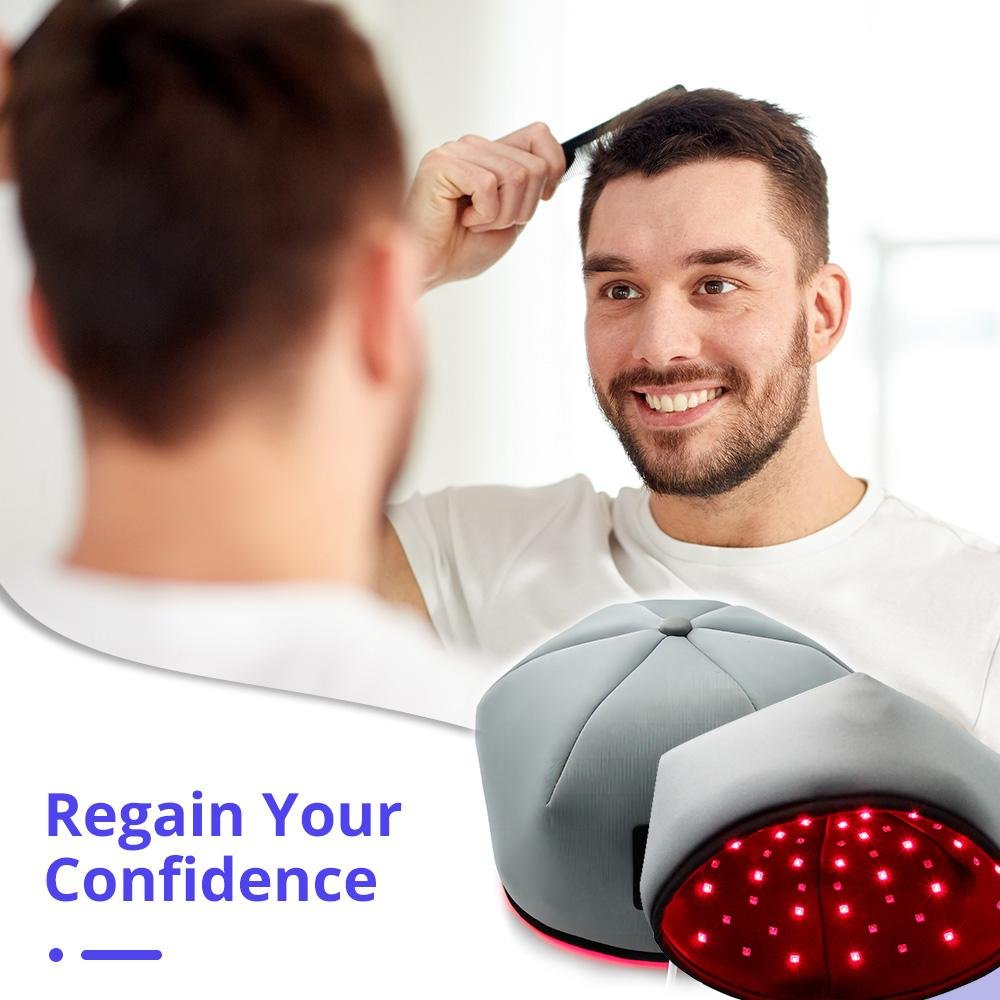
Hair loss can happen for many different reasons, and finding an approach that supports healthier-looking hair is an important goal for many people.
Red light therapy for hair loss has become increasingly popular as a non-invasive light-based approach, particularly for people experiencing androgenetic alopecia, commonly known as pattern hair loss. Scientific reviews have found that low-level laser and LED therapies can improve hair density in people with androgenetic alopecia compared with placebo treatments, although individual results can vary.
MyChway also discusses red and near-infrared light technologies in relation to scalp and hair applications. Understanding what this therapy involves, what research actually shows, and what factors can influence results can help people approach the technology with realistic expectations.
What Is Red Light Therapy?
Red light therapy is a form of photobiomodulation that uses specific wavelengths of light to interact with biological tissue. In hair-related applications, light is directed toward the scalp with the goal of supporting cellular activity around hair follicles.
MyChway explains that red and near-infrared light may interact with cellular structures involved in energy production, including mitochondria. The company's explanation proposes that this process may support cellular energy and hair-follicle activity.
It is important to distinguish light therapy from conventional drug treatments. It is a light-based approach rather than a medication, and its effectiveness depends on the underlying type of hair loss and the treatment parameters.
What Does Research Say About Hair Loss?
Scientific research provides encouraging evidence, particularly for androgenetic alopecia. A 2025 systematic review and meta-analysis included 38 studies involving 3,098 patients and found that low-level laser and LED therapy significantly improved hair density in people with androgenetic alopecia compared with placebo. The studies evaluated treatment periods ranging from four to 26 weeks.
Earlier research has reached similar conclusions. A meta-analysis of randomized controlled trials found a significant increase in hair density among adults with androgenetic alopecia receiving low-level laser therapy compared with sham devices.
These findings suggest potential benefits, but they should not be interpreted as a guarantee that every person with hair loss will experience substantial regrowth.
How Might Light Therapy Support Hair Growth?
The exact biological mechanisms are still being investigated. One proposed explanation is that appropriate light exposure may influence cellular processes within or around hair follicles.
MyChway describes a possible connection between red light, mitochondria, cytochrome c oxidase, and ATP production, suggesting that increased cellular energy availability may support follicular activity.
Research reviews have also investigated how photobiomodulation may influence the hair-growth cycle. However, it is better to describe these mechanisms as proposed explanations rather than established facts for every hair-loss condition.
Who May Benefit From This Approach?
The strongest current evidence concerns androgenetic alopecia. This form of hair loss can affect both men and women and usually develops gradually.
A 2025 review found strong enough evidence to perform a meta-analysis for androgenetic alopecia, while evidence for several other forms of alopecia was insufficient for the same type of statistical analysis.
This distinction is important because hair loss is not one single condition. Temporary shedding, nutritional deficiencies, hormonal changes, scalp disorders, medications, stress, and other factors can also contribute to thinning or hair loss.
If the cause is uncertain, identifying the underlying condition is an important step before choosing a treatment.
What Can Affect Treatment Results?
Not every light therapy device delivers identical treatment. Wavelength, energy fluence, exposure duration, treatment frequency, and device design can all be relevant.
A systematic review examining factors associated with photobiomodulation outcomes found that greater per-session energy fluence and longer total exposure were associated with increased hair density, while simply having a greater number of LEDs was not significantly associated with hair-density changes.
This means a device should not be judged simply by its number of LEDs or its appearance. Technical specifications and intended use are much more important when evaluating light-based equipment.
Understanding MyChway's Approach
MyChway provides information about red and near-infrared light applications and offers various aesthetic and light-based technologies. Its published explanation of red light therapy describes potential effects on cellular energy and hair-follicle activity.
When researching a MyChway device, users should examine the exact model and its specifications. Different products can have different wavelengths, output characteristics, treatment areas, and intended applications.
This is particularly important because a general LED skincare device should not automatically be considered equivalent to a device specifically designed and studied for scalp or hair-related photobiomodulation.
How Long Does It Take to See Results?
One of the most important things to understand about light therapy is that hair growth takes time. A single treatment session is unlikely to produce an obvious visual transformation.
Clinical research has evaluated low-level light therapy over periods of several weeks to several months. The 2025 meta-analysis found significant improvements in hair density during treatment periods of four to 26 weeks for androgenetic alopecia.
Individual results can still vary. Some people may notice changes earlier, while others may require longer periods of consistent treatment.
Why Consistency Matters
A consistent treatment routine is generally more meaningful than occasional use. Hair follicles follow natural growth cycles, so any potential benefit from light therapy needs to be evaluated over time rather than after just a few sessions.
Users should follow the treatment schedule and exposure instructions supplied for the specific device. Increasing the duration or frequency independently does not necessarily mean better results.
Taking photographs at regular intervals can also make gradual changes easier to identify.
How to Track Hair Growth Progress
Before starting treatment, take clear photographs of the areas experiencing thinning. Continue photographing the same areas at consistent intervals.
Try to maintain similar lighting, camera distance, hairstyle, and viewing angle. Differences in lighting or hair positioning can make the scalp look more or less visible and may create the impression of a change that is not actually related to hair density.
Comparing photographs over several months can provide a more useful picture than checking the hair every day.
Can Red Light Therapy Replace Other Treatments?
It is better to view light therapy as one possible approach rather than assuming it should replace all other hair-loss treatments.
For example, a 2025 systematic review comparing minoxidil alone with minoxidil combined with low-level laser therapy did not find a statistically significant difference in hair count or hair diameter between the two approaches at the measured time points.
This demonstrates why treatment combinations should be evaluated based on evidence rather than assuming that adding another treatment will automatically produce better results.
Safety and Proper Use
Low-level light therapy has generally shown a favorable safety profile in clinical research, although the safety of a specific device depends on its design, wavelength, output, exposure duration, and correct operation. Earlier systematic research described LLLT as a promising non-invasive approach with a generally favorable safety profile.
Users should follow the manufacturer's instructions and avoid creating their own treatment parameters. Professional equipment should be operated by appropriately trained personnel.
Anyone experiencing unusual irritation, discomfort, or unexpected changes should discontinue use and seek appropriate professional advice.
Setting Realistic Expectations
People researching red light therapy for hair loss may expect dramatic regrowth, but realistic expectations are important. Research supports potential improvements in hair density, particularly in androgenetic alopecia, but results are not identical for everyone.
The underlying cause of hair loss, treatment consistency, device specifications, exposure parameters, and individual response can all affect the outcome.
Light therapy should therefore be considered as a potential supportive option rather than a guaranteed cure.
Choosing the Right MyChway Equipment
When researching MyChway equipment, pay attention to the exact wavelength, treatment area, output characteristics, operating instructions, and intended application.
It is also useful to distinguish between devices marketed for general skin-related LED treatments and equipment specifically intended for scalp or hair applications.
For professional environments, appropriate training and careful adherence to the manufacturer's instructions are especially important.
Final Thoughts
Red light therapy for hair loss has become an increasingly researched approach to supporting hair density, particularly in people with androgenetic alopecia. Current evidence from systematic reviews suggests that low-level laser and LED therapies can produce measurable improvements in hair density compared with placebo, although results vary between individuals and more research is still needed for other types of alopecia.
MyChway provides information and equipment related to light-based aesthetic technologies, including red-light applications. Anyone considering this approach should research the exact device, understand its technical specifications, follow the recommended treatment instructions, and maintain realistic expectations.
Most importantly, identifying the reason behind hair loss should come first. With appropriate evaluation, consistent treatment, suitable equipment, and careful monitoring of progress, light therapy can be considered as one non-invasive option within a broader approach to hair and scalp care.

 Arabic
 French
 Spanish
 Portuguese
 Deutsch
 Turkish
 Dutch
Dutch
 Italiano
 Russian
 Romaian
 Portuguese (Brazil)
 Greek
Greek