


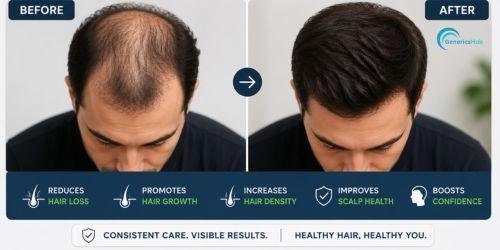
Finasteride is a prescription medicine that lowers the activity of dihydrotestosterone (DHT), a hormone linked to prostate enlargement and male pattern hair loss. Although Finasteride 1 mg and Finasteride 5 mg contain the same active ingredient, they are used for different medical purposes and should not be considered interchangeable.
The main difference between these strengths is the dose and the condition being treated. Finasteride 1 mg is commonly prescribed for male pattern hair loss, while Finasteride 5 mg is primarily used to treat benign prostatic hyperplasia (BPH), a condition in which the prostate becomes enlarged.
Understanding this difference can help patients have a more informed conversation with a healthcare professional about which treatment may be appropriate.
Finasteride 1 mg vs 5 mg: Quick Comparison
| Feature | Finasteride 1 mg | Finasteride 5 mg |
| Active ingredient | Finasteride | Finasteride |
| Main use | Male pattern hair loss | Benign prostatic hyperplasia (BPH) |
| Typical purpose | Helps slow hair loss and support hair regrowth | Helps reduce an enlarged prostate and improve urinary symptoms |
| Dose strength | Lower | Higher |
| Effect on DHT | Reduces DHT | Reduces DHT |
| Common users | Men with androgenetic alopecia | Men with an enlarged prostate |
| Prescription medicine | Yes | Yes |
What Is Finasteride?
Finasteride belongs to a group of medicines called 5-alpha-reductase inhibitors. The medicine blocks the conversion of testosterone into DHT.
DHT plays an important role in male pattern hair loss and prostate growth. In genetically susceptible men, DHT can gradually shrink hair follicles, particularly around the hairline and crown. Lowering DHT can help slow this process.
For prostate health, reducing DHT can gradually decrease prostate size and improve urinary symptoms associated with BPH.
Because the same active ingredient is used for different conditions, the appropriate strength depends on the medical indication.
Finasteride 1 mg: What Is It Used For?
Finasteride 1 mg is commonly used to treat male pattern hair loss, also known as androgenetic alopecia.
Male pattern hair loss can cause gradual thinning around the temples, hairline, and crown. Finasteride 1 mg works by lowering DHT levels, which may help reduce further hair follicle miniaturization.
Treatment generally requires consistent use over time. Hair growth is not immediate, and individual responses vary.
Potential benefits of Finasteride 1 mg
Finasteride 1 mg may:
- Slow the progression of male pattern hair loss
- Help maintain existing hair
- Support hair growth in some men
- Reduce the effect of DHT on susceptible hair follicles
It is important to understand that results differ between individuals. Stopping treatment can cause the benefits to gradually disappear.
Finasteride 5 mg: What Is It Used For?
Finasteride 5 mg is primarily used to treat benign prostatic hyperplasia (BPH).
BPH is a non-cancerous enlargement of the prostate that can cause urinary problems, such as:
- Frequent urination
- Difficulty starting urination
- Weak urine flow
- A feeling that the bladder has not completely emptied
- Increased nighttime urination
Finasteride 5 mg reduces DHT activity in the prostate. Over time, this can help reduce prostate size and improve urinary symptoms in appropriate patients.
Finasteride 1 mg vs 5 mg: What Is the Main Difference?
The biggest difference is why the medicine is prescribed.
Finasteride 1 mg is associated primarily with treatment of male pattern hair loss, whereas Finasteride 5 mg is used mainly for an enlarged prostate.
The 5 mg tablet is not simply a "stronger hair-loss treatment." Taking a higher dose does not necessarily mean better hair-growth results. The appropriate dose depends on the condition being treated and the healthcare professional's assessment.
For this reason, patients should not change from 1 mg to 5 mg, or split or combine tablets, without medical advice.
Does Finasteride 5 mg Work Better for Hair Loss Than 1 mg?
Not necessarily.
When finasteride is being used for male pattern hair loss, the commonly used dose is 1 mg once daily. Increasing the dose should not be assumed to produce proportionally greater hair-growth benefits.
If hair loss continues while using Finasteride 1 mg, the right next step is to discuss the situation with a healthcare professional rather than automatically increasing the dose.
Other factors can contribute to hair loss, including genetics, nutritional deficiencies, thyroid problems, certain illnesses, stress, and scalp conditions.
Finasteride Side Effects
Both strengths contain the same active ingredient, so they can cause similar types of side effects. However, the risk and severity can vary between individuals.
Possible side effects may include:
- Decreased sexual desire
- Erectile difficulties
- Changes in ejaculation
- Reduced semen volume
- Breast tenderness or enlargement
- Mood changes in some patients
Not everyone experiences these effects.
Patients who develop persistent or concerning symptoms should speak with their healthcare professional. Seek prompt medical advice for unusual breast changes, including a lump, pain, or nipple discharge.
Important Safety Information
Finasteride is intended for specific medical uses and should be taken according to professional advice.
Women who are pregnant or may become pregnant should not handle crushed or broken finasteride tablets because the active ingredient can potentially harm a developing male fetus. Intact tablets have a protective coating that normally prevents contact with the active ingredient during handling.
Finasteride can also affect prostate-specific antigen (PSA) levels. Men taking finasteride should tell their healthcare professional before having PSA testing because the medicine can change how PSA results are interpreted.
How Long Does Finasteride Take to Work?
Finasteride does not usually produce instant results.
For hair loss, visible improvement may take several months of consistent treatment. Some people may notice reduced hair shedding before seeing noticeable changes in hair density.
For BPH, improvement in urinary symptoms may also take time, and treatment is generally continued long term when clinically appropriate.
The response depends on factors such as the underlying condition, duration of treatment, age, genetics, and individual response.
Can You Switch Between Finasteride 1 mg and 5 mg?
You should not switch strengths without speaking with a healthcare professional.
Although both medicines contain finasteride, they are designed for different dosing purposes. A healthcare professional can determine whether a change is appropriate based on the condition being treated and your overall health.
Do not take additional tablets to try to speed up hair growth or improve symptoms.
Finasteride 1 mg vs 5 mg: Which One Should You Take?
There is no single strength that is best for everyone.
- For male pattern hair loss, Finasteride 1 mg is the commonly prescribed strength.
- For benign prostatic hyperplasia, Finasteride 5 mg is the commonly prescribed strength.
- The correct treatment depends on your diagnosis, medical history, other medicines, and individual risk factors.
If you are experiencing hair loss or urinary symptoms, a healthcare professional can help determine the underlying cause and recommend an appropriate treatment plan.
Frequently Asked Questions
Is Finasteride 1 mg the same medicine as Finasteride 5 mg?
Yes. Both contain the active ingredient finasteride. The main difference is the amount of finasteride in each tablet and the medical condition for which the strength is generally prescribed.
Can Finasteride 5 mg be used for hair loss?
Finasteride 5 mg contains the same active ingredient used for hair loss, but it is primarily prescribed for BPH. A higher dose should not be taken for hair loss unless specifically recommended by a healthcare professional.
Is Finasteride 1 mg used for prostate problems?
Finasteride 1 mg is primarily associated with male pattern hair loss. Finasteride 5 mg is the commonly prescribed strength for BPH.
Does finasteride permanently cure hair loss?
No. Finasteride helps manage male pattern hair loss while treatment is continued. If treatment is stopped, the benefits may gradually be lost and hair loss can resume.
How should I choose between Finasteride 1 mg and 5 mg?
The choice should be based on the condition being treated rather than simply choosing the higher strength. A healthcare professional can recommend the appropriate dose.
Final Takeaway
The difference between Finasteride 1 mg and Finasteride 5 mg is more than tablet strength. Both contain finasteride and reduce DHT, but they are generally prescribed for different conditions.
Finasteride 1 mg is commonly used for male pattern hair loss, while Finasteride 5 mg is mainly used for benign prostatic hyperplasia. Taking more finasteride does not automatically mean better results, so the dose should be selected according to the diagnosed condition and professional medical advice.
If you are considering finasteride for hair loss or prostate symptoms, discuss the benefits, risks, possible side effects, and appropriate dose with a qualified healthcare professional.

 Arabic
 French
 Spanish
 Portuguese
 Deutsch
 Turkish
 Dutch
Dutch
 Italiano
 Russian
 Romaian
 Portuguese (Brazil)
 Greek
Greek