


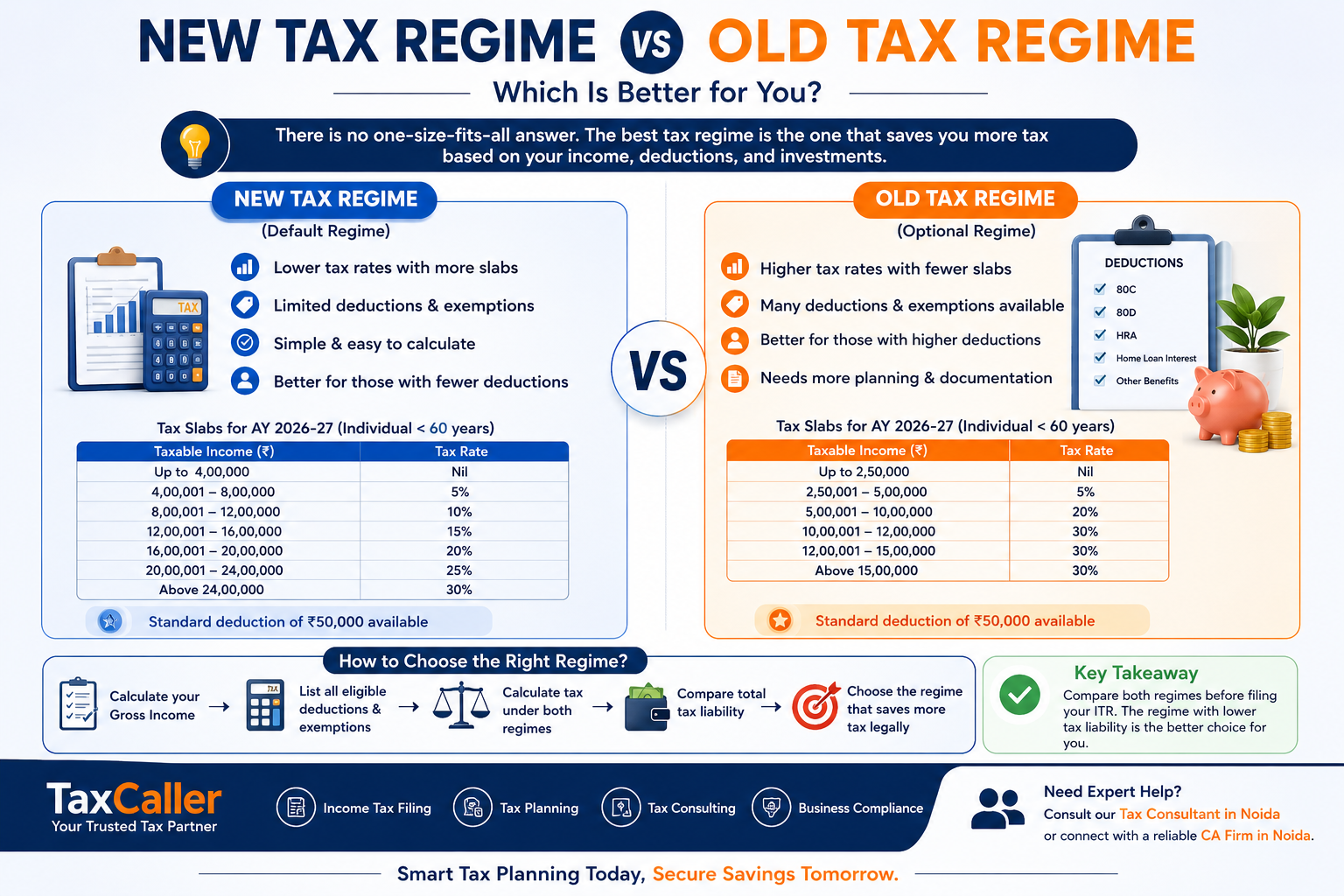
Old Tax Regime vs New Tax Regime – Which is better? There’s no one answer for every taxpayer. The new tax regime generally has lower slab rates and fewer deductions, whereas the old tax regime allows taxpayers to avail of several exemptions and deductions. It all depends on your income, investments, home-loan interest, HRA and other deductible expenses. The Income Tax Department also advises comparing tax liability under both regimes before making a choice..
New Tax Regime vs Old Tax Regime: Key Difference
The biggest difference is simple:
-
New Tax Regime: Lower and more detailed tax slabs with limited deductions and exemptions.
-
Old Tax Regime: Higher slab rates but allows several deductions and exemptions.
-
New Tax Regime: It is the default regime for eligible individual taxpayers.
-
Old Tax Regime: Eligible taxpayers can opt for it instead of the default new regime.
Tax Slabs for AY 2026–27
For an individual below 60 years, the applicable slab rates are:
| Taxable Income | Old Tax Regime | New Tax Regime |
| Up to ₹2.5 lakh | Nil | Nil up to ₹4 lakh |
| ₹2.5–₹5 lakh | 5% | — |
| ₹4–₹8 lakh | — | 5% |
| ₹5–₹10 lakh | 20% | — |
| ₹8–₹12 lakh | — | 10% |
| ₹10–₹12 lakh | 30% | — |
| ₹12–₹16 lakh | — | 15% |
| ₹16–₹20 lakh | — | 20% |
| ₹20–₹24 lakh | — | 25% |
| Above ₹24 lakh | — | 30% |
These are slab rates before considering applicable rebate, surcharge and 4% health and education cess.
What Is the New Tax Regime?
The new tax regime under Section 115BAC provides for a simplified tax regime with lower slab rates, but with fewer deductions and exemptions.
For many taxpayers not claiming large deductions, the new regime can be easier and more tax-efficient.
The new regime is the default tax regime for eligible taxpayers. Taxpayers can opt for the old regime subject to applicable rules.
Who May Benefit From the New Tax Regime?
The new regime may be suitable for taxpayers who:
-
Have relatively few tax-saving investments.
-
Do not claim substantial HRA benefits.
-
Do not have significant eligible deductions.
-
Prefer a simpler tax calculation.
-
Want to compare their liability using the lower new-regime slab structure.
However, the final decision should be based on an actual comparison of taxable income and eligible deductions.
What Is the Old Tax Regime?
The old tax regime uses higher slab rates but provides access to a wider range of deductions and exemptions.
Depending on eligibility, taxpayers may claim benefits such as:
-
Section 80C deductions
-
Section 80D medical insurance deduction
-
HRA exemption
-
Certain home-loan interest benefits
-
Certain other deductions and exemptions available under the Income Tax Act
The old regime can therefore be beneficial for taxpayers who make substantial eligible investments or have significant deductible expenses.
Who May Benefit From the Old Tax Regime?
The old regime may be worth considering if you:
-
Pay substantial rent and are eligible for HRA exemption.
-
Make significant eligible investments under Section 80C.
-
Pay eligible health insurance premiums.
-
Have eligible home-loan interest deductions.
-
Have other deductions that substantially reduce your taxable income.
The important point is that having deductions does not automatically mean the old regime is better. The total tax under both regimes should be calculated before choosing.
New Tax Regime vs Old Tax Regime: Simple Example
Let us assume a salaried taxpayer, with an annual income of ₹15 lakh.
In the new tax regime, the taxpayer is benefited from the new slab structure & applicable deductions allowed under this regime.
The old tax regime allows the taxpayer to claim eligible deductions and exemptions to reduce taxable income.
So, one can’t answer just from the gross salary.
For example, if you are someone who enjoys a large HRA exemption, Section 80C investments, health insurance deductions and home-loan benefits that you are eligible for, the old regime might turn out to be a better option.
The new regime may be more attractive if the taxpayer has very few deductions.
This is why the correct approach is to calculate tax under both regimes rather than choosing based only on salary.
Which Tax Regime Is Better for Salaried Employees?
For salaried employees, it is often worth checking the new tax regime first, especially when the taxpayer has limited deductions.
But those employees who have a large eligible exemption and deductions should also calculate their liability under the old regime.
A taxpayer should compare:
-
Gross salary
-
Standard deduction
-
HRA eligibility
-
Home-loan interest
-
Section 80C investments
-
Section 80D deductions
-
Other eligible deductions
-
Taxable income under both regimes
-
Final tax liability under both regimes
The Income Tax Department provides an online income and tax estimator that can compare tax under the old and new regimes.
Is Standard Deduction Available Under Both Regimes?
“Yeah. “Under both regimes, a standard deduction of ₹50,000 or salary, whichever is lower, is available from AY 2024-25 onwards,” says the Income Tax Department.
Taxpayers shouldn’t assume that by switching to the new regime, they’ll be losing out on all tax benefits.
The new regime still permits some specified deductions and benefits but the list is considerably more restricted than the old regime.
Can You Change From New Tax Regime to Old Tax Regime?
The option is available to taxpayers not in business or profession on an annual basis through an ITR, provided the filing requirements are met.
Eligible taxpayers who have income from business or profession need to file Form 10-IEA to opt out of the new regime which is the default. There are additional rules for changing regimes.
Therefore, business owners and professionals should be especially careful before choosing their tax regime.
New Tax Regime vs Old Tax Regime: Which One Should You Choose?
There is no universal “best” tax regime.
Choose the New Tax Regime if:
-
You have limited deductions.
-
You do not claim significant HRA exemption.
-
You have relatively few tax-saving investments.
-
Your calculation shows lower tax under the new regime.
-
You prefer a simpler tax structure.
Consider the Old Tax Regime if:
-
You have substantial eligible deductions.
-
You claim HRA exemption.
-
You have eligible home-loan benefits.
-
You make significant qualifying investments.
-
Your total tax after deductions is lower under the old regime.
The best regime is the one that results in the lower legally payable tax after considering your complete financial situation.
New Tax Regime vs Old Tax Regime: Quick Comparison
| Feature | New Tax Regime | Old Tax Regime |
| Default regime | Yes | No |
| Tax rates | Lower/more slabs | Higher slab rates |
| Deductions | Limited | More deductions |
| HRA exemption | Generally not available | Available subject to conditions |
| Section 80C | Generally not available | Available subject to conditions |
| Standard deduction | Available | Available |
| Suitable for | Few deductions | Higher eligible deductions |
| Complexity | Relatively simpler | More documentation and deductions |
The exact availability of deductions depends on the applicable provisions and taxpayer circumstances.
How a Tax Consultant in Noida Can Help
Do not decide whether you should opt for the new or the old tax regime only on the basis of your annual salary.
A professional Tax Consultant in Noida can compare your income, deductions, exemptions, investments and other relevant factors under both the regimes.
This can be particularly useful for:
-
Salaried employees
-
Freelancers
-
Consultants
-
Business owners
-
Professionals
-
Individuals with rental income
-
Taxpayers with home loans
-
Taxpayers receiving multiple sources of income
The objective should be simple: calculate both options and select the legally appropriate regime with the lower overall tax liability.
Why Choose a CA Firm in Noida for Tax Planning?
A CA Firm in Noida can assist you with tax planning, ITR filing, income calculation, deduction analysis and compliance.
Taxpayers can compare side-by-side using their real financial information instead of choosing a tax regime based on assumptions.
This approach can help avoid common mistakes such as:
-
Choosing the old regime without enough eligible deductions.
-
Choosing the new regime without checking the old regime calculation.
-
Missing eligible deductions.
-
Incorrectly claiming exemptions.
-
Selecting the wrong regime while filing the ITR.
-
Failing to maintain supporting documents.
Frequently Asked Questions
Which is better, the new tax regime or old tax regime?
Neither regime is better overall. Whether you should itemize depends on your income, deductions, exemptions and other applicable factors. The Income Tax Department advises to compare the tax liability under the two regimes before taking the decision.
Is the new tax regime compulsory?
Nope. The new tax regime is the default regime for eligible taxpayers, but eligible taxpayers can opt for the old regime as per applicable rules.
Can salaried employees choose the old tax regime?
Yes. Eligible salaried taxpayers can opt for the old tax regime as per the applicable provisions and ITR filing requirements.
Can I claim HRA in the new tax regime?
Under new tax regime generally HRA exemption under Section 10(13A) is not available. It is available on the old regime terms as may be applicable.
Can I claim Section 80C in the new tax regime?
In the new tax regime, generally, Section 80C deduction is not available. Certain specified deductions continue to be available in the new regime.
Is standard deduction available in the new tax regime?
Yes As per the applicable limit, the standard deduction is available in both the regimes, the Income Tax Department adds.
How can I know which tax regime saves more tax?
Determine your tax liability under both regimes taking into account your allowable deductions and exemptions. Generally, you will be better off with the option that leads to the lower legally payable tax.
Can a business owner switch between tax regimes?
Business and professional taxpayers that elect out of the default new regime must adhere to other rules, such as the requirements of Form 10-IEA. Professional advice may be helpful before making the election.
Final Verdict
The new tax regime and the old tax regime are not a ‘one size fits all’ choice.
The new tax regime might be better suited if you have few deductions and exemptions.
In case you have a large tax deduction, HRA exemption or other tax benefits then the old regime may be a better option.
The safest way to do this is to calculate your tax under both regimes and compare the final liability before filing your ITR.
Taxpayers can take help of a Tax Consultant in Noida or a trusted CA Firm in Noida like TaxCaller for professional help in tax planning and ITR filing.
Read More Blogs:
Who Needs to File an Income Tax Return in India? A Complete Guide
Last Date for Filing Income Tax Return (ITR) in India: Complete Guide
Local GST Consultant in Noida vs Online GST Portals: A Complete Comparison
ITR-1 vs ITR-2 vs ITR-3 vs ITR-4 Explained
Why Businesses Prefer Tax Consultants in Delhi NCR
How to Choose the Right CA Firm for Your Business
How to Choose the Best GST Consultant for Your Business
Tax Consultant vs CA
GST Consultant vs DIY GST Filing
GST Registration Rejected? Top Reasons How to Fix It

 English
 Arabic
 French
 Spanish
 Portuguese
 Deutsch
 Turkish
 Dutch
Dutch
 Italiano
 Russian
 Romaian
 Greek
Greek