


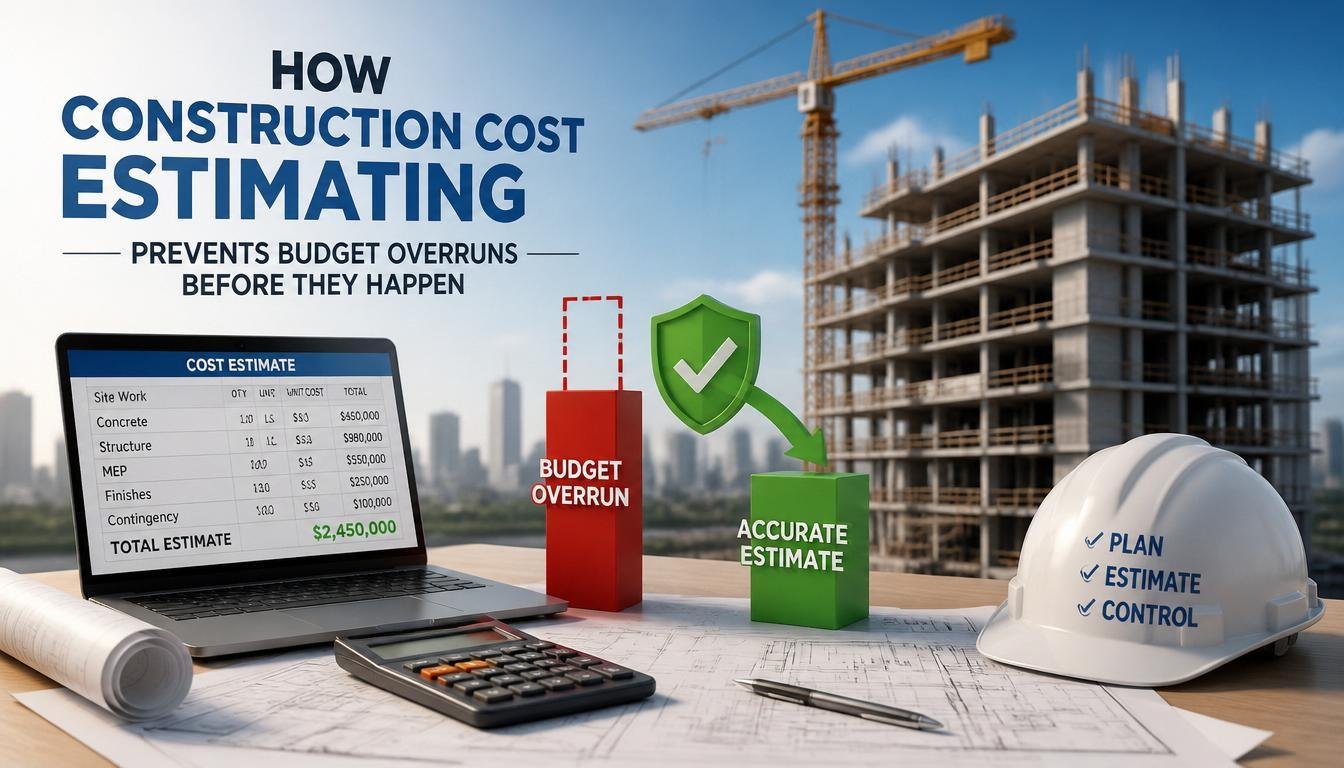
Every contractor has experienced it at some point—a project that starts with a promising budget but slowly becomes more expensive than expected. Material prices change, labor hours increase, unexpected site conditions appear, and before long, profit margins begin to disappear. In many cases, these problems don't start on the jobsite; they begin during the planning stage.
Accurate Construction cost estimating helps identify potential financial risks before construction begins. Instead of relying on rough calculations or assumptions, contractors use detailed quantity takeoffs, current market pricing, and project specifications to build realistic budgets. This proactive approach reduces uncertainty, supports smarter decision-making, and gives project teams greater control over costs from the very beginning.
Why Do Construction Projects Go Over Budget?
Budget overruns rarely happen because of one major mistake. More often, they result from several small issues that accumulate over time. Missing material quantities, outdated supplier prices, incomplete drawings, or underestimated labor requirements can all create unexpected expenses once construction is underway.
Another common challenge is poor communication during the planning phase. If estimators, project managers, and subcontractors are not working from the same information, important costs can easily be overlooked. A detailed cost analysis provides a clear financial roadmap that helps every team member understand the project's scope and expected expenses before work begins.
How Does Construction Cost Estimating Reduce Financial Risk?
Professional Construction cost estimating provides a complete picture of the project's financial requirements before the first piece of equipment arrives on site. Estimators carefully review drawings, specifications, schedules, and material requirements to calculate accurate costs for labor, equipment, subcontractors, and overhead.
Many contractors also rely on Construction cost estimating services to improve accuracy on complex projects where even small calculation errors can significantly affect profitability. Working with experienced estimators allows construction companies to prepare competitive bids while protecting their profit margins and reducing the likelihood of unexpected financial surprises during construction.
Common Causes of Budget Overruns and Their Solutions
| Common Issue | How Proper Planning Helps |
| Incorrect material quantities | Accurate quantity takeoffs reduce shortages and waste |
| Changing material prices | Updated supplier pricing improves budgeting |
| Underestimated labor hours | Realistic productivity calculations improve scheduling |
| Design revisions | Early cost analysis simplifies budget adjustments |
| Missing project scope | Complete drawing reviews reduce overlooked expenses |
What Practices Help Improve Cost Accuracy?
Accurate budgeting depends on a disciplined estimating process rather than guesswork. Contractors who consistently deliver profitable projects usually follow a structured approach before submitting bids.
Key practices include:
-
Reviewing every construction drawing carefully.
-
Using current supplier and subcontractor pricing.
-
Calculating realistic labor productivity.
-
Including equipment, overhead, and contingency costs.
-
Verifying quantity takeoffs before finalizing the estimate.
-
Updating estimates whenever project changes occur.
-
Reviewing previous projects to improve future accuracy.
These habits create more dependable estimates and reduce costly surprises later.
Why Is Technology Changing Modern Estimating?
Construction estimating has evolved significantly over the past decade. Digital takeoff software and cloud-based estimating platforms allow professionals to measure quantities faster, organize project information more efficiently, and update pricing with greater accuracy.
Instead of manually recalculating every revision, estimators can quickly adjust quantities and generate updated budgets whenever drawings change. This improves collaboration between project managers, procurement teams, and clients while reducing the risk of human error.
Technology doesn't replace experience—it enhances it by allowing skilled estimators to focus on making informed financial decisions rather than repetitive calculations.
How Does Accurate Planning Improve Long-Term Profitability?
Successful contractors understand that profitability is determined long before construction begins. Reliable budgeting allows companies to purchase materials efficiently, schedule labor more effectively, and avoid emergency spending during the project.
It also strengthens client relationships because transparent pricing builds confidence and reduces disputes related to unexpected costs. Projects that remain financially organized from the beginning are far more likely to finish on schedule, within budget, and with healthier profit margins.
Conclusion
Careful planning is one of the strongest safeguards against unnecessary construction costs. Detailed budgeting, accurate quantity analysis, and informed decision-making help contractors manage financial risks before they become expensive problems. Investing in a reliable estimating process creates stronger bids, more predictable project outcomes, and a solid foundation for sustainable business growth.

 English
 Arabic
 French
 Spanish
 Portuguese
 Turkish
 Dutch
Dutch
 Italiano
 Russian
 Romaian
 Portuguese (Brazil)
 Greek
Greek