


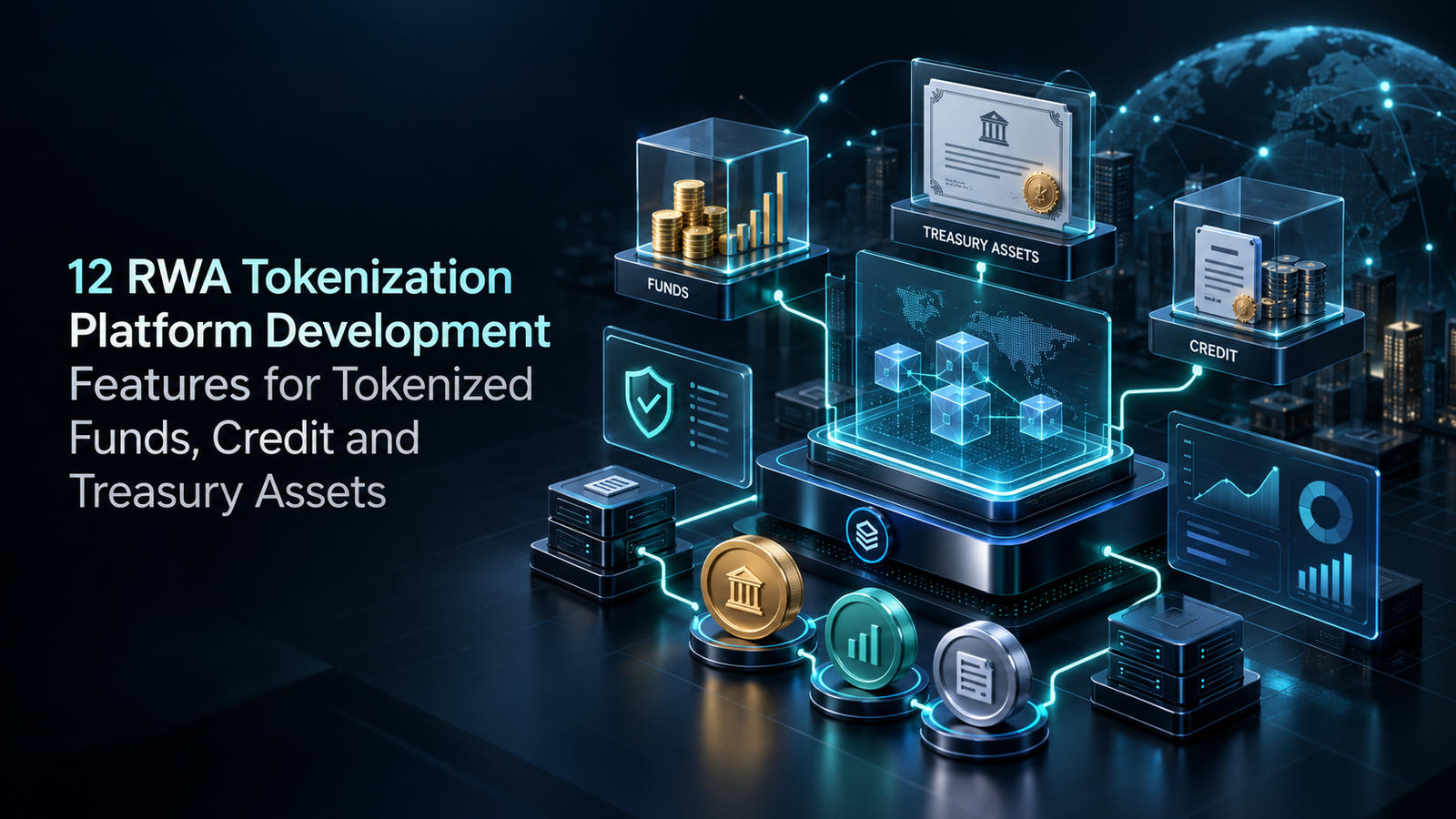
RWA tokenization is moving beyond individual property and commodity use cases. Funds, private credit instruments, treasury products, and other financial assets are increasingly being considered for representation on blockchain networks. For businesses entering this market, an RWA tokenization platform needs to handle much more than token issuance. It must support asset onboarding, investor verification, compliance rules, fund administration, payments, reporting, custody, and secondary transfers.
The requirements also differ across asset classes. A tokenized fund may need subscription and redemption workflows, while a private credit product may require repayment schedules and borrower monitoring. Treasury assets can require settlement controls, holding restrictions, and income distribution mechanisms. These differences make platform architecture and feature planning important parts of RWA tokenization development.
A suitable platform can give issuers a digital environment for managing the lifecycle of financial assets after they are represented as tokens. The following 12 features are particularly relevant for businesses planning tokenized funds, credit products, and treasury assets.
1. Asset Onboarding and Structuring
The first feature should provide a structured process for adding assets or financial products to the platform. Issuers can enter information such as asset category, valuation, issuer details, maturity, income terms, jurisdiction, ownership structure, and supporting documentation.
For funds, the system can capture fund type, NAV calculation method, subscription terms, and redemption conditions. Credit products may require borrower information, principal amount, interest rate, collateral details, and repayment dates. Treasury products can include maturity, yield, issuer information, and settlement terms.
An RWA tokenization company can use this module to organize asset information before token issuance. It also gives administrators a central location for reviewing documents and completing internal checks.
2. Token Issuance and Lifecycle Management
Token issuance is one of the primary functions of an RWA platform. The system should support token creation according to the legal and financial structure of the underlying asset.
Issuers may define supply, denomination, token type, transfer conditions, distribution rules, and lifecycle events. The platform can then associate the token with relevant asset records and maintain information about issuance, transfers, redemptions, and retirement.
For a tokenized fund, tokens could represent fund interests. In credit markets, they could represent claims linked to debt instruments. For treasury assets, tokens could represent defined economic interests subject to applicable restrictions.
A well-planned RWA token development process should also account for events such as maturity, redemption, partial repayment, and asset replacement.
3. Investor Onboarding and KYC
Financial asset tokenization requires investor onboarding procedures that can vary by jurisdiction and product type. A platform should therefore include investor registration, identity verification, KYC checks, accreditation or eligibility assessments, and risk-related questionnaires where required.
The system can collect investor information, send verification requests, record approval status, and restrict access until the required checks are completed.
For example, a private credit offering may only be available to certain investor categories. A tokenized treasury product may have different participation requirements depending on the jurisdiction. These rules can be represented within the investor management layer.
A Real-world asset tokenization company serving financial institutions may also connect external compliance providers to this part of the platform.
4. Permissioned Token Transfers
Token transfers for financial assets cannot always follow the same model as unrestricted cryptocurrency transfers. Fund, credit, and treasury tokens may need restrictions based on investor eligibility, jurisdiction, holding limits, lock-up periods, or other legal conditions.
The platform can check these requirements before allowing a transaction to proceed. If a receiving wallet does not satisfy the required conditions, the transfer can be rejected.
Transfer rules may also cover holding periods, maximum ownership percentages, restricted jurisdictions, and approved wallet lists. These controls can be incorporated into the token contract and supporting platform services.
This feature is particularly relevant to RWA tokenization platform development because compliance requirements need to remain connected to the movement of tokens.
5. Fund Administration and NAV Management
Tokenized funds require functions that are not normally needed for simple asset tokenization. A fund-focused platform should support NAV records, subscriptions, redemptions, investor holdings, fee calculations, and fund-related reporting.
The platform can receive valuation data and calculate investor positions based on the applicable methodology. Subscription requests can be recorded and matched with issued fund tokens, while redemption requests can initiate the appropriate settlement process.
Administrators may also need to record management fees, performance-related charges, expenses, and distributions.
For businesses working with funds, this feature can make RWA tokenization development more closely connected to existing fund administration practices rather than treating token issuance as an isolated blockchain activity.
6. Credit Asset and Loan Management
Private credit tokenization requires dedicated debt-management functionality. The platform should be able to record borrower information, principal balances, interest rates, payment dates, maturity dates, collateral information, and repayment status.
A credit module can track scheduled payments and update outstanding balances as repayments occur. It may also record late payments, restructuring events, defaults, and other relevant changes.
For token holders, the platform can associate payments with their holdings and calculate the amount payable to each eligible investor.
This type of functionality is particularly useful when an RWA token development project focuses on private loans, invoices, receivables, or other credit instruments.
7. Treasury Asset Management
Treasury assets require their own management workflows because they can have short maturities, defined yields, and frequent settlement requirements. A platform can maintain information about government securities, money-market instruments, cash equivalents, or similar products where legally appropriate.
The system can record maturity dates, coupon or yield information, purchase values, current holdings, and redemption events.
For tokenized treasury products, investors may receive income according to the terms associated with their holdings. When an instrument matures, the platform can initiate redemption and update the corresponding token supply or investor balances.
An RWA tokenization platform development company can include these functions as a dedicated module rather than forcing treasury products into a generic asset template.
8. Income Distribution and Corporate Actions
Tokenized financial assets often generate income. Funds can distribute returns, credit instruments can produce interest, and treasury products can generate coupon income or other payments.
The platform should calculate investor entitlements based on token holdings and applicable distribution rules. It can then record payment instructions, distribution dates, deductions, and completed transactions.
Corporate actions can also be relevant. These may include maturity, redemption, interest-rate changes, asset substitutions, fund events, or restructuring activities.
A distribution engine reduces the need to manually calculate each investor's entitlement. It also gives administrators a record of how each payment was calculated.
9. Wallet and Custody Management
Investors need a secure way to hold tokenized financial assets. The platform can provide wallet creation, approved wallet registration, wallet verification, asset balances, and custody-related workflows.
For institutional products, the system may need to work with external custodians or qualified custody arrangements rather than relying solely on platform-managed wallets.
Wallet permissions can also be connected with compliance rules. For example, only verified addresses may be permitted to receive a particular token.
This function gives the RWA tokenization platform a connection between investor accounts, blockchain addresses, token balances, and transaction records.
10. Payment and Settlement Integration
Tokenized assets still involve real financial transactions. Investors may need to pay for tokens, receive distributions, settle redemptions, or receive proceeds when assets mature.
A platform should therefore support payment and settlement workflows appropriate to the target market. Depending on the business model, this could include bank transfers, stablecoins, payment processors, or other approved settlement mechanisms.
The platform can record payment status and connect it with token issuance or redemption events. For example, a subscription request could remain pending until the corresponding payment has been confirmed.
This creates a relationship between the financial transaction and the blockchain transaction rather than treating them as two separate processes.
11. Compliance, Audit Trails and Reporting
Financial platforms require detailed records of what happened, when it happened, and who performed each action. An RWA platform should maintain logs for investor onboarding, token issuance, transfers, payments, distributions, administrative changes, and other relevant activities.
Administrators can use reporting tools to review investor holdings, transaction histories, asset positions, distribution records, and compliance statuses.
The platform may also generate reports for internal teams, investors, auditors, fund administrators, or regulators, depending on the product and jurisdiction.
For an RWA tokenization company, auditability is particularly important because blockchain records alone may not contain every business and compliance detail required for financial operations.
12. Multi-Chain and API Integration
Financial institutions and asset issuers may use different blockchain networks and external financial systems. A platform can therefore provide blockchain connectivity and APIs for integrating custody providers, KYC services, payment systems, pricing feeds, accounting software, fund administration systems, and analytics tools.
A multi-chain architecture can support issuance and transfer across selected networks when the legal and technical design permits it. APIs can also allow external applications to retrieve approved asset, investor, transaction, and portfolio data.
For example, a fund administrator could connect its existing system to the tokenization platform to synchronize investor positions. A credit manager could connect loan-management software to update repayment information.
For an RWA tokenization development company, API planning should be considered during architecture design rather than added only after the platform is operational.
How These Features Work Together
The 12 features are most useful when they operate as a connected platform rather than separate modules. Asset onboarding supplies financial and legal information to the issuance system. Investor onboarding determines who can participate. Compliance rules then influence token transfers and wallet permissions.
Once tokens are issued, fund, credit, or treasury modules can manage the underlying financial lifecycle. Payment systems handle subscriptions and settlements, while distribution functions calculate investor income. Reporting and audit systems record the resulting activity.
For example, consider a tokenized private credit product. The issuer first registers the loan and borrower details. Eligible investors complete onboarding and receive approved wallets. Tokens are issued according to the loan structure. When borrowers make interest payments, the platform records the payment, updates the loan balance, and calculates the relevant investor distribution. If tokens are transferred, the system checks whether the receiving investor satisfies the applicable conditions.
This connected workflow is one of the main reasons businesses approach an RWA tokenization company instead of using a standalone token generator.
Technology Considerations for RWA Tokenization Platform Development
The technical architecture should match the asset class and regulatory environment. Smart contracts can manage token balances, transfer restrictions, issuance rules, redemption conditions, and selected financial events. Backend services can handle investor records, asset data, compliance workflows, payment information, and reporting.
Blockchain selection also matters. The platform may use a public network, permissioned network, or combination of networks depending on the product requirements. Database infrastructure should maintain off-chain information that cannot or should not be stored directly on-chain.
Access control is another important consideration. Issuers, administrators, compliance officers, fund managers, custodians, and investors may require different permissions. Role-based access can restrict sensitive operations to authorized users.
A RWA tokenization platform development company can also include monitoring systems for transaction activity, contract events, payment status, and unusual account behavior.
Business Value of These Platform Features
The combination of asset management, investor administration, compliance controls, token operations, payments, and reporting gives financial businesses a broader operating environment for tokenized products.
For funds, the platform can connect subscriptions, investor positions, NAV records, and distributions. For credit products, it can connect loan information with token holdings and repayment events. For treasury assets, it can coordinate issuance, income, maturity, and redemption processes.
The result is a platform designed around the complete asset lifecycle rather than only blockchain token creation. This approach can also make future product additions easier because common functions such as onboarding, compliance, wallet management, reporting, and payments can serve multiple asset categories.
Conclusion
RWA tokenization is developing into a broader financial infrastructure model where funds, credit instruments, and treasury assets can be represented and managed through blockchain-based systems. A practical platform needs more than token issuance, with functions for asset onboarding, investor verification, restricted transfers, fund administration, credit management, treasury tracking, distributions, custody, settlement, compliance, reporting, and integrations. Businesses planning RWA tokenization development should select features according to their asset class, jurisdiction, investor model, and operating structure rather than treating every tokenized asset in the same way. A capable RWA tokenization development company can help connect these functions into a platform that supports the financial lifecycle from issuance through transfers, income payments, and redemption. Blockchain App Factory provides RWA tokenization development services for businesses planning platforms around tokenized funds, credit products, treasury assets, and other real-world financial instruments.
FAQs
1. What is an RWA tokenization platform?
An RWA tokenization platform is a software system used to represent real-world assets or financial interests as blockchain-based tokens while managing associated investor, compliance, payment, and asset lifecycle processes.
2. Which assets can be tokenized through an RWA platform?
Depending on legal and regulatory requirements, platforms can support funds, private credit, treasury instruments, real estate, commodities, receivables, intellectual property, and other asset classes.
3. Why do tokenized funds need specialized platform features?
Tokenized funds require functions such as subscriptions, redemptions, NAV management, investor holdings, fees, distributions, and fund reporting, which go beyond basic token issuance.
4. How does an RWA platform manage credit assets?
A credit-focused platform can record borrower information, principal, interest rates, payment schedules, repayments, maturity dates, collateral information, and investor distributions.
5. What role does KYC play in RWA tokenization?
KYC helps verify investor identities and determine whether participants satisfy the eligibility requirements associated with a particular tokenized financial product and jurisdiction.
6. Can an RWA tokenization platform support multiple blockchains?
Yes. A platform can be designed with connectivity for multiple blockchain networks when the selected networks are compatible with the asset structure, compliance requirements, and business model.
7. What is RWA token development?
RWA token development refers to creating blockchain-based tokens that represent ownership, economic rights, claims, or interests associated with real-world assets or financial instruments.
8. What should businesses consider before starting RWA tokenization platform development?
Businesses should evaluate the asset type, legal structure, target jurisdictions, investor categories, blockchain network, custody model, compliance requirements, payment methods, smart contract rules, and ongoing asset administration needs.

 English
 Arabic
 French
 Spanish
 Portuguese
 Deutsch
 Dutch
Dutch
 Italiano
 Russian
 Romaian
 Portuguese (Brazil)
 Greek
Greek