


If you have started noticing softer skin, early jawline changes or a loss of firmness in the face or neck, you may have come across XERF as a non-surgical skin tightening option. But how does XERF skin tightening work, and what actually happens beneath the skin during treatment? XERF uses monopolar radiofrequency (RF) energy to create a controlled thermal effect within targeted tissue. Rather than removing skin or using surgical incisions, the treatment uses heat to support the skin’s natural remodelling processes. Over time, this can contribute to changes in the appearance of skin firmness, elasticity and texture. The important point is that XERF is not designed to produce the same immediate structural change as a facelift. It is a non-invasive approach intended for selected patients, particularly where mild to moderate skin laxity is an important part of the concern. At SORA Aesthetics & Wellness Clinic, treatment starts with an assessment rather than automatically assuming that RF skin tightening is the right answer.
What Is XERF Skin Tightening?
XERF is a non-invasive monopolar radiofrequency treatment designed to support skin tightening and rejuvenation. Radiofrequency technology has been used in aesthetic medicine for many years. The basic principle is relatively straightforward: RF energy is delivered through the treatment area, where tissue resistance converts the energy into heat. That controlled heat is important because the skin responds to thermal stimulation through biological remodelling processes. Research into monopolar RF has reported changes involving collagen and elastic tissue, which can contribute to improvements in skin firmness and laxity over time. XERF takes this approach further by using dual-frequency RF technology and depth-dependent treatment settings. Research specifically examining 6.78 MHz and 2 MHz RF found differences in how thermal energy was distributed through tissue, with the dual-frequency approach producing different patterns of heating across dermal and deeper tissue structures. This is why XERF treatment is not simply about applying heat to the skin. The treatment area, depth, energy delivery and individual anatomy all matter. For a broader overview of the technology, treatment areas, suitability and what to expect, see our XERF skin tightening treatment guide.
How Does XERF Work Beneath the Skin?
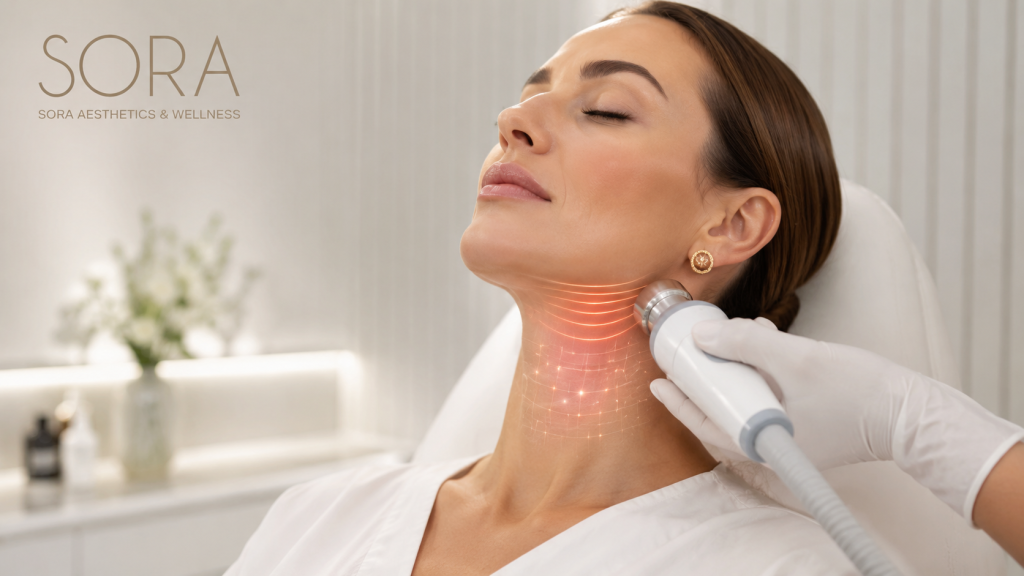 The easiest way to understand how does XERF work is to look at the process in stages.
1. Radiofrequency Energy Is Delivered Into the Treatment Area
During an XERF radiofrequency treatment, the handpiece is placed against the skin and controlled RF energy is delivered into the targeted area. Unlike laser resurfacing, the objective is not to remove the surface layer of skin. Unlike RF microneedling, XERF does not require needles to penetrate the skin. Instead, the treatment uses radiofrequency energy to generate controlled heat within the tissue. The exact energy delivery is adjusted according to the treatment area, skin characteristics and clinical objective.
2. RF Energy Creates Controlled Heat
As RF energy passes through tissue, resistance within the tissue produces heat. This thermal effect is the central part of radiofrequency skin tightening. The aim is not simply to make the skin hot. The temperature and energy delivery need to be controlled carefully so that the intended tissue response can occur while the surface of the skin is appropriately protected. This is one reason treatment settings and technique matter. RF treatment is not a one-size-fits-all procedure, and different facial areas may require different approaches.
3. The Heat Supports a Skin Remodelling Response
Controlled thermal stimulation can influence the structure of collagen-rich tissue. Collagen is one of the proteins that contributes to the skin’s structural support. As we age, changes in collagen and elastin are associated with reduced firmness and elasticity. The purpose of RF skin tightening is to encourage a remodelling response rather than simply create temporary surface tightness. Research into monopolar RF has found evidence of collagen and elastic-fibre remodelling following treatment, while broader dermatological guidance also recognises RF as a non-invasive approach that can stimulate collagen-related tightening over time. This helps explain why results from non-surgical skin tightening are generally gradual.
Why Does XERF Use Different Treatment Depths?
One of the important aspects of XERF is its ability to use different treatment depths. The face is not made up of one uniform layer. The skin thickness, underlying tissue and anatomy vary considerably between areas such as the cheeks, lower face, jawline and neck. A treatment approach that makes sense for one area may not be appropriate for another. XERF uses dual-frequency RF technology, with 6.78 MHz and 2 MHz frequencies, alongside depth-dependent treatment settings. Experimental research has shown that these frequencies can produce different patterns of thermal distribution within tissue. This allows treatment to be considered according to the specific anatomical area rather than applying exactly the same energy approach everywhere. For a patient, that means the treatment plan should be based on where the laxity is, what is contributing to it and what level of improvement is realistic.
What Happens to Collagen During XERF Treatment?
Collagen is central to understanding XERF skin tightening. When controlled RF energy heats tissue, it can affect the collagen-rich structures within the treated area. This thermal stimulus is associated with collagen remodelling and changes in the extracellular matrix. The process does not mean that new, fully formed collagen appears immediately after treatment. Instead, the skin’s response develops over time. This is why someone may notice an early sensation of tightness but still need to wait weeks or months before judging the overall result. The visible change is linked to the biological response that follows treatment rather than simply the immediate heating effect. A 2025 experimental study examining 6.78 MHz and 2 MHz monopolar RF found collagen and elastin remodelling in treated tissue, with changes becoming more pronounced at later observation points. However, laboratory and animal findings should not be treated as proof of an identical outcome in every human patient.
Does XERF Actually Tighten Loose Skin?
XERF may help improve the appearance of mild to moderate skin laxity, but it is important to understand what that means. Skin laxity can have several causes. Changes in collagen and elastin are only part of facial ageing. Volume loss, changes in facial structure, muscle activity and excess tissue can also affect the appearance of the jawline, cheeks and neck. If reduced firmness is a significant contributor, non-surgical skin tightening may be useful. If significant excess skin is the primary issue, however, an energy-based treatment cannot physically remove that excess skin. This distinction is important when considering XERF versus a surgical facelift. XERF is designed to support gradual skin firming. It is not intended to reproduce the degree of tissue repositioning or skin removal achieved through surgery.
XERF for the Jawline and Lower Face
The lower face is one of the areas where changes in skin firmness can become noticeable. As skin becomes less firm, the transition between the cheek, jawline and neck may appear softer. Early jowling can also become more visible. XERF skin tightening may be considered when skin laxity is contributing to this change. The treatment does not physically reshape the jawbone or remove significant fat beneath the chin. Instead, the objective is to improve the appearance of skin firmness and support the overall contour where laxity is part of the problem. This is why a proper assessment matters. A softer jawline does not automatically mean that skin tightening is the appropriate treatment.
XERF for the Neck
The neck can show changes in skin firmness and elasticity as part of the ageing process. Some people develop mild skin looseness or crepey-looking skin, while others have more significant laxity, platysma bands or fullness beneath the chin. XERF may be considered for selected neck concerns where reduced skin firmness is an important factor. However, the cause of the concern needs to be identified first. If the main issue is excess skin, muscle activity or submental fullness, another treatment approach may be more appropriate.
What Does XERF Feel Like?
One of the common questions about XERF treatment is whether it is painful. Because XERF uses controlled heat, patients generally experience warmth or heat during treatment. Individual comfort can vary depending on the treatment area, settings and personal sensitivity. The treatment system incorporates cooling to help manage the skin surface during energy delivery. The goal is controlled thermal treatment rather than uncontrolled heating. In a 2026 prospective multicentre study of dual-frequency non-invasive monopolar RF, participants received depth-dependent treatment across facial areas, and the study reported no persistent adverse events during its follow-up period. That said, results from a clinical study cannot predict exactly how every individual will experience treatment.
What Happens After XERF Treatment?
Because XERF is non-invasive and does not involve needles or surgical incisions, there is generally little to no downtime. The treated area may temporarily feel warm or appear red after treatment. Some people may also experience mild swelling, tenderness or sensitivity. These effects can vary according to the treatment area and individual response. The absence of a surgical wound does not mean that the skin has experienced no thermal effect. The treatment is deliberately designed to create a controlled response beneath the surface, so appropriate aftercare remains important. Your clinician will provide specific advice about skincare, exercise and other activities after treatment.
When Do XERF Results Start to Appear?
XERF results are generally progressive rather than immediate. Some people may notice an early feeling of firmness, but this should not be confused with the final treatment outcome. The skin needs time to respond to thermal stimulation and undergo remodelling. A 2026 prospective multicentre study specifically examining dual-frequency non-invasive monopolar RF followed participants at 30 and 90 days after treatment. The study reported improvement in clinician-rated aesthetic outcomes at both time points, with the proportion meeting its improvement threshold increasing at the 90-day assessment. However, the study involved only 39 participants and evaluated a specific treatment protocol. It should therefore be viewed as encouraging clinical evidence rather than a guarantee of results for every patient. For a more complete explanation of expected outcomes and treatment considerations, you can also read our XERF Skin Tightening Sydney CBD Complete Guide.
How Long Do XERF Results Last?
There is no single answer that applies to everyone. The longevity of results can depend on age, skin quality, degree of laxity, lifestyle, natural ageing and individual tissue response. It is also important to distinguish between evidence for RF technology generally and evidence specifically for XERF. Research on monopolar RF has demonstrated improvements that can persist across follow-up periods, but different RF devices, treatment protocols and patient populations cannot simply be treated as identical. For that reason, it is better to discuss maintenance and expected longevity during an individual consultation rather than promise a fixed duration.
Is XERF the Same as RF Skin Tightening?
XERF is a type of RF skin tightening, but not every RF treatment uses the same technology. Radiofrequency treatments can differ in:
- Frequency
- Energy delivery
- Treatment depth
- Applicator design
- Cooling technology
- Treatment settings
- Whether needles are used
- Whether imaging is used
- Treatment protocol
XERF uses non-invasive monopolar RF and dual-frequency technology. RF microneedling is different because it combines radiofrequency energy with needles that deliver energy into the skin. Other RF devices may use different frequencies, delivery systems or treatment approaches. So when comparing treatments, the phrase “RF treatment” alone does not tell you everything about how the procedure works.
XERF vs Other Non-Surgical Skin Tightening Treatments
There are several non-surgical approaches to skin tightening, including radiofrequency and ultrasound-based technologies. The technologies do not all heat tissue in the same way. XERF uses monopolar radiofrequency energy, whereas microfocused ultrasound treatments use focused ultrasound energy at selected depths. The right option depends on the patient’s anatomy, degree of laxity, treatment goals and tolerance. There is currently no basis for saying that one technology is universally best for every person. The more useful question is: Which treatment is appropriate for the specific cause and degree of laxity? That is why a proper consultation should come before selecting a device.
Who May Benefit From XERF?
XERF may be considered for people who:
- Have mild to moderate facial skin laxity
- Have noticed reduced firmness in the lower face
- Have early softening around the jawline
- Want a non-surgical skin tightening option
- Are concerned about mild neck laxity
- Want gradual rather than dramatic change
- Prefer a treatment without needles or surgical incisions
It may not be appropriate when significant excess skin, substantial volume loss, prominent muscle-related changes or another underlying concern is responsible for the appearance. In those situations, a different treatment may provide a more suitable solution.
Why Consultation Matters Before XERF
A good XERF assessment is about more than deciding whether someone wants tighter skin. Your clinician needs to consider what is actually causing the change in appearance. For example, a softer jawline could be related to:
- Skin laxity
- Volume changes
- Submental fullness
- Facial structure
- Muscle activity
- A combination of factors
If skin laxity is only a small part of the problem, RF skin tightening alone may produce limited improvement. At SORA, the aim is to assess the concern first and then determine whether XERF is an appropriate option.
What Does the XERF Treatment Process Involve?
A typical treatment journey begins with consultation and assessment.
Consultation
Your clinician discusses your concerns, medical history, previous procedures, expectations and treatment goals.
Skin Assessment
The skin and underlying facial characteristics are assessed to determine whether XERF is suitable.
Treatment Planning
If XERF is appropriate, treatment areas and settings are planned according to your individual needs rather than using a fixed approach for every patient.
XERF Treatment
The handpiece is applied to the selected areas and controlled RF energy is delivered according to the treatment plan.
Aftercare and Review
Your response is monitored and appropriate aftercare is provided. Future treatment decisions can then be based on how your skin responds.
Is XERF Right for You?
Understanding how does XERF skin tightening work is only the first step. The more important question is whether XERF is appropriate for your particular skin and concerns. If you have mild to moderate laxity and want a non-surgical approach, XERF may be worth discussing. If your concern is mainly significant excess skin, substantial volume loss or another structural issue, a different treatment may be more appropriate. There is no advantage in choosing a treatment simply because it is newer or popular. The treatment should match the problem you are actually trying to address.
Frequently Asked Questions About How XERF Works
How does XERF skin tightening work?
XERF uses non-invasive monopolar radiofrequency energy to create a controlled thermal effect within targeted tissue. This thermal stimulation is intended to support collagen and tissue remodelling, which can gradually improve the appearance of skin firmness and elasticity.
How does XERF work differently from RF microneedling?
XERF is a non-invasive monopolar RF treatment that does not use needles. RF microneedling combines radiofrequency energy with needles that penetrate the skin to deliver energy at selected depths.
Does XERF stimulate collagen?
XERF is designed to support collagen remodelling through controlled thermal stimulation. Research into dual-frequency RF has demonstrated collagen and elastin remodelling in experimental tissue, while clinical studies of dual-frequency monopolar RF have reported improvements in facial laxity and aesthetic appearance.
Can XERF tighten the jawline?
XERF may be considered for mild jawline softening when skin laxity is contributing to reduced definition. It does not remove significant fat or excess skin, so the cause of the jawline change needs to be assessed first.
Can XERF treat the neck?
Yes. XERF can be considered for selected neck concerns involving mild skin laxity or reduced firmness. Suitability depends on the individual’s anatomy and the underlying cause of the concern.
Is XERF a non-surgical facelift?
XERF is sometimes described as a non-surgical skin tightening treatment, but it should not be considered equivalent to a surgical facelift. XERF does not remove excess skin or surgically reposition facial tissues.
Is XERF treatment painful?
Most patients experience warmth or heat during treatment, although comfort varies between individuals. Cooling is incorporated into the treatment system to help manage the skin surface.
How quickly does XERF work?
XERF is designed to produce gradual changes. Some patients may notice an early feeling of firmness, while visible changes can develop progressively as the skin responds to treatment.
How many XERF treatments are needed?
There is no universal number of treatments. The appropriate plan depends on your skin, treatment area, degree of laxity and individual response. Clinical research has used different protocols, so study treatment schedules should not automatically be treated as a prescription for every patient.
Considering XERF Skin Tightening in Sydney?
If you are considering XERF treatment in Sydney, the first step should be understanding whether radiofrequency skin tightening is actually appropriate for your concerns. At SORA Aesthetics & Wellness Clinic, we take an assessment-led approach to XERF treatment. Your skin, concerns, goals and suitability are considered before a treatment plan is recommended. If XERF is appropriate, we can explain what the treatment is designed to achieve, what you can realistically expect and whether another option may be more suitable.
Start With a Personalised Consultation
Discover whether XERF is right for your skin at SORA Aesthetics & Wellness Clinic in Sydney CBD. Make a Booking →

 Arabic
 French
 Spanish
 Portuguese
 Deutsch
 Turkish
 Dutch
Dutch
 Italiano
 Russian
 Romaian
 Portuguese (Brazil)
 Greek
Greek