


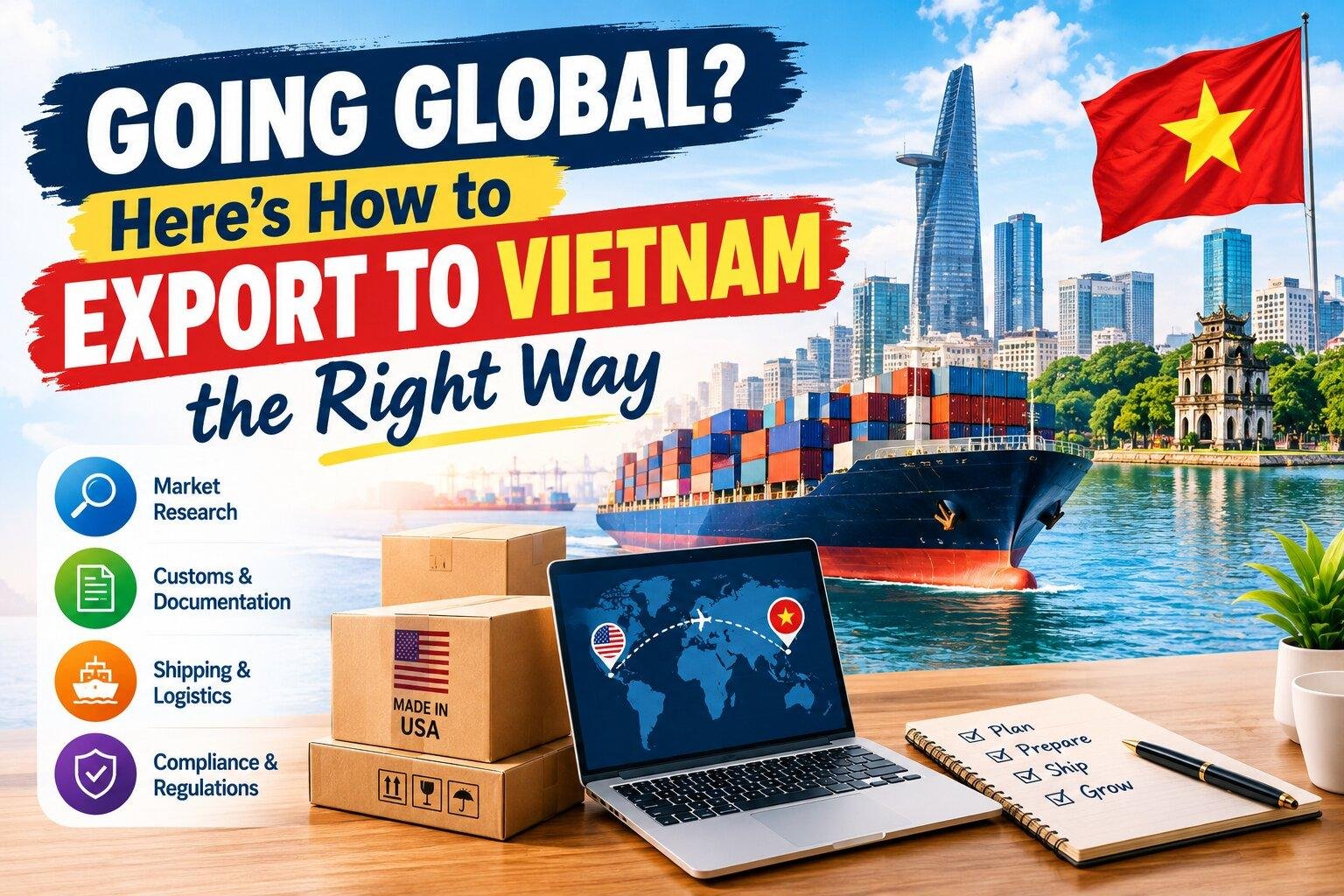
Expanding into another country can feel exciting and intimidating at the same time.
You may have a product that already sells well in the United States. You may have received interest from a Vietnamese buyer. Or perhaps you are simply looking for a new market in Asia.
Whatever brought you here, export to Vietnam can become a valuable growth opportunity when you approach it with the right preparation.
Vietnam has developed into an important commercial market for U.S. companies. Its growing economy, expanding middle class, manufacturing base, and increasing demand for international products have attracted businesses from around the world.
But international trade is not simply a matter of putting products in a container and sending them overseas.
You need to understand your product, your buyer, customs requirements, documentation, shipping terms, labeling rules, taxes, and any regulations that apply to your particular industry.
The good news is that you do not need to figure everything out at once.
This guide walks through the process step by step so you can understand what it takes to export to Vietnam successfully.
Why Vietnam Is Worth Considering for U.S. Exporters
Before dealing with paperwork, it helps to understand why businesses are paying attention to Vietnam.
The U.S. Commercial Service reports that U.S.-Vietnam bilateral trade exceeded $209 billion in 2025, making Vietnam the United States' eighth-largest trading partner. Vietnam is also an important destination for U.S. agricultural exports.
That does not mean every product will automatically succeed.
Market demand depends heavily on the industry, price point, competition, regulations, distribution model, and local customer preferences.
Still, Vietnam offers opportunities across areas such as:
- Agriculture and food products
- Industrial machinery
- Energy and infrastructure
- Technology
- Medical equipment
- Transportation
- Chemicals
- Consumer products
- Education and professional services
- Environmental and water technologies
For an exporter, the key question is not simply, "Is Vietnam a good market?"
The better question is:
"Is Vietnam a good market for my particular product and business model?"
That distinction can save you considerable time and money.
Step 1: Research the Vietnamese Market Before You Ship
One of the most common mistakes new exporters make is finding a buyer before understanding the market.
A buyer expressing interest is encouraging, but it does not automatically mean the transaction will be profitable.
Start by researching:
- Who buys your product in Vietnam?
- What competing products already exist?
- What price range is common?
- Who are the major distributors?
- Are there local alternatives?
- What certifications or approvals are required?
- Is the product restricted or regulated?
- What import duties and taxes may apply?
- How will the product reach the final customer?
Your research should also consider regional differences.
Vietnam is not one uniform commercial market. Northern Vietnam has a strong concentration of government ministries and regulatory bodies, while southern Vietnam is a major industrial and commercial center.
Your sales strategy may therefore need to change depending on where your customers are located.
Step 2: Find the Right Vietnamese Buyer or Distributor
Finding a reliable business partner is one of the most important parts of any export to Vietnam strategy.
A local distributor can potentially help with:
- Import procedures
- Market knowledge
- Customer relationships
- Warehousing
- Sales
- Product positioning
- After-sales service
- Local regulatory requirements
However, do not choose a distributor simply because someone recommends them.
Perform proper due diligence.
Check the company's:
- Legal registration
- Business history
- Financial condition
- Customer references
- Existing suppliers
- Product experience
- Distribution network
- Warehousing facilities
- Import capabilities
- Industry licenses
Ask potential partners specific questions about how they intend to sell your product.
A serious distributor should be comfortable discussing its sales channels, customer base, expected volumes, and market strategy.
The U.S. Commercial Service specifically recommends adequate due diligence when selecting Vietnamese agents and distributors, including checking whether they have the permits, facilities, workforce, and capital needed for the relationship.
Step 3: Confirm Who Will Be the Importer
This step is easy to overlook.
Before you finalize a sale, determine who will act as the importer in Vietnam.
In many transactions, the Vietnamese buyer or distributor handles the import side.
That party may be responsible for:
- Import declarations
- Customs clearance
- Applicable duties and taxes
- Required licenses
- Product inspections
- Local regulatory compliance
Vietnam's import requirements can depend on the product and the type of importing entity.
Some goods require permits or specialized inspections before customs clearance.
That is why your sales agreement should clearly identify the responsibilities of both parties.
Do not assume that the exporter and importer have the same obligations.
Step 4: Classify Your Product Correctly
Product classification is one of the foundations of international trade.
Your product needs the appropriate Harmonized System classification for customs purposes.
The HS code can influence:
- Import duty
- Regulatory requirements
- Product restrictions
- Statistical reporting
- Required permits
- Customs treatment
Do not select a code simply because it appears to be the closest description on a website.
Look carefully at the product's material, function, construction, use, and technical characteristics.
A classification mistake can create problems after the shipment arrives.
If the product is complex, regulated, or expensive, consider obtaining professional classification support before your first commercial shipment.
Step 5: Check Vietnam's Import Restrictions
Not every product can be imported into Vietnam under ordinary conditions.
Some products may be prohibited, restricted, licensed, or subject to specialized inspection.
Vietnam's current guidance identifies categories that can be subject to special controls, while other goods may require compliance with quarantine, food safety, quality, or technical regulations.
This matters particularly for products such as:
- Food and beverages
- Pharmaceuticals
- Medical equipment
- Agricultural products
- Chemicals
- Machinery
- Electrical products
- Fertilizers
- Seeds
- Steel
- Petroleum products
The exact requirements depend on the product.
So before you export to Vietnam, identify the applicable Vietnamese ministry or regulatory authority for your product.
Do not wait until the shipment reaches the port.
Step 6: Understand Vietnamese Labeling Requirements
Labeling is another area where exporters can make expensive mistakes.
Vietnamese rules require specific information on many imported products.
Depending on the product, labels may need information such as:
- Product name
- Responsible organization or individual
- Country of origin
- Quantity
- Manufacturing date
- Expiration date
- Warnings
- Other product-specific information
Vietnam's current labeling guidance also provides for Vietnamese-language supplementary labels in certain circumstances.
This means a product that is perfectly acceptable on a U.S. retail shelf may need additional labeling before being sold in Vietnam.
Do not redesign packaging at the last minute.
Review labeling requirements early enough to incorporate them into production and packaging schedules.
Step 7: Check Product Standards and Certifications
Vietnam uses national standards known as TCVNs and mandatory technical regulations known as QCVNs.
Not every standard is mandatory.
However, technical regulations can create mandatory compliance obligations for covered products.
Depending on what you sell, you may need:
- Testing
- Product certification
- Conformity assessment
- Safety documentation
- Technical files
- Registration
- Inspection
- Specialized certificates
Electrical equipment, machinery, food, pharmaceuticals, and other regulated products can face additional requirements.
This is why your product's HS classification should not be treated as the end of the research.
Classification tells you what the product is for customs purposes.
Regulatory research tells you what you must do before the product can legally enter or be sold in Vietnam.
Step 8: Prepare Your Export Documents
Good documentation makes international shipping much easier.
Common export documents may include:
- Commercial invoice
- Packing list
- Bill of lading or air waybill
- Export declaration
- Certificate of origin, when required
- Product certificates
- Inspection documents
- Insurance documents
- Special permits or licenses
The exact documents depend on the product, shipment, buyer, payment method, and Vietnamese import requirements.
Your buyer and freight forwarder should confirm what documentation will be needed before shipment.
Make sure the information is consistent across documents.
For example, product descriptions, quantities, weights, values, and package counts should not conflict between the commercial invoice and packing list.
Small inconsistencies can create unnecessary questions during customs clearance.
Step 9: Understand U.S. Export Filing Requirements
Export compliance does not end when the goods leave the United States.
For shipments requiring Electronic Export Information, the exporter or authorized filing agent must submit the required information through the Automated Export System.
The U.S. Census Bureau identifies ACE AESDirect as the primary filing tool for submitting EEI to AES.
Depending on the transaction, the filing may involve information such as:
- Exporter details
- Consignee
- Country of destination
- Schedule B number
- Quantity
- Value
- Transportation information
- License information, when applicable
The filing process can produce an Internal Transaction Number, or ITN, which may be needed for the shipment.
Do not assume your freight forwarder automatically handles everything.
Clarify who is responsible for the AES filing and make sure the information is accurate.
Step 10: Check U.S. Export Controls
A product being legal to sell in the United States does not automatically mean you can export it anywhere without restrictions.
Certain products, technologies, software, equipment, and end uses may be subject to U.S. export controls.
Before shipping, determine whether your product falls under the Export Administration Regulations or another U.S. regulatory regime.
Also screen the parties involved in the transaction.
This can include:
- Buyer
- End user
- Consignee
- Distributor
- Other intermediaries
For sensitive products, do not rely solely on the buyer's description of the transaction.
Understand the actual end use and end user.
Step 11: Calculate the Full Landed Cost
A product may look profitable until you calculate the actual cost of getting it into the Vietnamese market.
Your calculation should consider:
Product cost + packaging + inland transportation + export costs + freight + insurance + import duties + taxes + customs clearance + local delivery + distributor margin = approximate landed cost
Do not focus only on ocean or air freight.
A low freight quote does not necessarily mean a low total import cost.
Also consider currency movements, storage charges, inspection costs, port charges, documentation fees, and unexpected delays.
For your first shipment, build a reasonable contingency into your budget.
Step 12: Choose the Right Incoterm
Your Incoterm determines important responsibilities between you and the Vietnamese buyer.
Common terms include:
- EXW
- FCA
- FOB
- CIF
- CPT
- DAP
- DDP
Each term affects who handles transportation, insurance, export clearance, import clearance, and certain costs or risks.
For example, an exporter using DDP may take on significantly more responsibility than an exporter selling under an arrangement where the buyer handles import clearance.
Do not choose an Incoterm simply because the buyer asks for it.
Make sure you understand the obligations associated with it.
Step 13: Choose Between Air and Ocean Freight
Your shipping method depends on the product.
Ocean freight is often practical for larger commercial shipments where delivery speed is less important.
Air freight may make more sense for:
- Samples
- High-value goods
- Urgent shipments
- Small quantities
- Time-sensitive products
Ask your freight provider to compare the complete cost and estimated transit time.
For your first shipment, reliability may be more valuable than choosing the absolute cheapest transportation option.
Step 14: Protect Your Payment
Payment risk deserves serious attention when entering a new market.
For a new customer, consider payment structures that reduce your exposure.
Depending on the transaction, options may include:
- Payment in advance
- Confirmed letters of credit
- Documentary collections
- Open-account terms after a proven relationship
The U.S. Commercial Service recommends caution with new Vietnamese partners and notes that exporters may consider advance payment or an irrevocable confirmed letter of credit initially.
Once the buyer demonstrates a reliable payment history, you can reassess the commercial terms.
Step 15: Protect Your Intellectual Property
If your product includes proprietary technology, branding, designs, software, or other intellectual property, think about protection before entering the market.
This is especially important if you plan to:
- License technology
- Manufacture locally
- Share technical drawings
- Use local distributors
- Establish partnerships
- Provide proprietary software
Vietnam remains an important market for U.S. businesses, but intellectual property protection continues to be an area of concern for U.S. policymakers. In 2026, USTR identified Vietnam as a Priority Foreign Country under its Special 301 review and initiated a Section 301 investigation related to IP protection and enforcement.
That does not mean exporters should avoid the market.
It means companies should treat IP protection as part of their market-entry planning.
Common Mistakes to Avoid When You Export to Vietnam
A few mistakes appear repeatedly among inexperienced exporters.
1. Choosing a buyer without due diligence
A promising email or phone call is not enough.
Verify the company before committing inventory or extending credit.
2. Ignoring product-specific regulations
Do not assume ordinary customs clearance means your product can immediately enter the Vietnamese market.
3. Using an incorrect HS code
Classification errors can affect duties, documentation, and regulatory treatment.
4. Waiting too long to check labels
Packaging changes can become expensive when discovered immediately before shipment.
5. Underestimating landed costs
Freight is only one part of the total import cost.
6. Choosing an Incoterm without understanding it
The wrong Incoterm can leave you responsible for costs or risks you did not expect.
7. Giving a new buyer generous credit too soon
Build trust gradually.
8. Treating Vietnam as one identical market
Regional differences, industries, customer preferences, and distribution structures matter.
A Simple Export to Vietnam Checklist
Before shipping your first order, run through this checklist:
-
Research Vietnamese market demand
-
Identify your target customers
-
Find and verify a reliable buyer or distributor
-
Confirm who will act as importer
-
Determine the correct HS code
-
Check import restrictions
-
Review product-specific licenses
-
Check technical standards
-
Review labeling requirements
-
Prepare commercial documents
-
Confirm AES/EEI requirements
-
Review U.S. export controls
-
Calculate landed cost
-
Select an appropriate Incoterm
-
Choose transportation
-
Confirm payment terms
-
Protect intellectual property
-
Confirm customs clearance procedures
-
Keep complete transaction records
Final Thoughts
The idea of going global can sound complicated, but successful international trade usually comes down to preparation.
When you export to Vietnam, your biggest advantage is not simply having a good product. It is knowing what needs to happen before the product leaves your warehouse.
Research the market.
Verify the buyer.
Classify the product correctly.
Understand Vietnamese regulations.
Prepare accurate documents.
Calculate the real landed cost.
Choose sensible payment and shipping terms.
And most importantly, do not treat compliance as something to figure out after the shipment is already on the water.
Vietnam offers meaningful opportunities for U.S. exporters, but those opportunities are easier to capture when businesses enter the market with realistic expectations and a clear process.
Start with one product, one carefully researched market segment, and one reliable buyer.
Then build from there.
Frequently Asked Questions
Is Vietnam a good market for U.S. exporters?
Vietnam can be an attractive market for U.S. businesses, particularly in sectors where demand for American products, technology, agricultural goods, industrial equipment, and specialized services is strong. However, market suitability depends on the specific product and industry.
What documents do I need to export to Vietnam?
Common documents include a commercial invoice, packing list, bill of lading or air waybill, and export filing information. Some products require additional certificates, licenses, inspections, or other documents.
Do I need a Vietnamese distributor?
Not necessarily in every situation, but local agents and distributors can be useful for market access, customer relationships, logistics, and local knowledge. The appropriate structure depends on your product and business model.
Do products need Vietnamese labels?
Many imported products are subject to Vietnamese labeling requirements. The exact requirements depend on the product category and applicable regulations.
How do I calculate the cost of exporting to Vietnam?
Start with the product price and add packaging, inland transportation, export expenses, freight, insurance, duties, taxes, customs clearance, local delivery, and other applicable charges.
What is the most important thing to check before exporting?
There is no single answer for every product, but confirming the product's classification, import eligibility, regulatory requirements, buyer, documentation, and total landed cost before shipping can prevent many expensive problems.
Can small businesses export to Vietnam?
Yes. A small business can enter the Vietnamese market, but it should begin with careful research and manageable orders. Starting small can help you test demand, understand logistics, and build relationships before committing to larger shipments.

 Arabic
 French
 Spanish
 Portuguese
 Deutsch
 Turkish
 Dutch
Dutch
 Italiano
 Russian
 Romaian
 Portuguese (Brazil)
 Greek
Greek