

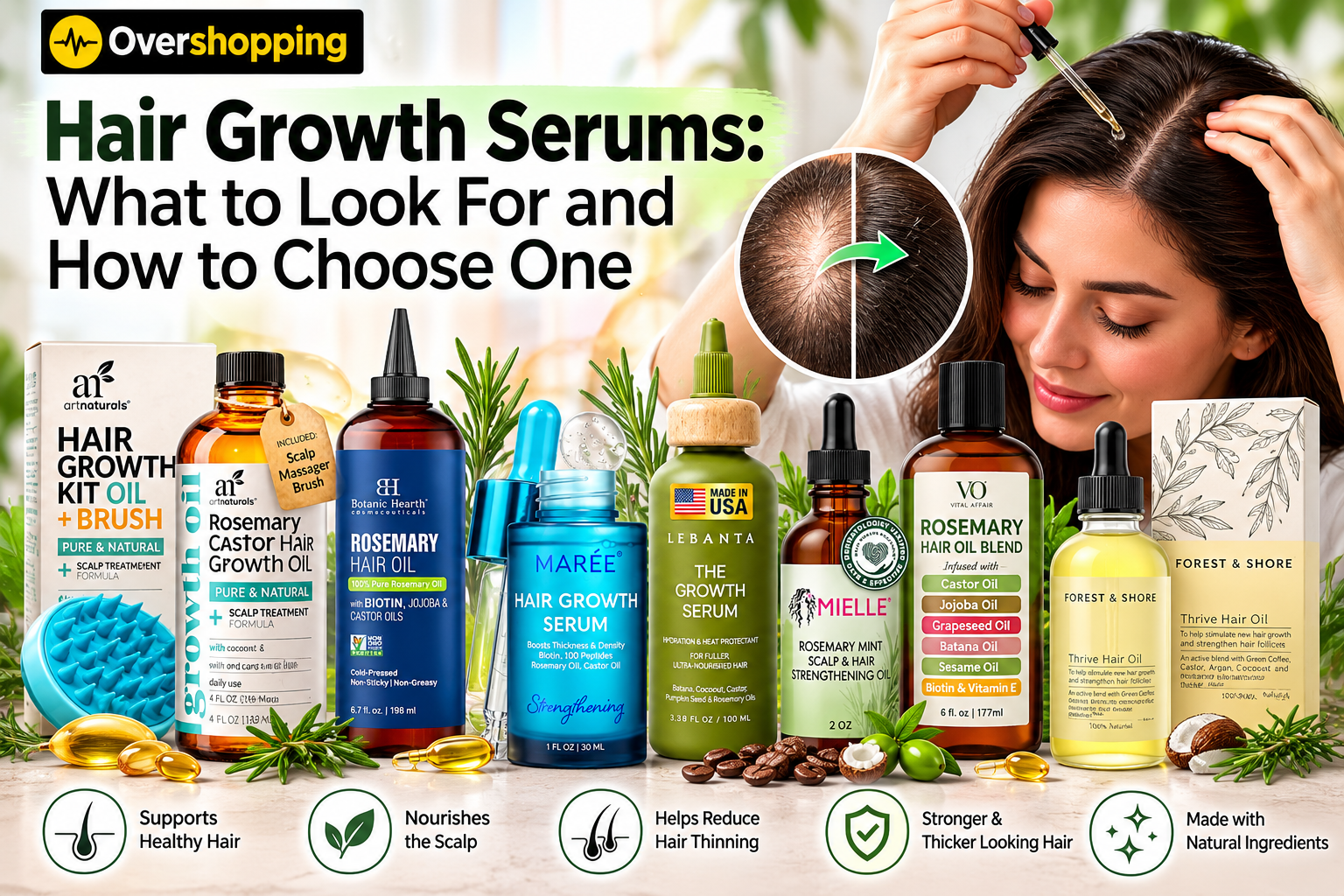
Hair thinning and excessive shedding are common concerns for many people, and choosing the right product can feel overwhelming. With so many hair growth products, scalp treatments, oils, and serums available, it is important to understand what a product is designed to do before adding it to your routine.
A hair growth serum is typically a lightweight topical product formulated to support scalp care, improve the appearance and condition of the hair, or target concerns associated with thinning and breakage. However, not every serum works in the same way, and ingredients, formulation, consistency, and your individual hair concerns all matter.
This guide explains what to look for in a hair growth serum, how different products compare, how to apply them, and when a serum may not be enough.
What Is a Hair Growth Serum?
A hair growth serum is a leave-in topical product designed to be applied directly to the scalp or hair. Unlike traditional hair oils, many serums have lightweight textures that are intended to absorb quickly without leaving the hair excessively greasy.
Depending on the formulation, a hair regrowth serum may contain ingredients such as peptides, caffeine, botanical extracts, conditioning agents, or other compounds commonly marketed for scalp and hair care.
It is important to distinguish cosmetic scalp care from medically established treatments for hair loss. A serum may help support a healthy-looking scalp, improve the appearance of hair, or reduce the effects of dryness and breakage, but results depend heavily on the formulation and the underlying reason for hair thinning.
When shopping for a serum, look beyond phrases such as "advanced hair growth" or "hair strengthening." Check the actual ingredient list and consider whether the product is designed for your specific scalp and hair needs.
Hair Serum vs Hair Oil vs Scalp Treatment
Although these products can appear similar, they are not necessarily interchangeable.
Hair Serum
A hair serum is generally lightweight and can be formulated for either the scalp, hair lengths, or both. A scalp-focused serum may contain ingredients intended to support scalp condition, while a cosmetic hair serum may primarily improve smoothness, shine, and manageability.
Hair Oil
Hair oils are generally richer and contain oils or oil-soluble ingredients. They can help reduce dryness and improve the feel and appearance of the hair. Depending on the oil and how it is used, they may also help minimize friction and breakage.
However, applying a heavy oil directly to the scalp is not appropriate for everyone. People with oily or easily irritated scalps may prefer lighter formulations.
Scalp Treatment
A scalp treatment is a broader category that can include serums, lotions, medicated products, exfoliating treatments, and other formulations. Some treatments are specifically designed for particular scalp conditions and may require professional advice.
The right option depends on your goal. If you primarily want lightweight scalp care, a scalp serum may be convenient. If dryness and breakage are your main concerns, a conditioning product or hair oil may be more appropriate.
Ingredients Commonly Found in Hair Serums
The ingredient list is one of the most useful things to examine when comparing hair serum for hair growth products.
Peptides
Peptides are frequently included in modern hair and scalp formulations. They are short chains of amino acids and are widely used in cosmetic products designed to condition the skin and hair.
Some hair serums use peptide blends as part of formulas marketed for strengthening or supporting the appearance of fuller-looking hair. However, the presence of a peptide does not automatically mean that a product has been clinically proven to treat hair loss.
Look at the complete formulation rather than choosing a product simply because the word "peptide" appears on the label.
Botanical Ingredients
Plant-derived ingredients are common in scalp-care formulas. Depending on the product, you may find botanical extracts such as rosemary, green tea, ginseng, aloe vera, or other plant ingredients.
Botanical ingredients can provide different properties, including conditioning, antioxidant activity, or soothing effects. Evidence varies considerably from one ingredient to another, so consumers should be cautious about products making strong claims based solely on botanical ingredients.
If you have sensitive skin, remember that "natural" does not necessarily mean irritation-free. Botanical extracts and essential oils can cause reactions in some individuals.
Caffeine
Caffeine is another ingredient commonly found in products marketed for thinning hair. It is often included in shampoos, scalp tonics, and serums.
Because caffeine-containing products are widely marketed for hair care, it can be tempting to assume that any caffeine serum will produce significant hair growth. However, evidence for topical caffeine varies, and cosmetic products should not automatically be considered equivalent to established medical treatments for hair loss.
Other Commonly Marketed Ingredients
Depending on the formula, a hair loss serum may contain ingredients such as niacinamide, hyaluronic acid, panthenol, amino acids, antioxidants, or conditioning agents.
These ingredients can have different purposes. For example, some may support skin hydration, while others improve the feel and manageability of the hair.
The best approach is to evaluate the whole formula instead of focusing on a single "hero ingredient."
How to Choose a Hair Growth Serum
Choosing a hair growth serum starts with identifying what you actually want the product to accomplish.
1. Identify Your Main Hair Concern
Are you dealing primarily with:
l Excessive shedding?
l Gradual thinning?
l Dry or irritated scalp?
l Hair breakage?
l Fine hair that lacks volume?
l A scalp that feels dry or uncomfortable?
A product intended for cosmetic strengthening may not address the same concerns as a treatment designed for a specific form of hair loss.
2. Check the Ingredient List
Do not rely exclusively on the front of the bottle. Read the full ingredient list and research unfamiliar ingredients when necessary.
Look for a transparent formulation rather than a product that makes numerous claims without clearly explaining what it contains.
If you are specifically looking for hair growth products, compare several formulas instead of choosing the first product that promises faster growth.
3. Consider Your Scalp Type
Your scalp can influence which serum texture works best.
If you have an oily scalp, a lightweight, non-greasy serum may be more comfortable. If your scalp tends to be dry, a hydrating formulation may be preferable.
People with sensitive scalps should be particularly cautious with products containing strong fragrances, essential oils, alcohol, or other ingredients that have previously caused irritation.
4. Look for Realistic Claims
Be skeptical of products promising dramatic results in a few days or weeks.
Hair grows through a biological cycle, so meaningful changes generally take time. A cosmetic serum can be useful as part of a consistent hair-care routine, but it should not be treated as a guaranteed solution for every type of hair loss.
For those comparing products online, hair growth serums can also be reviewed based on their formulation, intended use, and application instructions.
5. Consider Your Hair Type
A serum designed for fine hair may feel very different from one formulated for thick, curly, or coarse hair.
If your primary concern is breakage, a conditioning serum used on the hair lengths may be more useful than a scalp-focused product. If the concern is scalp care, choose a formula specifically intended for scalp application.
6. Check How the Product Should Be Used
Some serums are intended for daily use, while others may be recommended several times per week.
Read the manufacturer's directions before applying the product. Using more serum than recommended does not necessarily produce better results and may increase the chance of buildup or irritation.
How to Apply a Hair Serum
Correct application is important because a good product will not perform as intended if it is consistently applied incorrectly.
For a scalp-focused serum, start with a clean scalp unless the product instructions say otherwise.
Part the hair into several sections and apply a small amount directly to the scalp. Concentrate on the areas where the product is intended to be used rather than coating the entire hair shaft.
Gently massage the serum into the scalp using your fingertips. Avoid aggressive rubbing, which can irritate the skin.
Do not automatically rinse the serum out. Many leave-in scalp products are designed to remain on the skin, but always follow the instructions on the specific product.
If the serum is intended for the hair lengths rather than the scalp, apply a small amount from the mid-lengths toward the ends. Avoid applying excessive product, particularly if your hair is fine.
How Long Should You Use a Hair Serum?
Consistency is usually more important than using a large amount of product.
Hair does not transform overnight, and the visible effects of a hair-care routine can take time. Depending on the purpose of the serum, you may notice improvements in softness, manageability, or scalp comfort before noticing any change in the appearance of density.
Follow the recommended usage period provided by the manufacturer.
If you have been using a product consistently and your hair concerns continue to worsen, consider discussing the issue with a dermatologist or other qualified healthcare professional rather than continuously switching between different products.
Hair Growth Serum Mistakes to Avoid
Even a well-formulated serum can be disappointing when used incorrectly.
Using Too Much Product
More is not necessarily better. Excess serum can leave buildup on the scalp or make hair look greasy.
Changing Products Too Frequently
Switching between multiple products every few days makes it difficult to determine whether a particular product is working for you.
Give a suitable routine enough time to evaluate it, unless you experience irritation or another adverse reaction.
Ignoring Scalp Irritation
Burning, persistent itching, redness, swelling, or significant discomfort should not simply be ignored.
Stop using a product that causes a concerning reaction and seek appropriate professional advice if symptoms persist or are severe.
Expecting a Cosmetic Serum to Treat Every Type of Hair Loss
Hair thinning can have many possible causes. Genetics, hormonal changes, nutritional issues, certain medications, stress, illness, and scalp disorders can all contribute to hair loss.
A cosmetic serum may be useful for scalp and hair care, but it cannot necessarily address the underlying cause.
Judging Results Too Quickly
Hair growth cycles take time. Taking photographs under similar lighting and conditions can be a more useful way to track gradual changes than checking your hair every day.
When a Serum May Not Be Enough
A serum may not be sufficient when hair loss is sudden, severe, patchy, or progressively worsening.
For example, noticeable bald patches, rapid shedding, scalp inflammation, or unexplained changes in hair density may warrant professional evaluation.
The underlying cause matters. A person experiencing hereditary pattern hair loss may require a different approach from someone experiencing temporary shedding after an illness or major stress.
Similarly, a person with a scalp condition may need treatment directed at the scalp rather than a general cosmetic serum.
If you are concerned about significant or persistent hair loss, a dermatologist can help determine possible causes and discuss evidence-based treatment options.
FAQ
Does a hair growth serum really work?
Results depend on the ingredients, formulation, individual circumstances, and the reason for hair thinning. Some serums can support scalp care and improve the appearance or condition of the hair, but not every product marketed for hair growth has strong clinical evidence for treating hair loss.
How often should I use a hair growth serum?
Follow the instructions provided by the manufacturer. Some products are designed for daily use, while others may be intended for several applications per week.
Can women use hair growth serum?
Yes. Many products are marketed as a hair serum for women, although suitability depends on the ingredients and intended use rather than gender alone. Women experiencing persistent or unexplained hair loss should consider professional evaluation.
Can I use a hair serum every day?
Some serums are designed for daily application, but not all formulas are. Check the product directions and pay attention to how your scalp responds.
Is a scalp serum better than hair oil?
Neither is automatically better. A scalp serum may provide a lightweight application and can be formulated with specific scalp-care ingredients, while hair oils can provide conditioning and help with dryness and friction. The better choice depends on your hair and scalp needs.
How long does a hair growth serum take to show results?
The timeframe varies by product and individual. Cosmetic improvements such as softness or manageability may appear relatively quickly, while changes in the appearance of hair density can take considerably longer. Avoid products that guarantee dramatic results in an unusually short period.
Can hair growth serum stop hair loss?
A cosmetic serum should not automatically be considered a treatment for hair loss. Some formulas may support the appearance and condition of the hair and scalp, but persistent hair loss may require identification and treatment of an underlying cause.
Final Thoughts
Choosing a hair growth serum should be based on your actual hair and scalp needs rather than marketing claims alone. Start by identifying your primary concern, examine the ingredient list, consider your scalp type, and choose a product with realistic claims and clear usage instructions.
Consistency also matters. Applying a suitable serum correctly and following the manufacturer's directions can make it easier to evaluate whether the product fits your routine.
Most importantly, remember that hair thinning can have many different causes. If shedding is persistent, sudden, severe, or accompanied by scalp symptoms, professional evaluation can help identify the underlying issue and determine whether a serum is appropriate or whether a different treatment approach is needed.
Learn more about DHT and Hair Loss: https://www.overshopping.pk/hair-serums-regrowth-care/

 Arabic
 French
 Spanish
 Portuguese
 Deutsch
 Turkish
 Dutch
Dutch
 Italiano
 Russian
 Romaian
 Portuguese (Brazil)
 Greek
Greek