


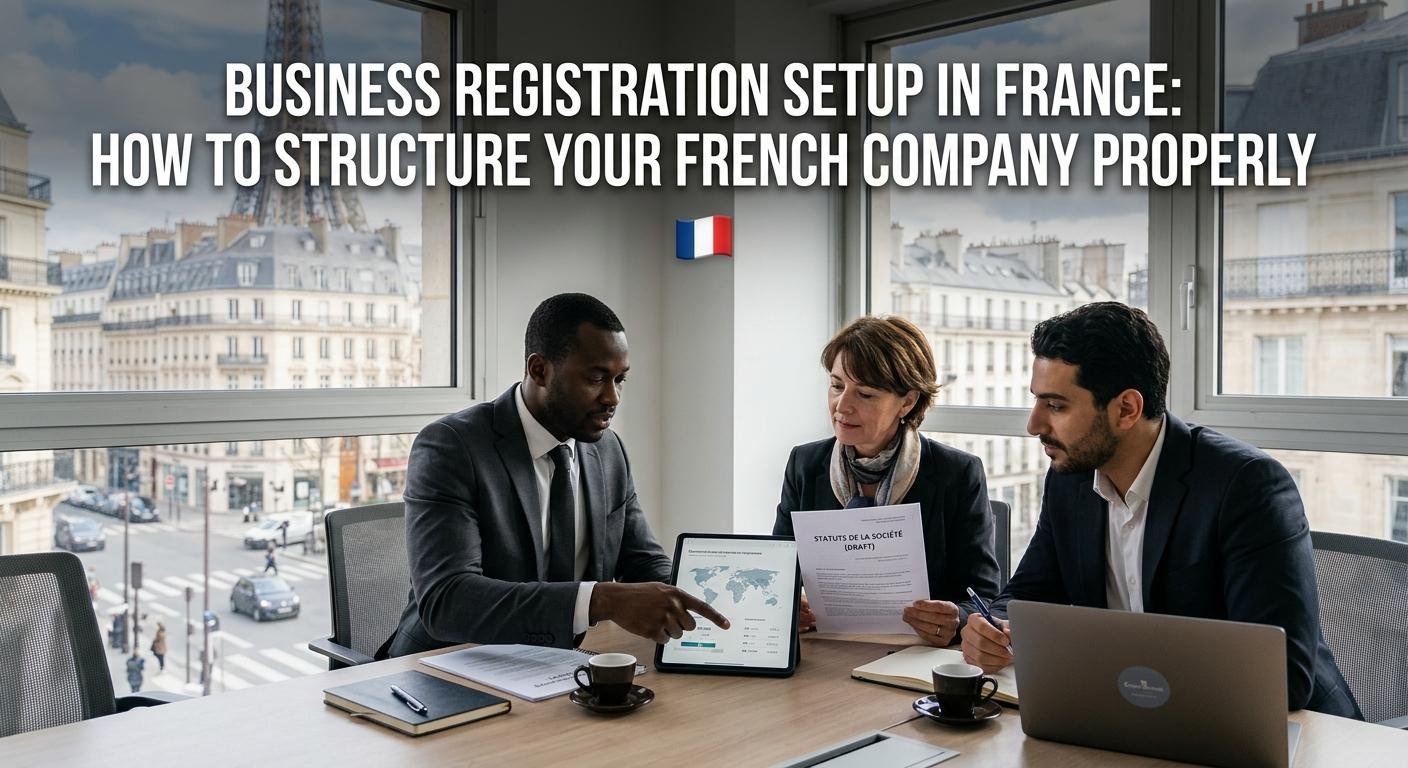
Starting a company in France can look straightforward from the outside. Choose a business idea, register the company, open a bank account and begin trading. In reality, the quality of the setup often depends on decisions made before the registration application is submitted.
For UK entrepreneurs, international founders and businesses expanding into France, Business Registration Setup in France is not simply an administrative exercise. It is the foundation for taxation, banking, reporting, ownership, management and future growth. A company that is structured correctly from the beginning can be easier to manage, easier to finance and better prepared for French compliance.
That is why company formation in France should begin with planning rather than paperwork.
Why Getting the Structure Right Matters
The first important question is not simply how to register a company. It is which business structure makes sense for the activity, ownership arrangement and long-term plans.
France offers several legal structures, including SAS, SASU, SARL, EURL and individual business structures. Each can have different consequences for management, taxation, social contributions, liability and administration. French government guidance confirms that the choice of legal form affects the company's tax and social obligations as well as the responsibilities of the business owner.
For some founders, an SAS may provide the flexibility they need for a growing or internationally oriented business. Others may find a SARL better aligned with the way they intend to operate.
There is no universally correct structure. The right choice depends on the business.
This is especially important when a UK company or entrepreneur wants to establish a UK business in France. The relationship between the UK operation, French entity, owners, management and transactions should be considered before incorporation.
Understanding French Company Formation Before You Register
A successful French company formation process begins with preparation.
Before submitting registration formalities, founders generally need to determine the company's legal form, choose a company name, establish a registered office and prepare the necessary corporate documents. The French government's business guidance specifically identifies these steps as part of the preparation required before an incorporation filing.
Your registered office in France is particularly important. The company needs a French business address, and that address becomes part of the company's formal identity.
You also need to consider the company's activity carefully. The description of what the company will actually do should be consistent across the corporate documents, registration information and banking documentation. A vague or poorly prepared activity description can create unnecessary questions later.
This is one reason why French business setup works better when the legal, tax and operational sides are planned together.
Choosing Between SAS and SARL
Two structures frequently considered during Business Registration Setup in France are the SAS and SARL.
The SAS is often considered by entrepreneurs who want flexible governance arrangements and a structure that can accommodate different ownership or investment scenarios.
The SARL can be suitable for businesses looking for a more defined legal framework, particularly where the ownership structure and management arrangements are relatively straightforward.
The decision should not be based on the name of the structure alone. Founders should consider expected profits, remuneration, ownership, social protection, future investors, management requirements and the relationship between France and any existing overseas business.
French government guidance provides a legal-form comparison framework based on factors such as the number of members, projected turnover, income, social protection and accounting and legal management requirements.
In other words, the right company structure in France should support the business model instead of forcing the business model to fit the structure.
Registration Is Only One Part of the Process
Many entrepreneurs think of French company registration as the moment the job is finished. It is better understood as a transition from planning into operation.
French company creation formalities are now handled online through the Guichet unique, the country's central business formalities platform. Since January 2023, creation, modification and cessation formalities have been submitted through this system.
Before filing, depending on the company and activity, founders may need to prepare:
- Company statutes
- Registered office information
- Share capital arrangements
- Management appointments
- Beneficial ownership information
- Identity and supporting documentation
- Activity details
- Banking preparation
For a company, the statutes are particularly important because they establish key rules concerning how the business is organised and operated. French public guidance also identifies share capital deposit, appointment of officers and drafting the statutes as important pre-registration steps.
The practical lesson is simple: do not treat registration as a form-filling exercise.
Preparing for the French Business Bank Account
A newly incorporated business can still face operational difficulties if banking has not been considered properly.
A French business bank account may require detailed information about the company's activity, ownership, management, expected transactions and source of funds. For international founders, the bank may also need a clear explanation of the relationship between the founder, any overseas company and the French entity.
This means banking preparation should happen alongside incorporation.
The corporate documents, business plan, activity description and financial expectations should tell a consistent story. When those pieces align, the company is easier to explain during the banking and compliance process.
This is particularly relevant for a non-resident director or UK founder establishing a business in France while continuing to live outside the country.
Tax Planning Should Start Before Trading
A company can be legally incorporated and still be poorly prepared from a tax perspective.
For businesses subject to French corporation tax, the standard French corporate tax rate is currently 25%. Qualifying small and medium-sized businesses may benefit from a 15% rate on the first €42,500 of taxable profit, subject to the applicable conditions.
VAT also needs attention from the beginning. The standard French VAT rate is 20% for most goods and services in metropolitan France, although reduced rates and specific rules can apply depending on the transaction.
For an international business, this becomes more complex.
A French company may have transactions involving UK customers, EU customers, overseas suppliers or another company within the same group. That makes cross-border tax planning an essential part of the setup.
The objective is not simply to reduce tax. It is to understand where obligations arise, how transactions should be documented and how the French company fits into the wider commercial structure.
What About UK Entrepreneurs?
For UK nationals, Business Registration Setup in France can involve additional immigration and residence considerations.
Being able to establish a French company and having the right to live and work in France are separate questions. French government information confirms that foreign nationals can establish companies in France, but the applicable procedures depend on nationality and circumstances.
Where a person intends to relocate to France and actively operate there, visa and residence requirements need to be assessed separately. France-Visas provides specific routes for self-employed activity and certain business-creation situations, with eligibility and documentary requirements depending on the individual's circumstances.
For this reason, set up a company in France should never be treated as automatically equivalent to obtaining permission to reside and work there.
The Importance of SIREN and SIRET Numbers
Once the company is registered, its official identification becomes important for everyday business administration.
French registration results include identifiers such as the SIREN and SIRET numbers. The SIREN identifies the company, while the SIRET identifies an establishment. An APE activity code is also assigned to identify the company's main activity.
These details can appear throughout the company's commercial and administrative life, including invoices and dealings with authorities.
For a founder coming from the UK or another country, understanding these identifiers early can make French administration much less confusing.
Do Not Forget Ongoing Compliance
The incorporation stage is only the beginning.
After completing French company registration, businesses need to manage their ongoing obligations. Depending on the company's circumstances, this can involve accounting records, VAT reporting, corporation tax, payroll, annual accounts, corporate records and other filings.
This is where French accounting compliance becomes particularly valuable.
The founders of a growing company should be focused on customers, sales, operations and expansion. Spending excessive time trying to understand every French administrative requirement can become a distraction.
A well-organised accounting process helps ensure that the company's financial records support its tax reporting and wider decision-making.
A Better Approach to Business Setup
Good French business setup is about building the complete structure before the company starts trading.
That means thinking about:
Business structure: Which legal form matches the ownership and commercial model?
Tax position: What French and international tax considerations could apply?
Banking: What documentation will the bank need and how will money move through the company?
Registered office: Where will the French company be formally domiciled?
Management: Who will run the company and where will management actually take place?
Compliance: What accounting, VAT, payroll and annual reporting obligations will arise?
Growth: Will the structure still work if the business hires employees, adds shareholders or expands into other markets?
These questions create a much stronger foundation than simply asking how quickly a company can be registered.
Building a French Company That Is Ready to Operate
The real goal of Business Registration Setup in France is not receiving a registration confirmation. It is creating a company that is commercially and financially ready to operate.
For UK entrepreneurs and international businesses, that means connecting French company formation, tax planning, banking preparation and compliance into one coherent process.
A properly planned French company gives the founder a clear framework for making decisions from day one. It can help avoid structural changes later, reduce administrative uncertainty and create a more organised path toward growth.
France can be an important market for businesses looking to establish a European presence, but the opportunity should be approached with preparation rather than assumptions.
The strongest company setups are rarely the result of rushing through registration. They come from understanding the business first, selecting the right structure, preparing the documentation carefully and considering tax and compliance before the first invoice is issued.
That is what Business Registration Setup in France should really mean: not simply creating a French company, but creating the right French company for the business you intend to build.

 English
 Arabic
 Spanish
 Portuguese
 Deutsch
 Turkish
 Dutch
Dutch
 Italiano
 Russian
 Romaian
 Portuguese (Brazil)
 Greek
Greek