


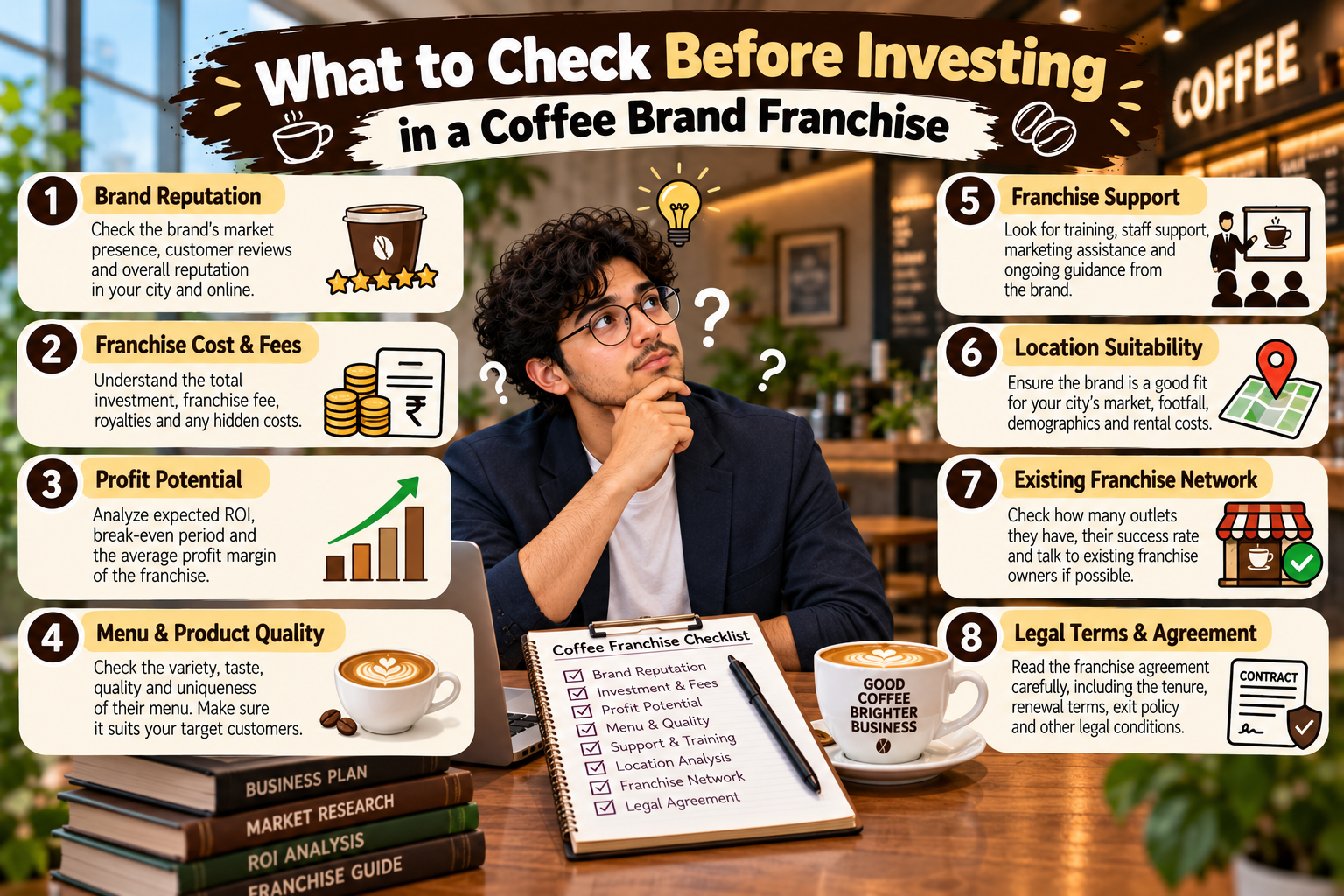
Investing in a coffee brand franchise can be an attractive business opportunity for entrepreneurs who want to enter the café industry. With coffee culture growing in India, cafés are becoming popular places for socialising, working, studying and casual meetings. However, starting a franchise requires more than selecting a popular brand. You need to understand the investment, location, operating costs and terms of the agreement before making a decision.
Choosing the right coffee franchise can help you follow an established business model, but it does not guarantee profitability. Here are the most important factors to check before investing in a coffee brand franchise.
1. Research the Brand's Market Reputation
Before investing, understand how well the coffee brand is recognised in the market. A familiar name may attract customers, but you should also evaluate its product quality, service standards and customer feedback.
Check the brand's online reviews, social media presence and customer ratings. Visit a few existing outlets to observe customer footfall, menu pricing, cleanliness and service quality.
You should also speak with existing franchise owners, if possible. Ask about their experience with the brand, the support they receive and the challenges they face while running their outlets.
A brand with a consistent reputation and a clear business strategy may offer a stronger foundation for your café business.
2. Understand the Total Investment Required
One of the most important steps is calculating the complete coffee franchise cost. Do not focus only on the initial franchise fee because several additional expenses can affect your budget.
Your investment may include:
-
Franchise or brand licensing fees
-
Shop security deposit and monthly rent
-
Interior design, furniture and signage
-
Coffee machines, grinders and refrigeration equipment
-
Initial inventory and packaging
-
Staff recruitment and training
-
Licences, registrations and utilities
-
Marketing expenses and working capital
Ask the franchisor for a detailed cost breakdown and clarify which expenses are included in the quoted package.
It is also wise to maintain a financial reserve for unexpected costs and the initial months of operation. A realistic budget helps you avoid cash flow problems before the business becomes stable.
3. Evaluate the Proposed Location
Location plays a major role in a café's performance. Even a recognised coffee brand may struggle if its outlet is located in an area with limited demand or poor visibility.
When choosing a coffee franchise, study the location's customer profile and daily movement. Office areas, colleges, shopping streets, residential neighbourhoods and commercial complexes may offer different opportunities depending on the brand's target audience.
Consider these factors before finalising a property:
-
Daily pedestrian and vehicle traffic
-
Visibility from the main road
-
Parking and accessibility
-
Nearby offices, colleges and residential areas
-
Rental costs compared with expected sales
-
Competition from cafés and independent coffee shops
Visit the location at different times of the day and on weekends. This helps you understand whether the area attracts enough potential customers throughout the week.
4. Review the Coffee Franchise Agreement Carefully
The coffee franchise agreement defines the relationship between you and the franchisor. Before signing, read every clause and understand your responsibilities, financial commitments and operating restrictions.
Pay particular attention to the following terms:
-
Agreement duration: How long can you operate under the brand?
-
Renewal conditions: What requirements must you meet to renew?
-
Royalty fees: Are royalties fixed, percentage-based or linked to sales?
-
Marketing contributions: Are additional advertising fees required?
-
Territory protection: Can the brand open another outlet near yours?
-
Purchasing requirements: Must you buy ingredients and equipment from approved suppliers?
-
Termination clauses: Under what circumstances can the agreement end?
-
Transfer and exit terms: Can you sell the outlet or transfer ownership?
Ask for clarification on any unclear provision. Consider having a qualified lawyer review the coffee franchise agreement before signing, especially when the investment is substantial.
5. Check the Franchise's Profitability Potential
A coffee franchise should be evaluated through realistic financial projections rather than attractive earnings claims.
Ask the franchisor for available outlet-level financial information and understand how revenue, expenses and operating margins vary between locations.
Estimate your potential monthly expenses, including rent, salaries, ingredients, electricity, maintenance, royalties, delivery platform commissions and marketing.
For example, a café with strong sales may still generate limited profit if rent and operating costs are too high.
Calculate your break-even point to understand how much revenue is required to cover monthly expenses. Also estimate the payback period using realistic profit assumptions.
Avoid relying entirely on projected returns provided by the franchisor. Actual performance depends on location, customer demand, operating efficiency and local competition.
6. Understand the Menu and Product Quality
The menu influences customer satisfaction, repeat purchases and overall profitability. Before investing, examine the brand's coffee selection, food options, pricing and product consistency.
Check whether the menu suits the local audience. Customers in some areas may prefer affordable everyday coffee, while others may be willing to pay more for speciality beverages and premium café experiences.
Ask about ingredient sourcing, supplier reliability, shelf life and quality-control procedures. You should also understand whether franchise owners can introduce local menu items or must follow a fixed menu.
A practical menu with consistent quality and appropriate pricing can help attract repeat customers.
7. Evaluate Training and Ongoing Support
A good franchisor should provide more than permission to use its brand name. Training and operational support can be especially important for first-time business owners.
Before investing, confirm what assistance is included in the franchise package.
This may cover:
-
Staff recruitment guidance and barista training
-
Store setup and equipment installation
-
Standard operating procedures
-
Inventory and supplier management
-
Marketing campaigns and promotional materials
-
Technology for billing and sales tracking
-
Ongoing operational guidance
Clarify whether support is available after the outlet opens and whether additional fees apply. Reliable assistance can make day-to-day operations easier, particularly when you are new to the café industry.
8. Study the Competition in Your Target Area
Research the cafés, coffee chains, bakeries and beverage outlets already operating near your proposed location.
Compare their menu prices, customer reviews, product variety, seating facilities and promotional offers. Identify what customers like about these businesses and where they may be falling short.
Your chosen coffee brand should offer a clear reason for customers to visit, such as convenient locations, distinctive beverages, affordable pricing or a comfortable café environment.
Also consider whether the market has enough demand to support another coffee outlet. A busy area is not automatically a profitable location if competition is intense and rental costs are high.
9. Verify Legal Requirements and Business Responsibilities
Before opening the outlet, understand the registrations, licences and local requirements applicable to your business.
Depending on the outlet and its location, these may include FSSAI registration or licensing, GST registration where applicable, municipal permissions, Shops and Establishments registration and fire-safety compliance where required.
Confirm which responsibilities belong to the franchisor and which must be handled by you as the franchise owner.
Do not assume that the brand will automatically manage every compliance requirement. Verify the applicable rules with the relevant authorities or a qualified professional before starting operations.
10. Speak With Existing Franchise Owners
One of the most useful steps is to speak directly with people who already operate outlets under the same brand.
Ask about their initial investment, ongoing expenses, customer demand, staff management, supply-chain issues and experience with franchisor support.
Find out whether the actual operating conditions match the expectations created during the sales process. If possible, speak with owners of both established and recently opened outlets.
Their experiences can help you identify practical challenges that may not be obvious from brochures or presentations.
Conclusion
Investing in a coffee brand franchise requires careful research, financial planning and a clear understanding of the agreement. Brand reputation, location, total investment, operating costs and ongoing support should all influence your decision.
Before choosing a coffee franchise, compare multiple opportunities and evaluate their suitability for your budget and target market. Review the coffee franchise agreement carefully, verify financial claims and speak with existing franchise owners before committing your money.
A well-researched decision can help you enter the café industry with a clearer business plan and a better understanding of the risks involved. Ultimately, the right franchise is not necessarily the most famous one, but the one whose business model, costs and support align with your goals.

 English
 Arabic
 French
 Spanish
 Portuguese
 Deutsch
 Turkish
 Dutch
 Italiano
 Russian
 Romaian
 Portuguese (Brazil)