


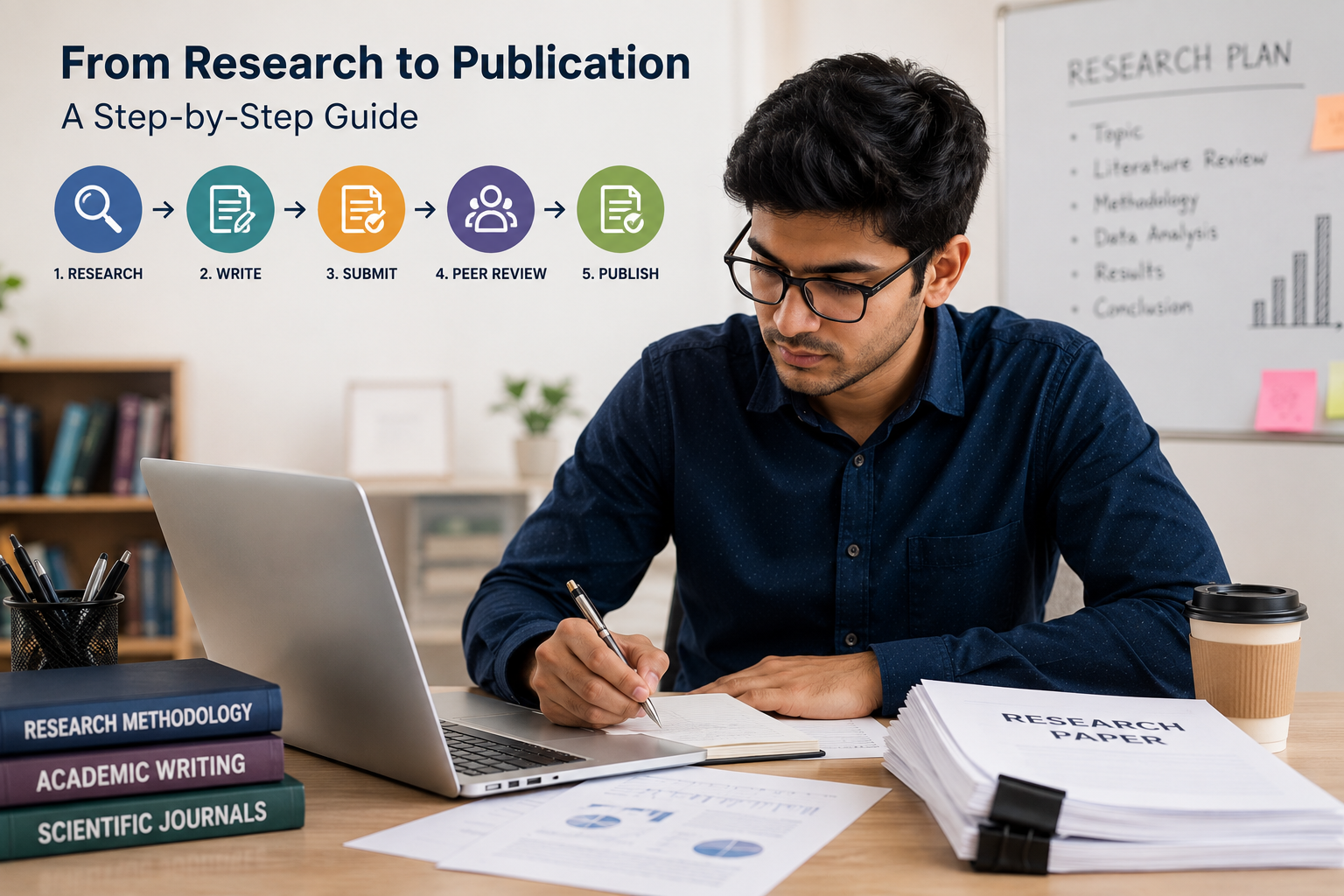
Publishing a research paper is one of the most effective ways to share your findings, build academic credibility, and contribute to your field. Whether you are a student, researcher, or faculty member, understanding the publication process helps you avoid unnecessary delays and increase your chances of journal acceptance. From selecting the right journal to responding to peer reviewers, every stage requires careful planning. This guide explains how to publish a research paper successfully while following best academic practices and improving your manuscript for publication.
What Does It Mean to Publish a Research Paper?
Publishing a research paper involves submitting an original manuscript to an academic journal where it undergoes editorial screening and peer review. If the paper meets the journal's quality standards, it is accepted, edited, and published for the global research community.
Publishing benefits include:
-
Increasing academic visibility
-
Building professional credibility
-
Supporting career advancement
-
Contributing new knowledge
-
Improving citation opportunities
A well-published paper can also strengthen grant applications and future research collaborations.
Step 1: Conduct High-Quality Research
Every successful publication begins with reliable and original research. Ensure your study addresses a clear research question, follows appropriate methodology, and generates meaningful results.
Before writing, organize your:
-
Research objectives
-
Literature review
-
Methodology
-
Data analysis
-
Conclusions
Strong research forms the foundation of every publishable manuscript.
Step 2: Choose the Right Journal
Selecting the appropriate journal significantly affects publication success. Review the journal's scope, audience, impact, indexing status, acceptance rate, and author guidelines before submission.
Look for journals that:
-
Match your research topic
-
Publish similar studies
-
Offer transparent peer review
-
Are indexed in reputable databases
-
Follow ethical publishing standards
Submitting to the wrong journal often results in immediate rejection.
Step 3: Write Your Research Paper
A research paper should follow the journal's formatting requirements while maintaining clarity and logical flow.
Most papers include:
Title
Create a concise, informative title containing your primary research focus.
Abstract
Summarize the objective, methods, findings, and conclusion within the required word limit.
Introduction
Explain the research problem, objectives, and significance.
Methodology
Describe research design, participants, materials, and analytical methods clearly.
Results
Present findings objectively using tables or figures when appropriate.
Discussion
Interpret results, compare previous studies, discuss limitations, and explain practical implications.
Conclusion
Summarize major findings and recommend future research directions.
Step 4: Edit and Proofread Carefully
Grammar mistakes, inconsistent formatting, and unclear writing reduce acceptance chances.
Before submission:
-
Check grammar and punctuation
-
Improve readability
-
Verify references
-
Remove duplicate content
-
Ensure consistency throughout
Professional editing services can further improve manuscript quality.
Step 5: Submit Your Manuscript
Once your paper is ready, submit it through the journal's online submission system.
Typical submission requirements include:
-
Manuscript file
-
Cover letter
-
Figures and tables
-
Author information
-
Ethical declarations
-
Conflict of interest statement
Double-check every uploaded document before final submission.
Step 6: Understand the Peer Review Process
After submission, editors evaluate whether the paper fits the journal's scope. Suitable manuscripts proceed to peer review, where subject experts assess originality, methodology, clarity, and contribution.
Possible editorial decisions include:
-
Accepted
-
Minor revisions
-
Major revisions
-
Rejected
Revision requests are common and should be addressed professionally.
Example: Strong Submission vs Poor Submission
| Strong Submission | Poor Submission |
|---|---|
| Original research question | Weak or repetitive topic |
| Clear methodology | Missing research details |
| Proper formatting | Journal guidelines ignored |
| Accurate references | Citation errors |
| Thorough proofreading | Grammar mistakes throughout |
Small improvements often make a significant difference during peer review.
Common Reasons Research Papers Get Rejected
Understanding rejection causes helps authors prepare stronger submissions.
Common reasons include:
-
Poor research design
-
Lack of originality
-
Weak statistical analysis
-
Journal mismatch
-
Incomplete literature review
-
Plagiarism issues
-
Poor English writing
-
Ignoring reviewer comments
Addressing these issues before submission greatly improves publication success.
Tips to Increase Acceptance Chances
Improve your publication opportunities by following proven academic practices.
-
Select the most appropriate journal.
-
Follow author guidelines carefully.
-
Present original, ethical research.
-
Write clearly and logically.
-
Use recent, credible references.
-
Proofread multiple times.
-
Respond politely to reviewer feedback.
-
Revise thoroughly before resubmission.
Consistency and patience are essential throughout the publication journey.
Frequently Asked Questions
How long does it take to publish a research paper?
Publication timelines vary by journal but generally range from three months to over one year depending on peer review, revisions, and editorial processing.
Can students publish research papers?
Yes. Undergraduate, postgraduate, and doctoral students can publish original research if it meets journal standards and follows ethical guidelines.
What is the most important factor for publication?
High-quality, original research combined with proper journal selection and clear scientific writing significantly increases publication success.
Do all research papers go through peer review?
Most reputable academic journals require peer review before accepting research papers for publication.
Conclusion
Learning how to publish a research paper requires more than writing strong research. Success depends on selecting the right journal, following submission guidelines, preparing a well-structured manuscript, and responding effectively to peer review. By understanding each stage of the publication process and maintaining high academic standards, researchers can improve their acceptance rates and expand the impact of their work. If you need expert guidance with manuscript preparation, journal selection, editing, or submission support, professional publication services can simplify the process and help you publish with greater confidence.

 English
 Arabic
 French
 Spanish
 Portuguese
 Turkish
 Dutch
Dutch
 Italiano
 Russian
 Romaian
 Portuguese (Brazil)
 Greek
Greek