


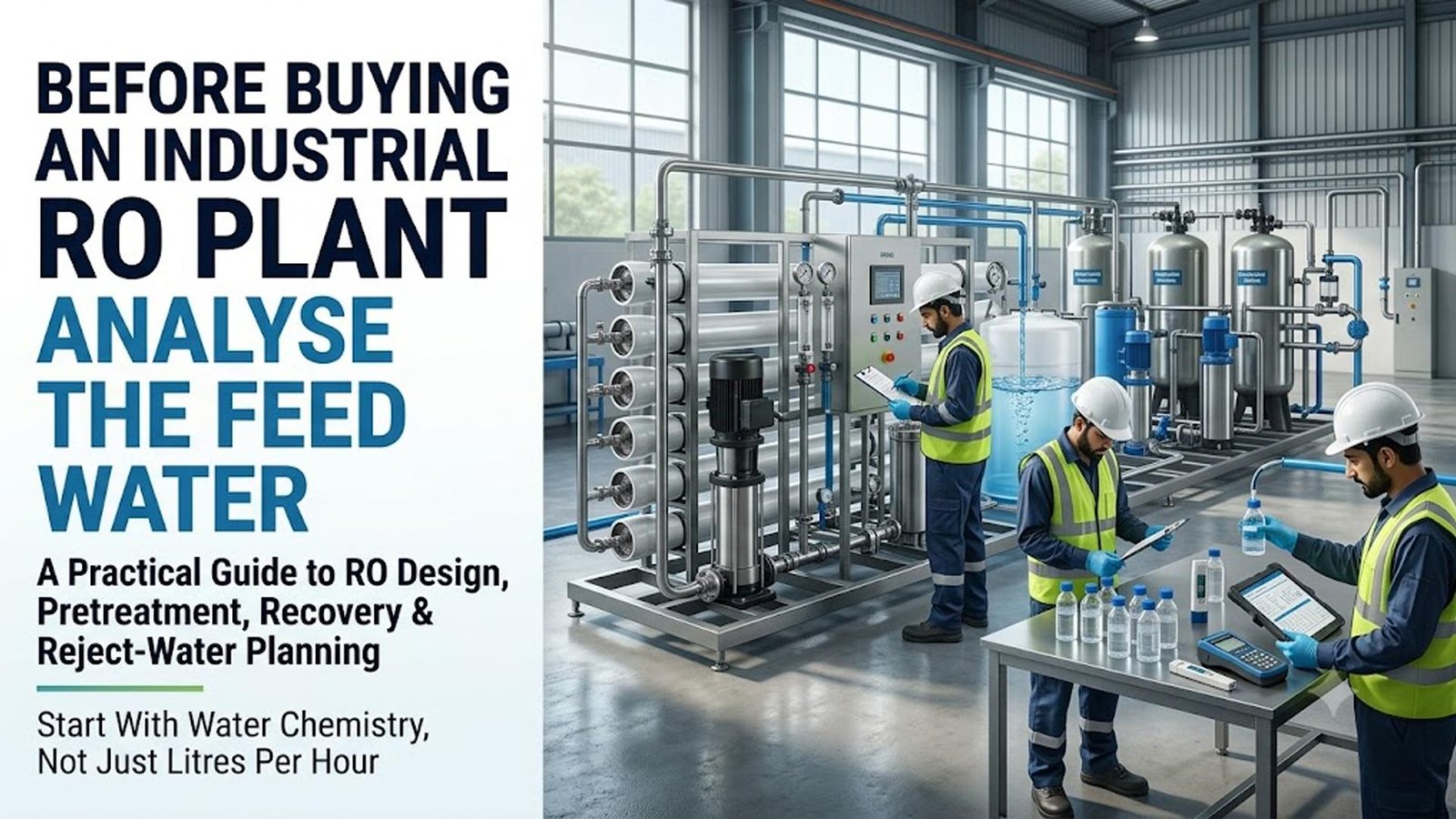
A dependable RO system begins with water chemistry, not a litres-per-hour quotation.
Two industrial reverse-osmosis plants can have the same production capacity and still deliver very different results. One may operate consistently for months, while the other experiences falling output, frequent cartridge replacement, rising pressure and repeated membrane cleaning.
The difference often begins before the equipment is purchased.
An effective industrial RO plant must be designed around the water entering it. Capacity matters, but feed-water chemistry determines pretreatment, membrane arrangement, operating pressure, recovery and cleaning requirements.
TDS Alone Is Not Enough
Many RO enquiries provide only total dissolved solids, commonly known as TDS. This is useful, but it does not show how the dissolved material is distributed.
Two water samples with similar TDS may contain very different concentrations of hardness, silica, iron, alkalinity, sulphate or organic matter. These differences can change scaling and fouling behaviour significantly.
A responsible assessment may review:
- TDS and conductivity
- Calcium and magnesium hardness
- Alkalinity
- Silica
- Iron and manganese
- Sulphate and chloride
- Turbidity
- Suspended solids
- pH and temperature
- Chlorine or other oxidants
- Organic and microbiological conditions
The required parameters also depend on whether the source is municipal water, bore water, surface water, tanker water or previously treated wastewater.
Hardness Influences Scaling Risk
Calcium and magnesium can form deposits as water becomes concentrated inside an RO system. The risk depends on hardness, alkalinity, pH, recovery and the presence of other scale-forming constituents.
Possible control strategies include softening, antiscalant dosing, pH adjustment or reducing system recovery. The right method should be selected from calculations and operating conditions rather than applied as a standard package.
A system that operates safely on one bore-water source may scale rapidly when connected to another source with different hardness and alkalinity.
Silica Can Limit Recovery
Silica deserves specific attention because it can form difficult deposits on membrane surfaces. Its behaviour can also be affected by pH, temperature and the presence of metals such as iron or aluminium.
A proposal that recommends a high recovery without reviewing silica may underestimate the risk of scaling.
Higher recovery is not automatically better. It reduces the volume of reject water but increases the concentration of salts and other retained substances inside the membrane system.
Iron and Manganese Require Pretreatment
Iron and manganese may oxidise and form particles that block filters or foul membranes. Their treatment may involve controlled oxidation, media filtration or another process selected for the source-water conditions.
Simply installing a cartridge filter may not be enough when dissolved metals become particulate after exposure to air or disinfectants.
The sampling method matters as well. A laboratory sample should represent the water entering the proposed system, not water that has already passed through an existing filter or storage process.
Turbidity and Suspended Solids Affect Membrane Fouling
RO membranes are not intended to act as primary suspended-solids filters. Turbidity, colloids and fine particles should be controlled before the high-pressure membrane stage.
Pretreatment may include:
- Multimedia filtration
- Coagulation and clarification
- Cartridge filtration
- Microfiltration
- Ultrafiltration
- Controlled disinfection
The correct arrangement depends on the water source and how much its quality changes during different seasons or operating conditions.
Chlorine Must Be Managed Correctly
Chlorine is commonly used to control microorganisms, but many RO membrane materials can be damaged by prolonged exposure to oxidising chemicals.
Where chlorination is part of the pretreatment strategy, the system may need reliable dechlorination before water reaches the membranes.
Removing chlorine too early can also increase biological-fouling risk. Disinfection and dechlorination therefore need to be designed as connected process steps.
Required Water Quality Determines the Treatment Train
An RO system should be selected for a defined application.
Water used for general washing does not necessarily need the same quality as water required for:
- Boiler feed
- Product preparation
- Pharmaceutical processes
- Final rinsing
- Food and beverage production
- Cooling systems
- Laboratory use
The buyer should define relevant product-water limits instead of requesting “pure water” without measurable requirements.
Capacity Must Include the Operating Schedule
A plant described only as “10,000 litres” is incomplete. The quotation should state whether capacity is measured per hour or per day and under which feed-water conditions.
The design should consider:
- Daily water requirement
- Peak demand
- Operating hours
- Product-water storage
- Membrane-cleaning downtime
- Feed-water temperature
- Future production growth
- Treatment recovery
A factory that needs water throughout the day may operate the RO plant continuously or produce water during selected hours and use a properly sized storage tank.
Reject Water Needs a Defined Destination
Reverse osmosis produces permeate and reject water. The reject stream contains the substances retained by the membranes at a higher concentration than the original feed.
Its volume and composition depend on system recovery and water chemistry.
Before procurement, the project should identify whether reject water will be discharged, collected, treated further or evaluated for a suitable secondary use. It should not be assumed to be harmless.
Information Buyers Should Provide
A useful enquiry for an industrial RO system should include:
- Recent feed-water analysis
- Water-source description
- Required treated-water quality
- Average and peak water demand
- Planned operating hours
- Available electrical supply
- Site-space limitations
- Product and reject-water storage plans
- Intended reject-water route
- Installation and commissioning expectations
Providing this information allows suppliers to compare technically suitable solutions rather than offering a generic system based only on capacity.
Select the System, Not Just the Price
The least expensive proposal may exclude essential pretreatment, instrumentation, cleaning equipment, storage or commissioning.
Buyers should compare:
- Design assumptions
- Pretreatment stages
- Membrane configuration
- Recovery
- Instruments and alarms
- Materials of construction
- Cleaning provisions
- Installation scope
- Operator training
- Consumables and spare parts
Water World International’s industrial RO plant in Pakistan page outlines its broader commercial and engineering scope for factory and process-water applications.
Conclusion
Feed-water analysis is not an optional preliminary step. It is the foundation of RO system design.
Understanding hardness, silica, iron, turbidity, oxidants and operating demand helps determine whether the plant needs softening, chemical conditioning, filtration, ultrafiltration or another pretreatment process.
A well-defined design basis reduces uncertainty, supports stable operation and gives buyers a more meaningful way to compare proposals.
Share the feed-water report, required production capacity and intended water application with Water World International for an industrial RO project review.

 English
 Arabic
 French
 Spanish
 Portuguese
 Deutsch
 Turkish
 Italiano
 Russian
 Romaian
 Portuguese (Brazil)
 Greek
Greek