

Real-world assets are moving into blockchain-based markets as businesses look for new ways to represent ownership, investment rights, and asset value digitally. Real estate, private credit, commodities, artwork, infrastructure, and other physical or financial assets can be represented through blockchain tokens. This shift has increased interest in RWA Tokenization among financial institutions, asset managers, investment firms, and Web3 businesses.
A tokenization platform is more than a system that creates digital tokens. It needs to manage asset onboarding, investor verification, token issuance, compliance, transactions, custody, reporting, and secondary market activity. Each component has a role in keeping the platform practical for issuers and investors.
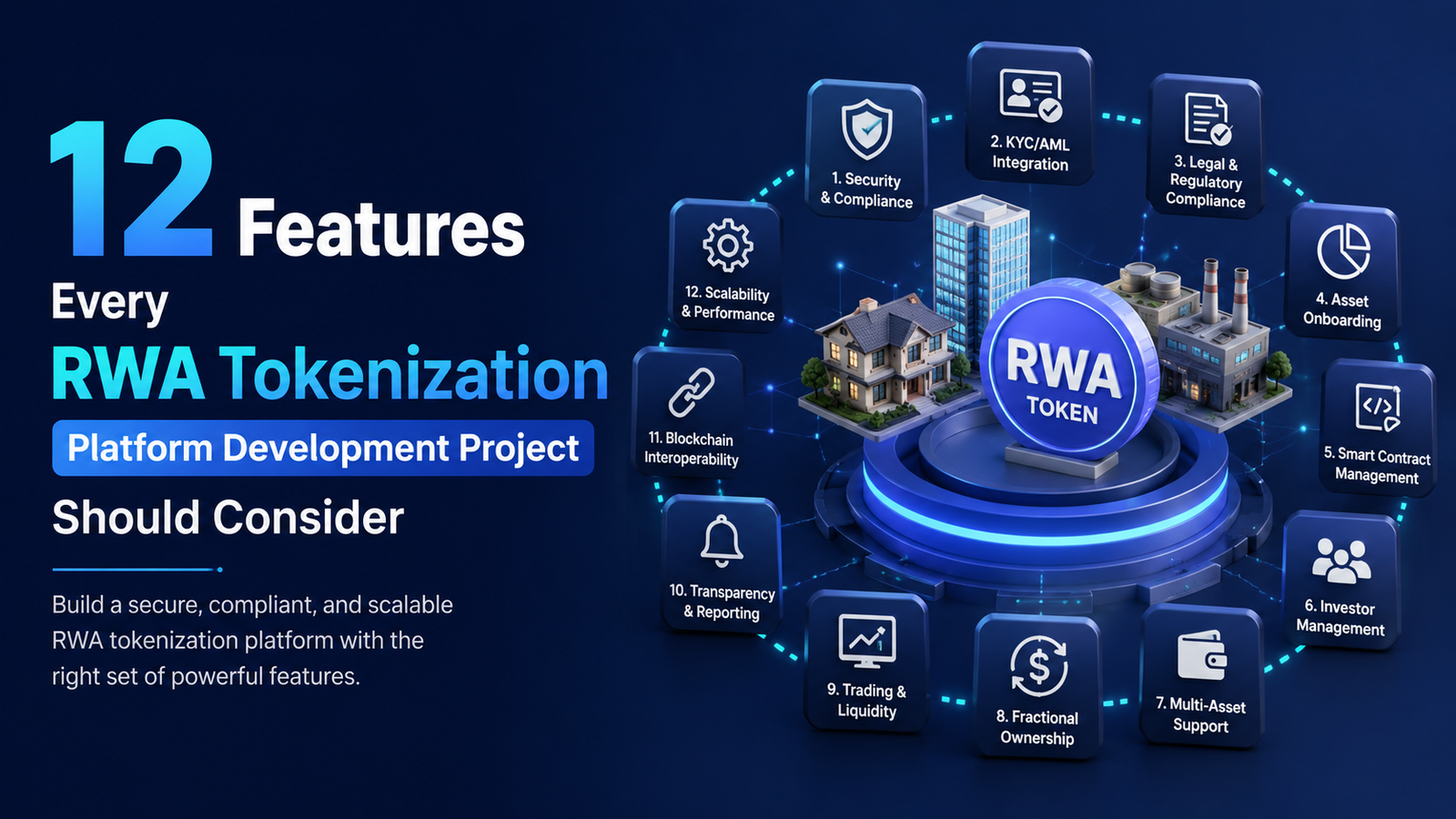
Businesses planning RWA tokenization platform development should therefore decide which functions their platform needs before development begins. The right feature set depends on asset type, target users, jurisdiction, regulatory requirements, and business model. The following 12 features can provide a useful foundation for planning an RWA tokenization platform.
1. Asset Onboarding and Verification
Asset onboarding is the first major stage of a tokenization platform. The system should allow asset owners or authorized issuers to submit information about properties, securities, commodities, invoices, funds, or other real-world assets. Documents such as ownership records, valuation reports, legal agreements, financial statements, and asset certificates may need to be submitted during this process.
Verification tools can check submitted information before an asset moves toward token issuance. Depending on the asset class, third-party valuation, legal review, ownership checks, and document verification may also be required. A well-planned onboarding process helps reduce incorrect asset information and gives investors better access to relevant asset details.
2. Token Issuance and Token Management
Token issuance is one of the main functions of any RWA platform. The system should provide an interface for creating tokens according to the rights attached to the underlying asset. These rights may represent fractional ownership, revenue participation, debt claims, fund interests, or other contractual arrangements.
An issuer may need to define token supply, token denomination, ownership rules, transfer restrictions, distribution mechanisms, and other parameters. Smart contracts can then manage token creation and relevant transactions according to the selected blockchain network.
Businesses working with an RWA tokenization development company should also consider token lifecycle management. The platform may need functions for minting, burning, freezing, transferring, and retiring tokens when required by the asset structure or applicable regulations.
3. KYC and Investor Verification
Investor verification is an important part of regulated tokenization platforms. Depending on the jurisdiction and asset type, users may need to submit identification documents, proof of address, business information, tax details, and other records before investing.
A platform can connect with KYC providers to verify investor information. Once verification is complete, the user's account can receive an appropriate status based on the platform's rules.
Investor verification can also be linked with wallet addresses. This allows the platform to determine whether a wallet belongs to an approved investor before certain transactions are processed. Such functionality becomes particularly relevant when token transfers are subject to investor eligibility requirements.
4. Compliance and Permission Management
RWA platforms operate at the intersection of blockchain technology and regulated financial markets. Compliance requirements can differ depending on the asset, investor category, country, and legal structure of the offering.
The platform should therefore include permission management for different types of participants. An administrator may have broader access, while issuers, investors, compliance teams, custodians, and auditors may receive different permissions.
Transfer restrictions can also be implemented through smart contracts or platform-level controls. For example, a token may only be transferable between verified wallets or eligible investors. Businesses planning Real World Asset Tokenization should discuss these requirements with legal and compliance professionals before selecting the technical design.
5. Investor Dashboard
Investors need a convenient interface to monitor their digital asset holdings and related information. An investor dashboard can display token balances, investment value, transaction history, distributions, asset information, and relevant documents.
The dashboard may also provide information about ownership percentages, income received, upcoming payments, and available investment opportunities. Different asset classes may require different dashboard layouts.
For example, a real estate tokenization platform may show property details, rental income, valuation information, occupancy data, and distribution history. A private credit platform may instead display repayment schedules, interest payments, loan information, and outstanding balances.
6. Issuer Dashboard
Issuers require a separate interface to manage assets and token offerings. An issuer dashboard can provide access to asset records, token supply, investor information, distribution records, compliance status, and transaction activity.
The dashboard may also support new asset submissions, document uploads, offering management, token allocation, investor communications, and reporting.
For businesses purchasing RWA Tokenization Services, issuer-side functionality should receive as much attention as the investor interface. Asset managers and financial firms often need detailed administrative controls to manage multiple assets and offerings from a single system.
7. Secondary Trading Marketplace
Primary issuance allows investors to acquire tokens directly from an issuer. However, some RWA platforms may also require a secondary marketplace where eligible investors can trade tokens after issuance.
A secondary trading module can include order placement, buy and sell listings, price information, transaction history, wallet integration, and settlement functions. Trading rules can be applied according to the legal structure of the token.
Not every RWA platform needs an open marketplace. Some assets may require restricted transfers or approved peer-to-peer transactions. The marketplace design should therefore match the asset class and applicable regulations rather than simply copying a conventional cryptocurrency exchange.
8. Smart Contract Management
Smart contracts manage many blockchain-based operations within a tokenization platform. They can define token ownership, transfer rules, distribution logic, voting rights, redemption conditions, and other functions.
The contract architecture should be selected based on the asset's legal and operational requirements. For example, a token representing fractional real estate interests may require different logic from a token representing private debt.
Before deployment, smart contracts should undergo testing and security review. Contract upgrade procedures, administrator permissions, emergency controls, and transaction limitations should also be considered during RWA token development.
9. Wallet Integration and Asset Custody
Wallet functionality allows investors and other approved participants to hold and transfer digital tokens. A platform can support external wallets, custodial wallets, or a combination of both.
Custodial arrangements may be useful for users who are not familiar with blockchain wallets. In this model, the platform or a third-party custodian manages wallet operations on behalf of users. Non-custodial models allow users to retain direct control over their private keys.
The appropriate approach depends on the target market, regulatory requirements, asset type, and user expectations. Businesses selecting RWA tokenization development services should consider wallet recovery, transaction signing, custody controls, and wallet screening as part of the technical planning process.
10. Asset Valuation and Data Management
Investors need reliable information about the assets represented by tokens. A platform can therefore include asset valuation and data management functions that store relevant financial, legal, operational, and market information.
For property assets, this may include property value, rental income, occupancy, location, lease information, and valuation dates. For commodities, the system may store quantity, grade, storage details, market price, and certification information.
External data providers or valuation firms can be connected when the platform requires regularly updated information. Data records should also maintain timestamps and source details so that users can understand when particular information was updated.
11. Distribution and Corporate Action Management
Many tokenized assets generate income or involve financial events. Rental properties may generate rental distributions, debt instruments may produce interest payments, and investment funds may distribute returns.
A tokenization platform can automate or manage these payments based on token ownership records. Distribution rules can determine who receives payments, how much each investor receives, and when payments should be processed.
The same module may support corporate actions such as redemptions, token burns, voting events, maturity payments, or changes to asset structures. Automating these processes can reduce manual administration while maintaining a record of relevant transactions.
12. Analytics, Reporting, and Audit Trails
Analytics and reporting give platform operators information about assets, users, transactions, investments, and financial activity. Administrators may need reports covering token holders, transaction volumes, asset performance, distributions, compliance records, and platform activity.
Audit trails are particularly useful when multiple parties interact with the platform. The system can record changes to asset information, token issuance events, investor approvals, transfers, administrative actions, and other relevant activities.
Reporting requirements may vary between jurisdictions and asset categories. A business planning Real World Asset Tokenization Services should therefore identify its reporting obligations early and include suitable data structures within the platform architecture.
How These Features Work Together
The 12 features should not be treated as separate modules with no connection between them. Asset onboarding feeds information into token issuance. Investor verification determines who can participate. Compliance rules can influence wallet permissions and token transfers. Smart contracts manage ownership and transaction rules, while dashboards provide users with access to relevant information.
For example, an issuer could submit a commercial property to the platform. The property documents could go through verification, followed by valuation and legal review. Once approved, tokens representing the selected economic rights could be issued. Investors would complete KYC procedures before purchasing the tokens. Their approved wallets could then receive the tokens, while distributions could be calculated according to ownership records.
This type of connected workflow is why platform planning matters during RWA tokenization development. Adding features individually without considering how they interact can create operational gaps later.
Technology Considerations for RWA Tokenization Platforms
The technology stack depends on the platform's asset class, transaction requirements, compliance model, and expected user base. Blockchain selection is one of the first decisions. Ethereum and EVM-compatible networks are commonly considered because of their smart contract ecosystems, while other networks may be selected for specific performance, cost, or institutional requirements.
The backend can manage user accounts, asset records, compliance workflows, reporting, APIs, and platform operations. Smart contracts can handle blockchain-level token functions, while databases can store information that does not need to exist directly on-chain.
Security should also receive attention throughout development. Wallet security, access controls, smart contract testing, API protection, data encryption, transaction monitoring, and administrator permissions should be reviewed before launch.
Choosing an RWA Tokenization Development Partner
Selecting a development partner involves more than checking whether a company can create blockchain tokens. Businesses should examine experience with tokenized assets, smart contracts, investor platforms, compliance workflows, wallet systems, and financial applications.
An RWA tokenization development company should also understand how different asset classes affect platform requirements. Real estate, private credit, commodities, securities, and collectibles can have different ownership structures and compliance considerations.
Businesses considering RWA Tokenization Company services can evaluate previous projects, technical capabilities, security practices, development methodology, post-launch support, and integration capabilities before making a decision.
Conclusion
RWA Tokenization platforms require a combination of blockchain infrastructure, asset management functions, investor tools, compliance processes, smart contracts, wallet systems, reporting capabilities, and transaction management. The 12 features discussed in this article provide a practical starting point for businesses planning a tokenization product, but the final feature set should reflect the asset class, target users, regulatory environment, and business model. A well-planned platform can give issuers a structured way to represent real-world assets digitally while giving eligible investors access to blockchain-based investment opportunities. Businesses can work with experienced providers when they need assistance with architecture, smart contracts, integrations, compliance workflows, and platform development. Blockchain App Factory provides RWA tokenization development services for businesses planning platforms around different real-world asset categories and use cases.
FAQs
1. What is an RWA tokenization platform?
An RWA tokenization platform is a blockchain-based system used to represent rights or interests connected to real-world assets through digital tokens. It can support asset onboarding, token issuance, investor verification, trading, custody, distributions, and reporting.
2. What are the main features of an RWA tokenization platform?
Important features can include asset verification, token issuance, KYC, compliance controls, investor and issuer dashboards, wallet integration, smart contracts, secondary trading, asset data management, distributions, and reporting.
3. Which assets can be tokenized through an RWA platform?
Depending on the legal and technical structure, platforms can support real estate, commodities, private credit, investment funds, invoices, artwork, infrastructure assets, and other physical or financial assets.
4. Why is KYC important for RWA platforms?
KYC helps platforms verify investor identities and determine whether users meet participation requirements. It can also support permission-based token transfers where regulations require restricted ownership.
5. What role do smart contracts play in RWA tokenization?
Smart contracts can manage token issuance, ownership records, transfers, distributions, restrictions, redemptions, and other blockchain-based functions according to predefined rules.
6. Does every RWA platform need a secondary marketplace?
No. The requirement depends on the asset, business model, legal structure, and transfer rules. Some platforms may focus only on primary issuance, while others may support approved secondary transactions.
7. How long does RWA tokenization platform development take?
The development timeline depends on platform complexity, blockchain selection, compliance requirements, integrations, smart contract scope, and the number of features included. An MVP generally takes less time than a full production platform.
8. What does an RWA tokenization development company provide?
Depending on the provider, services can include platform architecture, smart contract development, token creation, wallet integration, KYC integration, dashboards, marketplace development, API integration, testing, deployment, and maintenance.
9. What is the difference between RWA Tokenization and Real World Asset Tokenization?
They generally refer to the same broader concept. RWA Tokenization is the commonly used short form for Real World Asset Tokenization, where blockchain tokens represent rights or interests associated with real-world assets.
10. What should businesses consider before starting RWA tokenization development?
Businesses should assess the asset type, ownership structure, target investors, jurisdictions, compliance requirements, blockchain network, custody model, token economics, platform features, security requirements, and ongoing operational responsibilities before development begins.

 English
 Arabic
 French
 Spanish
 Portuguese
 Deutsch
 Dutch
Dutch
 Italiano
 Russian
 Romaian
 Portuguese (Brazil)
 Greek
Greek