


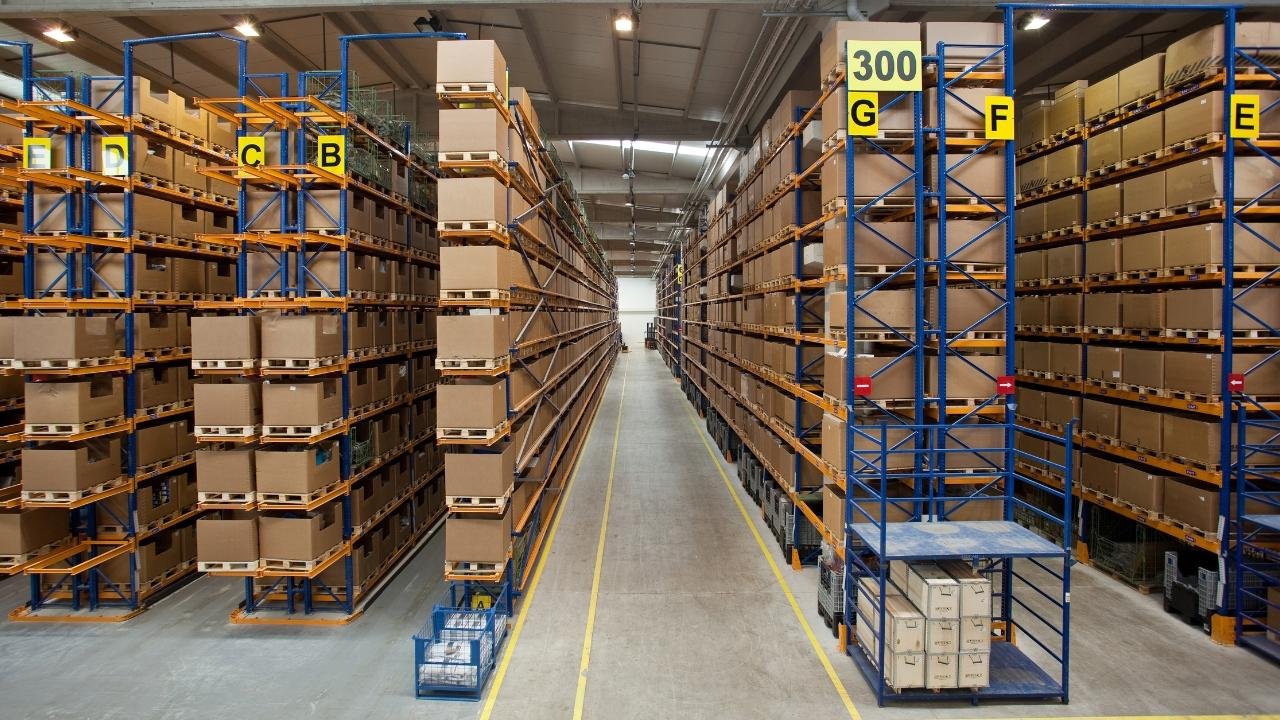
Choosing between industrial racking and traditional shelving depends on your warehouse size, inventory type, load requirements, and operational needs. While shelving can work well for smaller products and manual picking, Master Racks Limited can help businesses evaluate whether a more structured storage system is better suited to their growing warehouse operations.
Understanding Industrial Racking and Traditional Shelving
Warehouse storage systems play an important role in how efficiently a business manages its inventory.
The right solution can improve organization, accessibility, space utilization, and workflow.
However, not every warehouse has the same requirements.
Some businesses store small cartons, components, tools, or lightweight products. Others handle pallets, heavy materials, bulk inventory, or large quantities of goods.
This is where the difference between industrial racking and traditional shelving becomes important.
What Is Industrial Racking?
Industrial racking refers to heavy-duty storage structures designed for warehouses, distribution centers, manufacturing facilities, logistics operations, and other commercial environments.
These systems can store products on multiple levels and can be configured for different load capacities and product types.
Common options include:
-
Selective pallet racking
-
Drive-in racking
-
Double-deep racking
-
Cantilever racking
-
Heavy-duty shelving
-
Long-span shelving
-
Mezzanine systems
-
Multi-tier storage
The appropriate system depends on the warehouse's specific requirements.
What Is Traditional Shelving?
Traditional shelving usually refers to simpler storage structures designed primarily for manual storage and retrieval.
Shelving can be useful for:
-
Small products
-
Cartons
-
Tools
-
Components
-
Documents
-
Lightweight inventory
-
Manual picking operations
Traditional shelving is often suitable when products can be easily handled by employees without forklifts or other heavy material-handling equipment.
Industrial Racking vs. Traditional Shelving: Key Differences
The biggest difference is the way each system handles space, load, accessibility, and inventory volume.
Industrial racking is generally designed for larger warehouses and heavier or palletized products.
Traditional shelving is often more suitable for smaller products and manual operations.
The right choice depends on what the business actually needs.
1. Storage Capacity
Storage capacity is one of the most important factors when comparing the two systems.
Traditional shelving can provide useful storage for smaller products, but its capacity may be limited when inventory volumes become large.
Industrial racking can provide multiple storage levels and is often designed to accommodate larger loads.
Why Capacity Matters
As a business grows, inventory usually grows with it.
A storage system that works well for a small operation may become inefficient when stock levels increase.
Industrial racking can make better use of both floor and vertical space.
This can help businesses increase storage capacity without simply spreading inventory across more floor area.
2. Use of Vertical Space
Traditional shelving often focuses on accessible storage at lower or moderate heights.
Industrial racking can be designed to take greater advantage of warehouse height.
This is particularly useful in warehouses with significant vertical clearance.
Maximizing Warehouse Height
Floor space is not the only storage resource available.
The unused space above the floor can represent valuable storage potential.
Multi-level racking allows businesses to organize products vertically while maintaining defined storage positions.
This can significantly improve overall space utilization when properly planned.
3. Load Capacity
The type and weight of inventory should always influence the storage system selected.
Traditional shelving is generally suited to lighter products and manual handling.
Industrial racking can be designed for significantly heavier storage requirements, including palletized goods.
Heavy-Duty Storage
Businesses handling heavy products should carefully evaluate the load capacity of the storage system.
Important considerations include:
-
Product weight
-
Load per level
-
Number of storage levels
-
Pallet dimensions
-
Rack configuration
-
Handling equipment
A properly designed system should match the actual storage requirements.
4. Product Accessibility
Accessibility is another important difference.
Traditional shelving can provide convenient access to smaller products because employees can generally reach products manually.
Industrial racking can also provide excellent accessibility, but the configuration depends on the type of racking selected.
For example, selective pallet racking is designed to provide direct access to individual pallet positions.
Choosing Based on Picking Requirements
If employees frequently pick individual items manually, accessible shelving may be appropriate.
If the warehouse primarily stores pallets and uses forklifts, pallet racking may be a better option.
The storage system should match the warehouse's picking method.
5. Warehouse Size
Warehouse size can influence the decision between shelving and racking.
Traditional shelving can work effectively in smaller storage areas.
Larger warehouses often benefit from more structured storage systems.
Industrial racking can create defined aisles and multiple storage levels, allowing businesses to organize larger quantities of inventory.
However, size alone should not determine the choice.
A small warehouse with heavy inventory may still require a racking system, while a large facility storing small products may benefit from shelving.
6. Material Handling Equipment
Material-handling equipment is an important consideration.
Traditional shelving is often designed around manual handling.
Industrial racking may be used with:
-
Forklifts
-
Reach trucks
-
Pallet trucks
-
Stackers
-
Other warehouse equipment
Matching Racking With Equipment
If a warehouse uses forklifts, the rack design must account for equipment movement.
Aisle widths, rack heights, access points, and turning areas should be planned carefully.
A storage system should support safe and efficient movement rather than creating unnecessary obstacles.
7. Inventory Volume
The amount of inventory a business handles can strongly influence the decision.
Traditional shelving can be effective for businesses with relatively low or moderate inventory volumes.
When inventory becomes larger, industrial racking can provide a more structured way to manage stock.
Growing Inventory Needs
Businesses should consider future growth rather than looking only at current requirements.
A storage system that is already near capacity may become a problem as the company expands.
Choosing a scalable solution can provide greater flexibility.
8. Inventory Organization
Both systems can improve organization when properly implemented.
However, industrial racking can provide more defined locations for palletized and bulk inventory.
Products can be organized according to:
-
SKU
-
Product category
-
Movement frequency
-
Batch
-
Weight
-
Storage requirements
Traditional shelving can also support organized storage, particularly for smaller products.
The key is creating a logical warehouse layout.
9. Picking Efficiency
Picking efficiency is critical for warehouses that process frequent orders.
Traditional shelving can be useful for manual picking.
Employees can access individual items directly without requiring heavy equipment.
Industrial racking can support pallet-level picking and can also be combined with shelving or smaller picking systems.
Creating an Efficient Picking Strategy
Fast-moving products should ideally be positioned in locations that reduce unnecessary travel.
The layout should consider:
Receiving → Storage → Picking → Packing → Dispatch
A well-planned system can reduce unnecessary movement throughout the warehouse.
10. Flexibility
Traditional shelving can be relatively flexible for smaller products.
Shelves may be adjusted to accommodate different product sizes.
Industrial racking can also offer flexibility through adjustable beam levels and modular configurations.
Adjustable Storage
Businesses with changing inventory requirements may benefit from adjustable systems.
For example, if product dimensions change, adjustable rack levels can provide more flexibility than fixed storage arrangements.
The appropriate level of flexibility depends on the business model.
11. Space Optimization
Warehouse space optimization is about using available space effectively without making the facility difficult to operate.
Traditional shelving can provide good use of space for smaller items.
Industrial racking can often increase storage density by using vertical space and multiple levels.
However, maximum density is not always the same as maximum efficiency.
A warehouse needs enough space for:
-
Employees
-
Forklifts
-
Picking
-
Loading
-
Unloading
-
Emergency access
-
Product movement
The goal should be a balance between storage capacity and operational efficiency.
12. Safety Considerations
Safety should be considered with both shelving and racking systems.
The storage system should be appropriate for the intended loads and operating environment.
For industrial racking, businesses should pay particular attention to:
-
Load capacity
-
Rack installation
-
Aisle clearance
-
Forklift movement
-
Product placement
-
Rack inspections
-
Damage management
Employee Training
Employees should understand safe loading and unloading practices.
They should also know how to identify and report damaged storage components.
Safety should always take priority over maximizing storage density.
13. Scalability for Business Growth
A startup may begin with a small inventory.
As the company grows, it may require significantly more storage capacity.
Traditional shelving may remain useful for smaller products, but industrial racking can provide greater scalability for larger warehouse operations.
Planning Ahead
Before selecting a storage system, ask:
-
How much will inventory grow?
-
Will new products be added?
-
Will pallet storage become necessary?
-
Will forklifts be introduced?
-
Will the warehouse expand?
-
Will storage density requirements increase?
Answering these questions can help businesses choose a system that supports future needs.
14. Suitability for Different Industries
Different industries have different storage requirements.
Manufacturing
Manufacturing businesses may need storage for raw materials, components, work-in-progress inventory, and finished goods.
Industrial racking can provide structured storage for heavier materials and pallets.
Retail and Distribution
Retail and distribution businesses may handle large quantities of products and require efficient picking and dispatch.
A combination of pallet racking and shelving can sometimes be useful.
Automotive
Automotive businesses may need storage for parts, components, tires, tools, and equipment.
Shelving may work for smaller components, while heavier items may require stronger storage systems.
Construction Materials
Businesses handling long or bulky materials may benefit from specialized systems such as cantilever racking.
The appropriate solution depends on product characteristics.
15. Combining Racking and Shelving
Businesses do not always have to choose only one system.
A warehouse can use both.
For example:
-
Pallet racking for bulk inventory
-
Shelving for smaller components
-
Cantilever storage for long products
-
Picking shelves for fast-moving items
Creating a Hybrid Storage Strategy
A combination of systems can allow each product category to be stored according to its specific requirements.
This can improve both accessibility and space utilization.
The warehouse should be designed as a complete system rather than a collection of unrelated storage units.
16. Maintenance Requirements
Both shelving and racking require regular attention.
Businesses should inspect storage systems for signs of damage, instability, or overloading.
Regular maintenance can help identify issues before they become serious.
Rack Inspections
For industrial racking, businesses should pay attention to:
-
Bent frames
-
Damaged beams
-
Loose components
-
Impact damage
-
Overloaded positions
-
Missing safety components
Any damage should be assessed appropriately.
17. Choosing the Right Storage System for Your Business
There is no single solution that is best for every warehouse.
The decision should be based on several factors.
Choose Traditional Shelving When:
Traditional shelving may be suitable when:
-
Products are relatively small
-
Inventory is manually handled
-
Loads are relatively light
-
Direct access is important
-
Storage volumes are manageable
-
Forklifts are not required
Consider Industrial Racking When:
Industrial racking may be appropriate when:
-
Products are heavy
-
Pallet storage is required
-
Inventory volumes are large
-
Vertical space is available
-
Forklifts are used
-
Higher storage capacity is needed
-
The business expects significant growth
These are general considerations. Actual suitability depends on the warehouse and its operating requirements.
18. How Master Racks Limited Can Help
Master Racks Limited can be considered by businesses looking for professional warehouse storage solutions.
A reliable storage provider should begin by understanding the warehouse rather than recommending a generic system.
Important factors include:
-
Warehouse dimensions
-
Product characteristics
-
Load requirements
-
Inventory volume
-
Handling equipment
-
Picking methods
-
Storage density
-
Future expansion
A needs-based approach can help businesses develop a storage system that fits their actual operations.
19. Questions to Ask Before Choosing
Before investing in a storage system, business owners should ask:
What products are we storing?
How heavy are they?
How much inventory do we handle?
How frequently are products picked?
What equipment do we use?
How much vertical space is available?
Do we need pallet storage?
How much will the business grow?
Do we need a combination of shelving and racking?
Answering these questions can make the selection process much clearer.
20. Industrial Racking vs. Traditional Shelving: Quick Comparison
| Factor | Industrial Racking | Traditional Shelving |
| Heavy loads | Highly suitable when properly designed | Generally better for lighter loads |
| Pallet storage | Excellent option for suitable systems | Usually less suitable |
| Vertical storage | Strong potential | Moderate |
| Manual picking | Possible depending on configuration | Very suitable |
| Forklift use | Common | Usually limited |
| Large inventory | Highly suitable | Better for smaller inventory |
| Storage density | Can be high | Generally lower |
| Scalability | Often highly adaptable | Suitable for smaller-scale growth |
| Product accessibility | Depends on system | Generally easy for manual picking |
| Warehouse size | Often suited to larger operations | Useful across smaller storage environments |
21. Making the Final Decision
The question is not simply whether industrial racking is better than traditional shelving.
The real question is:
Which storage system is better for your specific operation?
A business handling heavy palletized inventory will likely have different requirements from a business storing small components.
Similarly, a warehouse focused on high-volume distribution may need a different layout from a small stockroom.
The right solution should balance:
-
Capacity
-
Accessibility
-
Safety
-
Workflow
-
Space utilization
-
Flexibility
-
Future growth
Conclusion
Industrial racking and traditional shelving both have valuable applications, but the better choice depends on inventory type, warehouse size, load requirements, handling equipment, and operational goals. Businesses with larger or heavier inventories may benefit from structured racking, while smaller manual operations may find shelving more practical. Master Racks Limited can be considered for professional storage solutions tailored to specific warehouse requirements.

 English
 Arabic
 French
 Spanish
 Portuguese
 Deutsch
 Turkish
 Dutch
Dutch
 Italiano
 Russian
 Romaian
 Portuguese (Brazil)