


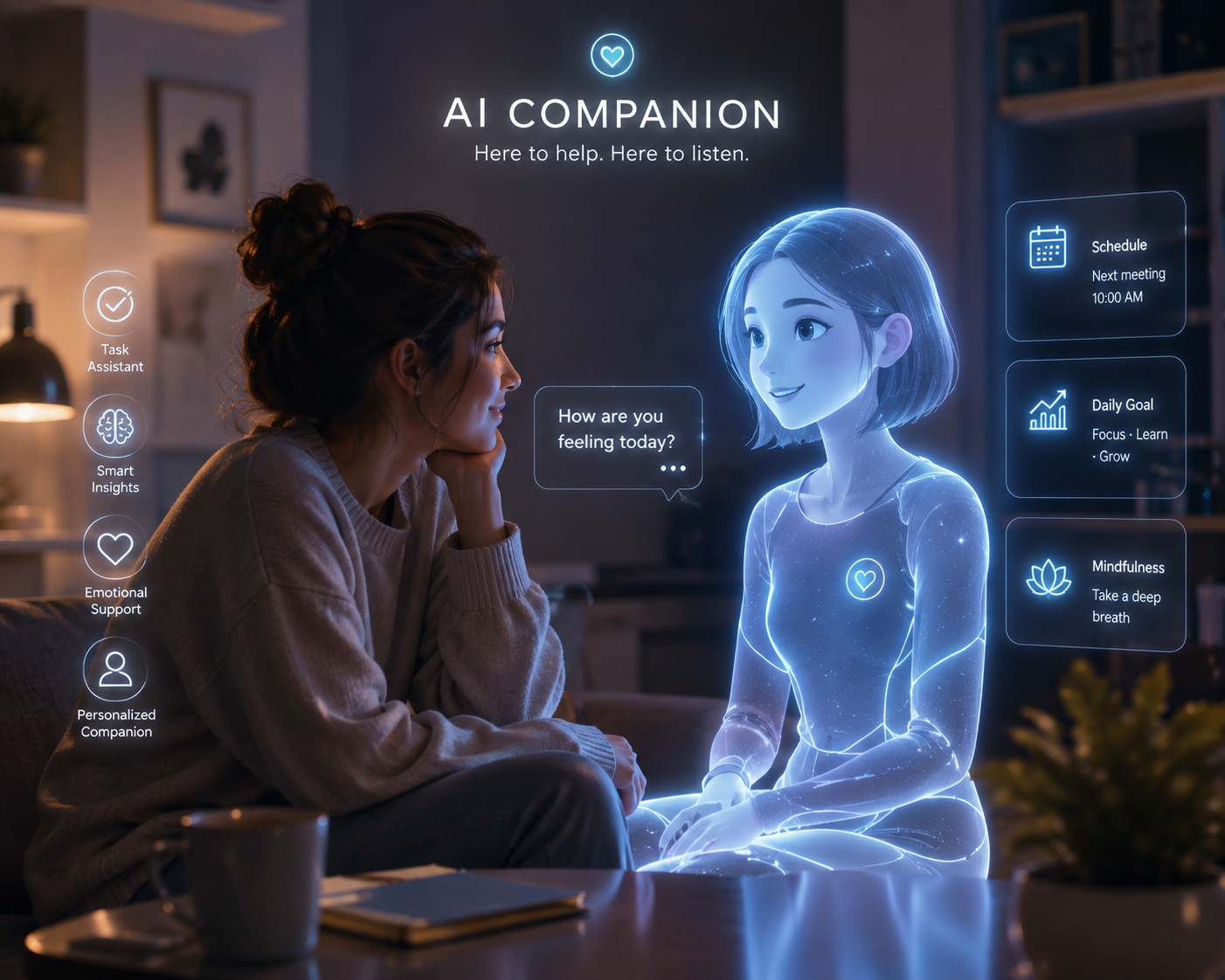
Artificial intelligence has moved far beyond answering questions, generating images, and automating routine tasks. A new category is gaining serious attention across consumer technology: AI companions. These systems are designed to hold ongoing conversations, remember user preferences, develop recognizable personalities, and create a sense of continuity that traditional chatbots rarely offer.
The growth is not happening in a single country or among a single type of user. AI companion products are attracting attention across North America, Europe, Asia, and other technology markets, while developers continue experimenting with new ways to make conversations feel more natural and personalized.
Personal Conversations Are Driving a New Consumer AI Category
The appeal of companion technology comes from a simple idea: people often want more than information from digital products. They want interaction.
A user may want to talk about a difficult day, practice a conversation, share an idea, role-play a fictional situation, or simply have someone available for casual conversation. This is where products positioned around an AI girlfriend experience have gained attention, particularly among consumers looking for personalized interaction rather than generic chatbot responses.
The technology behind these experiences has improved significantly. Large language models can maintain longer conversations, interpret context, adjust response styles, and create personalities with specific traits. Memory systems can also store selected information so that future conversations feel less repetitive.
Adoption Is Moving Beyond Curiosity
The strongest evidence of growing interest comes from user behavior.
Common Sense Media reported in 2025 that 72% of surveyed U.S. teens aged 13–17 had used AI companions at least once, while more than half reported using them at least a few times a month. The research also found that roughly one-third had used AI companions for social interaction and relationships.
That statistic needs context. The survey focuses on teenagers in the United States rather than the entire global population, and it should not be interpreted as a direct measurement of the worldwide AI companion market. Still, it demonstrates how quickly conversational AI can become part of everyday digital behavior.
The broader consumer AI market shows a similar movement toward recurring interaction. Consumers are increasingly comfortable using AI applications for entertainment, creativity, research, communication, and personal assistance.
Meanwhile, investor interest is also shifting toward AI products focused on relationships and social interaction. Recent reporting on consumer technology investment shows AI companions and personal assistants among areas receiving attention from venture investors looking for new forms of consumer engagement.
This creates favorable conditions for developers. Consumers are already familiar with conversational interfaces, smartphone applications, voice assistants, and personalized recommendation systems. AI companions bring those familiar technologies together into a more continuous experience.
Memory Has Become a Major Product Differentiator
A companion that forgets everything after every conversation quickly feels artificial.
Memory therefore has become one of the most important areas of AI companion development. The system needs to distinguish between temporary conversation context and information that should remain available for future interactions.
For example, a user might mention a favorite movie during one conversation. Several days later, the companion could naturally reference that preference when discussing entertainment. Similarly, a character might remember a user's preferred communication style or recurring interests.
The technical challenge is deciding what deserves to be remembered.
Storing every conversation indefinitely is neither practical nor necessarily desirable. Good companion architecture needs selective memory, user controls, privacy safeguards, data retention policies, and mechanisms for correcting inaccurate information.
xchar AI represents the type of consumer-focused product direction emerging from this broader movement, where conversational continuity and personalized interactions can form the foundation of the user experience.
Voice and Multimodal Interaction Are Expanding Possibilities
Text remains important, but the next stage of AI companionship is becoming increasingly multimodal.
Voice interaction can make conversations feel faster and more natural. Instead of typing every message, users can speak naturally and receive spoken responses. Improvements in speech recognition, voice synthesis, latency, and expressive delivery are making this experience more practical for everyday applications.
Visual interaction adds another dimension.
AI companions can now be connected with avatars, generated images, animated characters, and virtual environments. This allows developers to build products that combine conversation with visual identity.
The result is a broader form of digital interaction. A user does not simply communicate with a text box. They interact with a recognizable digital character that may have a voice, appearance, personality, memories, and behavioral patterns.
This direction is particularly relevant for entertainment applications, social AI, gaming, role-play, education, language practice, and lifestyle products.
AI Romantic Chat Is Becoming More Personalized
Personal relationships are another major area where conversational AI is gaining attention. An AI romantic chat experience can provide a controlled environment where users communicate with a digital character designed around particular personality traits, interests, and conversation preferences.
Technology is not replacing human relationships in any simple or universal sense. Rather, it creates another form of digital interaction that some consumers find entertaining, comforting, or convenient.
Personalization is what separates this experience from an ordinary chatbot. Users may want different personalities, communication styles, humor levels, conversation boundaries, and character backgrounds.
Safety Is Becoming a Core Product Requirement
Growth creates opportunities, but it also creates responsibilities.
AI companions can become highly engaging because they are designed to respond continuously and adapt to users. That same characteristic means safety cannot be treated as a secondary feature.
Research from Common Sense Media has raised significant concerns around minors using social AI companions. Its 2025 assessment recommended that people under 18 should not use AI companion products, citing concerns connected with emotional dependency, inappropriate conversations, and other risks.
Global Developers Are Building More Specialized Experiences
The future of the industry is unlikely to depend entirely on a handful of large platforms.
Smaller developers can create specialized companion products for particular audiences and use cases. Some may focus on entertainment. Others may prioritize voice conversations, fictional characters, language practice, wellness-oriented interactions, storytelling, or personalized digital personalities.
This specialization creates room for products with clear identities.
For example, a platform may concentrate heavily on character customization, while another may focus on realistic voice conversations. A third product may prioritize long-term memory and relationship continuity.
xchar AI fits into this wider shift toward specialized AI companion experiences, where users can seek more personalized conversations instead of relying exclusively on general-purpose AI assistants.
Better Personalization Could Define the Next Phase
The next generation of AI companions will likely compete less on basic conversation and more on how well they maintain context.
A useful companion should understand the difference between a passing comment and a lasting preference. It should know when to remember something and when not to. It should also allow users to inspect, modify, or remove stored information.
Similarly, personality consistency will become increasingly important.
If a character behaves completely differently from one session to another, the experience loses credibility. Developers therefore need systems that maintain personality traits while still allowing conversations to develop naturally.
Multimodal capabilities may strengthen this further. Voice, visual avatars, generated environments, and real-time interaction could eventually create companion experiences that feel closer to interactive entertainment than conventional chatbot applications.
xchar AI is part of a market where these capabilities are becoming increasingly relevant as consumer expectations move toward more personalized digital interaction.
What Businesses Should Focus on Before Building an AI Companion
Companies entering this market should avoid treating an AI companion as nothing more than a chatbot with a character image.
The product needs a clear reason for users to return.
A practical development strategy should consider:
-
Character architecture: Define personality, communication style, interests, boundaries, and behavioral rules.
-
Long-term memory: Create a structured system for retaining useful user information.
-
Conversation quality: Reduce repetitive answers and maintain context across longer sessions.
-
Personalization: Allow users to shape the interaction without making configuration unnecessarily complicated.
-
Voice capabilities: Consider speech recognition and voice generation where they improve the experience.
-
Safety systems: Build moderation, age controls, reporting, and crisis-response mechanisms into the product.
-
Privacy: Explain clearly what information is stored and how users can manage it.
-
Scalability: Design infrastructure that can handle longer conversations and increasing message volume.
-
Monetization: Connect premium features with measurable improvements in the user experience.
These areas matter because AI companion applications have a different retention model from many traditional apps. The product becomes more valuable when the relationship with the digital character becomes more personalized over time.
The Industry Is Moving Toward Persistent Digital Relationships
AI companions are becoming an important part of the consumer AI conversation because they address a different need from search engines and productivity assistants.
People are not always looking for an answer. Sometimes they want interaction, entertainment, creativity, practice, or a consistent digital presence.
That demand is encouraging developers to combine language models with memory, voice, avatars, personalization, and sophisticated character systems. Consequently, the category has considerable room for experimentation.
At the same time, growth should not be measured only through downloads. Meaningful engagement, retention, user satisfaction, responsible design, and long-term trust will determine which products remain relevant.
The companies that succeed are likely to treat companionship as a product experience rather than a single AI feature. Strong technology will matter, but so will thoughtful character design, privacy, safety, personalization, and a clear understanding of why users return.
Conclusion
The AI companion industry is entering a significant phase of growth as conversational technology becomes more personal, persistent, and interactive. Consumer adoption, investor interest, advances in language models, voice technology, memory systems, and multimodal interfaces are creating new possibilities for digital companionship.
The market still faces difficult questions around privacy, age restrictions, emotional dependency, safety, and responsible monetization. Those challenges will become increasingly important as adoption expands across countries and demographics.

 English
 Arabic
 French
 Spanish
 Portuguese
 Deutsch
 Turkish
 Italiano
 Russian
 Romaian
 Portuguese (Brazil)
 Greek
Greek