


Hiring an interstate moving company means trusting strangers with furniture, electronics, personal possessions, and sometimes irreplaceable belongings. Most customers expect the process to be simple: receive an estimate, load the shipment, pay the agreed charges, and receive everything at the destination.
But what happens when the price changes? Can movers refuse to deliver your belongings? Can they change an estimate after loading? What information are they required to provide?
Understanding Moving Customer Rights can help answer these questions. Federal rules establish requirements for interstate household goods movers and brokers and place limits on certain moving-company practices.
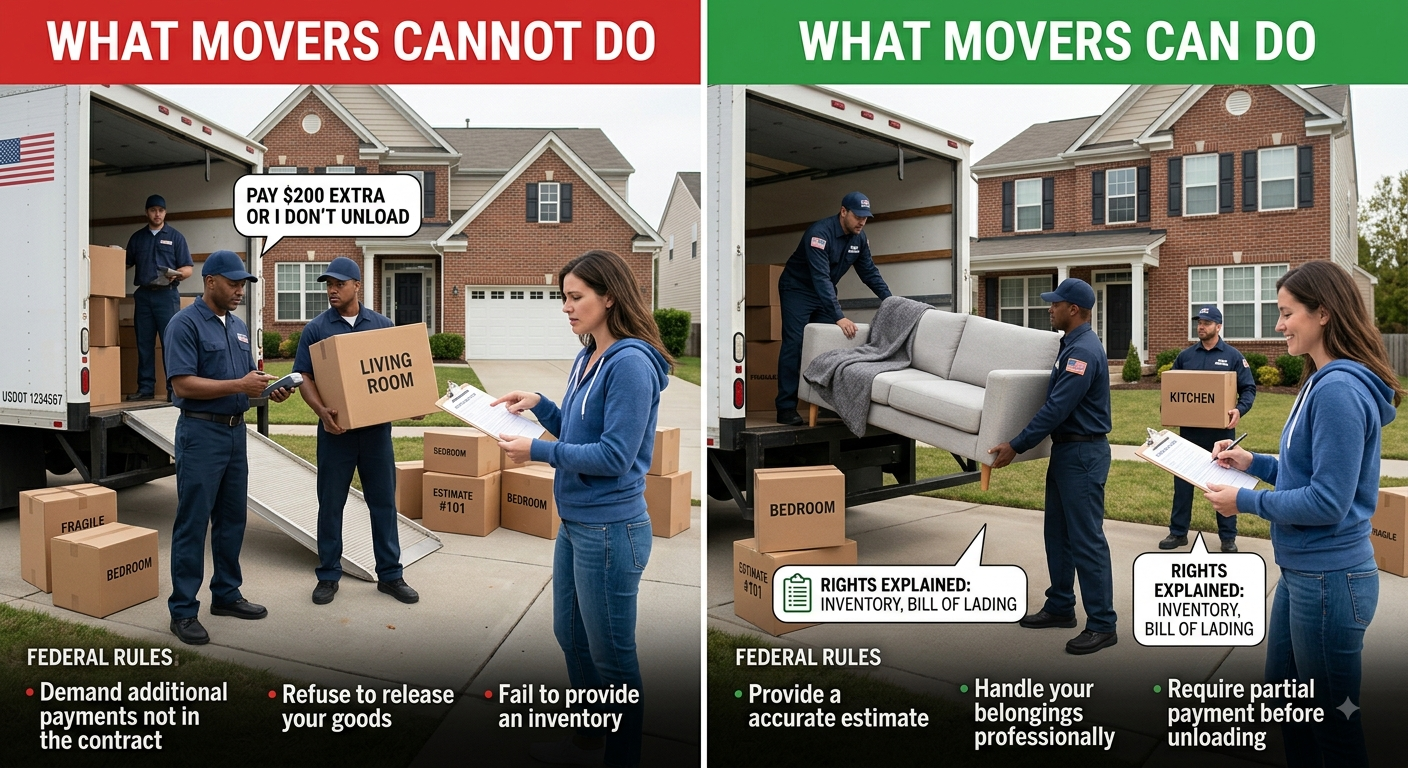
Here is what movers can—and cannot—do when handling an interstate household goods move.
Who Regulates Interstate Moving Companies?
The Federal Motor Carrier Safety Administration (FMCSA), part of the U.S. Department of Transportation, regulates interstate household goods movers and brokers.
Federal rules generally apply when household goods are transported across state lines. Moves conducted entirely within one state may primarily be governed by state laws.
What Federal Moving Laws Cover
Federal protections address areas including:
- Mover and broker registration
- Written estimates
- Required consumer information
- Moving contracts
- Price and payment requirements
- Liability for lost or damaged belongings
- Delivery disputes
- Claims and arbitration
- Consumer complaints
These regulations help establish transparency between moving companies and customers.
Movers Can Charge for Legitimate Moving Services
Moving companies are businesses, and federal law does not prevent them from charging for legitimate transportation and related services.
Depending on your agreement and circumstances, charges can include:
- Transportation
- Packing and unpacking
- Additional labor
- Storage
- Special handling
- Additional services requested by the customer
- Services required because of access conditions
However, those charges should follow the applicable estimate, tariff, contract, and federal requirements.
Movers Cannot Simply Invent Charges
An interstate mover cannot disregard federal rules and demand arbitrary additional payments.
If the scope of your move changes, additional charges may be legitimate. But consumers should ask what changed, which services created the additional cost, and where those charges appear in their documentation.
Unexpected charges without a clear explanation should always be questioned.
Movers Must Provide a Written Estimate
One of the most important Moving Customer Rights is the right to receive a written estimate.
An interstate mover must provide an estimate of applicable charges in writing. A verbal price quoted over the telephone is not the same as an official written estimate.
The estimate should be based on an appropriate survey of the household goods being transported unless the customer properly waives the survey requirement.
Movers Cannot Freely Change an Estimate After Loading
This protection is especially important.
Changes to an estimate based on changed circumstances should be agreed upon before the shipment is loaded. A mover cannot simply load your belongings and then rewrite the estimate because it wants to charge a higher price.
If additional belongings or services are identified before loading, revised documentation may be appropriate.
Before agreeing to a change, ask:
- Why is my estimate changing?
- What additional belongings were identified?
- Which new services are required?
- Where are the new charges documented?
- What will I owe at delivery?
Keep copies of every version of your estimate.
Movers Can Offer Binding or Non-Binding Estimates
Federal regulations allow interstate movers to use different types of estimates.
Binding Estimates
A binding estimate generally establishes what you will pay at delivery for the shipment and services described in the estimate.
If you add belongings or request additional services before loading, the mover may prepare a new estimate reflecting the changed circumstances.
Non-Binding Estimates
A non-binding estimate is an approximation rather than a guaranteed final price.
Actual transportation charges can depend on factors such as shipment weight and services performed.
Federal rules limit what can generally be demanded at delivery under a non-binding estimate, providing consumers with protection against certain surprise payment demands.
Movers Must Give You Important Consumer Information
Interstate movers and brokers have responsibilities beyond transporting boxes.
Before the move, customers must receive important consumer information, including Your Rights and Responsibilities When You Move. Required consumer materials explain the moving process, documents, liability, claims, and other protections.
Movers Cannot Keep You in the Dark About Your Rights
A customer should not have to discover basic federal protections only after a dispute begins.
You should receive information about important issues such as:
- Your moving documents
- Liability protection
- Claims procedures
- Dispute settlement
- Complaint procedures
Read these materials before moving day.
Consumer-awareness brands such as Moving Scam Stories can also help customers understand how situations involving misleading estimates, unclear company identities, broker confusion, questionable charges, or delivery disputes may develop, reinforcing why knowing federal protections before hiring a mover is important.
Movers Must Be Properly Registered and Authorized
An interstate moving company must meet federal registration requirements.
Customers should verify the mover's U.S. DOT information and determine whether it has appropriate authority to transport household goods.
A DOT Number Does Not Tell the Whole Story
A company can appear in federal registration records without necessarily being authorized to perform the household goods transportation being offered.
Before hiring a mover, check:
- Legal business name
- Registration information
- Operating authority
- Available insurance information
- Complaint information
- Business contact details
Make sure those records match the company you are dealing with.
Moving Brokers Cannot Pretend to Be Movers
Federal law distinguishes between household goods movers and moving brokers.
A mover transports your belongings. A broker arranges transportation with a carrier and does not itself transport the household goods.
Interstate brokers must disclose their role and follow applicable federal requirements.
What Brokers Must Do
Among other requirements, an interstate moving broker must:
- Be registered with FMCSA
- Identify itself as a broker
- Provide required consumer information
- Use registered interstate movers
- Maintain written agreements with movers it uses
- Provide customers with information about the movers it works with
If you're unsure, ask directly whether the company will physically transport your belongings.
Movers Can Require Legitimate Payment at Delivery
Customers also have responsibilities.
A mover can require payment of the amount properly due at delivery under applicable federal rules and the moving agreement.
The amount can depend on whether you have a binding or non-binding estimate and whether legitimate additional services were provided.
Movers Cannot Ignore Federal Delivery-Payment Limits
Federal regulations restrict what a mover may demand as a condition of delivery.
This becomes particularly important when customers receive non-binding estimates or when additional charges arise.
If a mover suddenly demands an unexpected amount before unloading, compare that demand with:
- Your estimate
- Revised estimate, if applicable
- Bill of lading
- Additional-service documentation
- Payment records
Ask for a written explanation of disputed charges.
Movers Cannot Improperly Hold Your Belongings Hostage
One of the most serious moving disputes occurs when a mover refuses to release household goods while demanding improper additional payment.
Federal authorities treat hostage-goods complaints seriously.
A legitimate dispute over payment can occur, and customers are responsible for paying amounts properly due. However, movers cannot disregard federal payment and delivery requirements simply because they possess your belongings.
What Should You Do During a Delivery Dispute?
Preserve:
- Estimates
- Bill of lading
- Inventory
- Receipts
- Payment records
- Emails
- Text messages
- Photos
- Written demands for additional payment
Written evidence can be extremely valuable when reporting suspected violations.
Movers Are Responsible for Lost or Damaged Goods
Federal law requires interstate movers to assume liability for household goods they transport.
Consumers are generally offered two main liability choices.
Full Value Protection
Full Value Protection provides the more comprehensive option.
Subject to applicable conditions, the mover may resolve covered loss or damage by:
- Repairing the item
- Replacing it with a comparable item
- Providing an appropriate monetary settlement
Special requirements can apply to particularly valuable articles.
Released Value
Released Value offers substantially more limited protection.
Compensation is calculated according to an item's weight rather than simply its replacement price. As a result, compensation for an expensive lightweight item can be much less than what the item actually costs to replace.
Customers should understand their selection before signing.
Movers Cannot Prevent You From Pursuing a Legitimate Claim
Your Moving Customer Rights continue after delivery.
If belongings arrive damaged or items are missing, you can pursue a loss-and-damage claim under the applicable process.
Interstate movers must also have an arbitration program for qualifying disputes.
Document the Problem Immediately
Keep evidence such as:
- Before-and-after photographs
- Shipment inventory
- Purchase receipts
- Repair estimates
- Moving documents
- Emails and messages
Report problems promptly and follow the mover's written claims procedure.
You Can Report Suspected Federal Violations
Consumers are not limited to arguing directly with a moving company when they suspect serious misconduct.
Complaints involving interstate movers and brokers can be reported through federal consumer-protection channels.
Potential complaints can involve issues such as:
- Unauthorized operations
- Failure to provide required documents
- Hostage-goods situations
- Certain delivery problems
- Improper broker practices
- Failure to handle qualifying claims properly
Keep in mind that filing a regulatory complaint is different from filing an individual claim seeking compensation for damaged or missing property.
How to Protect Your Moving Customer Rights
The best time to protect yourself is before your belongings are loaded.
Before moving day:
- Verify the mover's federal credentials.
- Determine whether you're dealing with a mover or broker.
- Get a written estimate.
- Understand whether the estimate is binding or non-binding.
- Make sure the inventory is accurate.
- Question unexplained price changes.
- Read every document before signing.
- Never sign blank paperwork.
- Understand your liability option.
- Photograph valuable belongings.
- Keep copies of estimates and contracts.
- Save receipts, emails, and messages.
If something changes, ask for written documentation before agreeing to it.
Conclusion: Know What Your Mover Is Allowed to Do
Understanding Moving Customer Rights helps separate legitimate moving-company practices from conduct that may violate federal requirements.
Movers can charge for legitimate services, require applicable payments, and revise arrangements when the scope of a move legitimately changes before loading. But they must also follow federal requirements involving estimates, consumer disclosures, contracts, liability, payment, delivery, and dispute procedures.
They cannot simply rewrite an estimate after loading, misrepresent broker services, ignore applicable payment protections, or improperly withhold household goods.
Research your mover before booking, get everything important in writing, understand what you sign, and keep detailed records.
Knowing what movers can and cannot do gives you a stronger position to recognize problems early and protect your belongings, money, and rights throughout an interstate move.
Frequently Asked Questions About Moving Customer Rights
Can a mover change my estimate after loading?
Federal guidance states that an estimate may be changed based on changed circumstances before the shipment is loaded. A mover may not simply change the estimate after loading.
Can an interstate mover charge additional fees?
Yes. Legitimate additional services and changed circumstances can result in additional charges, but applicable federal estimate, documentation, and payment requirements still apply.
Can a moving broker transport my belongings?
A broker's role is to arrange transportation. The actual transportation must be performed by an appropriately registered mover.
Can a mover refuse to deliver my belongings?
Movers can require legitimate payment under applicable rules, but federal regulations restrict what may be demanded at delivery and prohibit improper hostage-goods practices.
What should I do if I believe a mover violated federal law?
Preserve your contracts, estimates, bill of lading, inventory, receipts, photographs, and communications. Depending on the issue, you can pursue the mover's claims or arbitration process and report suspected federal violations through the appropriate complaint system.

 English
 Arabic
 French
 Spanish
 Portuguese
 Turkish
 Dutch
Dutch
 Italiano
 Russian
 Romaian
 Portuguese (Brazil)
 Greek
Greek