


Let me tell you about a conversation I have almost every day in my clinic. A woman in her late thirties or early forties walks in, clutching her AMH blood test results. She looks relieved. "Doctor, my egg count is good," she says. "That means I have time, right?"
I wish it were that simple.
This is one of the biggest misconceptions in fertility medicine. Women often equate their ovarian reserve—the number of eggs they have left—with their chances of getting pregnant. But in the world of IVF, especially as we age, there's a far more critical player at work. And that player is quality, not quantity.
What We Actually Mean By "Egg Quality"
Let's clear this up right away. When I talk about egg quality, I am not talking about some vague, mystical measure of how "healthy" your egg looks under a microscope. I am talking about genetics. Specifically, the chromosomal integrity of that egg.
Every egg a woman carries contains 23 chromosomes. When fertilization happens, the sperm brings its own 23, and together they form a complete set of 46. This is the blueprint for a healthy embryo.
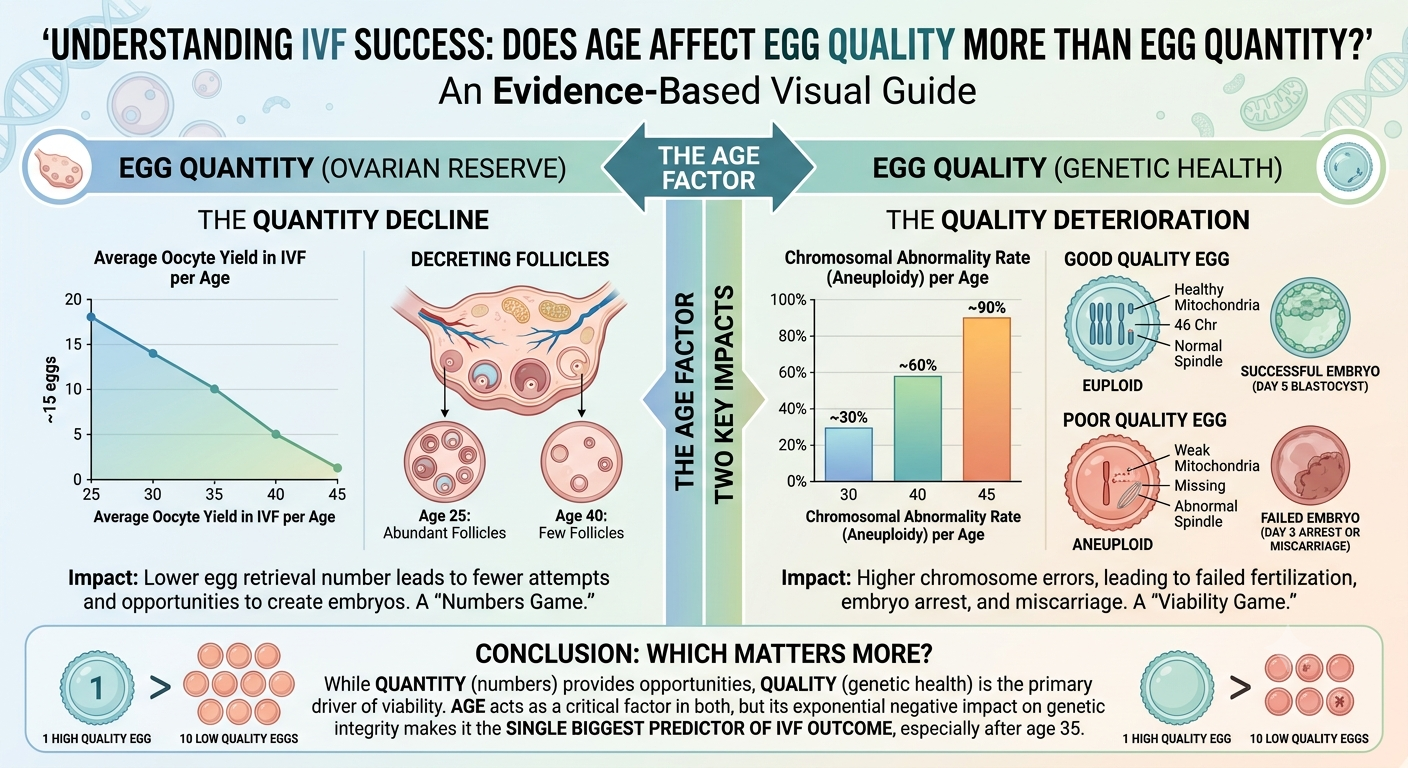
As a woman ages, the process of cell division inside the egg becomes error-prone. It's like a photocopier that has run thousands of copies; eventually, it starts making mistakes. An older egg is far more likely to end up with the wrong number of chromosomes—too many or too few. This is called aneuploidy.
An egg with abnormal chromosomes might fertilize. It might even look beautiful and grade perfectly under a microscope in the lab. But it won't implant. Or, if it does, it leads to an early miscarriage. The heartbreak of a negative pregnancy test or a loss often has nothing to do with your uterus or your hormone levels. It comes down to that single egg's genetic makeup.
The Quantity Illusion
Now, let's talk about the numbers. Egg quantity is your ovarian reserve. This is the pool of eggs you have remaining in your ovaries. We measure this through AMH (Anti-Müllerian Hormone) blood tests and by counting your antral follicles via ultrasound.
Here is the hard truth I share with my patients: quantity matters for your options. A higher egg count means more eggs to retrieve during an IVF cycle, which gives us more chances to find a "good" one. It gives you a safety net.
But quantity does not guarantee success. You can have an AMH level that is excellent for your age, retrieve fifteen eggs in a single cycle, and end up with only one or two chromosomally normal embryos. Conversely, you can have a low egg count, retrieve just three eggs, and all three could be genetically perfect.
This is the reality that surprises women the most. A young woman with a low egg count due to premature ovarian insufficiency might have better success than an older woman with a high egg count. Why? Because her eggs are biologically young. They have better chromosomal quality.
The Great Trade-Off
To give you a practical perspective, let's look at the numbers. In a woman under 35, around 70-80% of her eggs are chromosomally normal. By age 40, that number drops to about 30-40%. By age 42, it falls to roughly 10-15%.
Think about that for a moment. In a 42-year-old woman, even if we retrieve ten eggs, statistically, only one or two of them are genetically competent. The rest are biologically incapable of creating a viable pregnancy.
You can't see this on an ultrasound. You can't feel it. Your AMH levels don't reveal it. The only way to truly know is to retrieve the eggs, fertilize them, and test the resulting embryos. This is why pregnancy rates drop so dramatically with age, regardless of how "fertile" a woman feels.
What This Means For Your IVF Journey
So, when we sit down to plan your IVF strategy, age dictates the approach. If you are younger, we focus on stimulation and retrieving a good number of eggs because the odds that each one is healthy are in our favor. If you are older, we have to adjust expectations.
We know we may need to do more than one retrieval to bank enough embryos to test. We know that we are playing a numbers game where the odds are stacked against us, not because of your ovaries, but because of the biology of aging inside those eggs.
This is where technology steps in. Preimplantation Genetic Testing for Aneuploidy (PGT-A) has become a game-changer. It allows us to screen embryos before transfer, so we only put back the ones with the correct number of chromosomes. It doesn't improve your egg quality, but it helps us identify the few good ones you have, saving you the emotional and physical toll of transferring embryos that were never going to work.
A Final Word On Your Next Steps
The narrative that IVF is just a numbers game is misleading. Yes, we count follicles and track hormone levels. But the real battle is fought on a microscopic, chromosomal level.
If you are over 35 and concerned about your fertility, do not get hung up on a single AMH number. It tells us your reserve, but it doesn't tell us your potential. You need a specialist who understands the nuance of aging eggs and can build a stimulation protocol tailored to maximize the quality of the ones you have left.
If you are in the Delhi region, seeking expert advice early makes all the difference. You need a clinician who looks beyond the lab reports and sees the bigger biological picture. I strongly recommend you reach out to the Best IVF Doctor in Preet Vihar Delhi who can offer a comprehensive evaluation and a realistic, personalized roadmap.
Don't let the obsession with egg count delay your decision. Time is the one variable we cannot change. The sooner you understand the quality vs. quantity equation, the sooner you can make empowered choices for your future. For those seeking compassionate and skilled guidance, Female Infertility Treatment Preet vihar, Delhi offers advanced reproductive technologies that are tailored to the specific challenges of age-related infertility.
Start the conversation today. Your journey is unique, and you deserve a plan that respects both the science and your personal story.

 English
 Arabic
 French
 Spanish
 Portuguese
 Deutsch
 Turkish
 Dutch
Dutch
 Italiano
 Russian
 Romaian
 Greek
Greek