

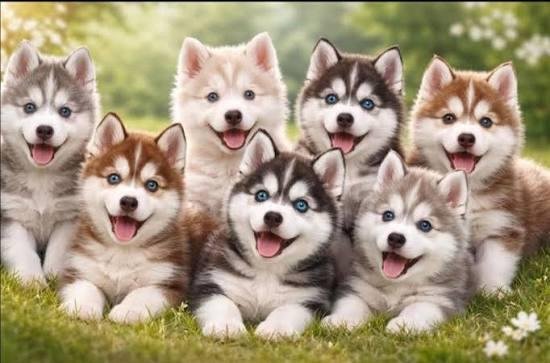
Husky puppies are known for their expressive eyes, fluffy coats, playful behavior, and energetic personalities. The Siberian Husky is a medium-sized working breed originally developed for pulling light loads over long distances. Modern Huskies still carry many of the physical and behavioral characteristics that made them successful working dogs. Adult Siberian Huskies generally stand around 20 to 23.5 inches tall and commonly weigh between 35 and 60 pounds, depending on sex. Their typical life expectancy is around 12 to 14 years. What makes Husky puppies especially interesting is the combination of athletic ability and mischievous behavior. A puppy may spend several minutes playing happily with a toy and then suddenly become fascinated by something happening across the room. Their intelligence, curiosity, and independence make them entertaining companions, but they also mean that owners need patience and consistency from the beginning.
Husky Puppies Have a Remarkable Working History
The modern Siberian Husky Puppies has a fascinating history connected with the Chukchi people of northeastern Asia. These dogs were developed as working sled dogs and were valued for endurance, efficiency, and their ability to work as a team. Instead of being bred primarily for strength and heavy loads, they were designed to carry relatively light loads over substantial distances. This history helps explain why today's Husky can appear surprisingly energetic even after an ordinary walk. Their bodies and minds were shaped for movement and cooperation. The famous sled-dog heritage also influenced their social behavior because working dogs depended heavily on their human handlers and canine teammates. Understanding this history makes it easier to understand why a Husky puppy often wants to be involved in family activities rather than spending the entire day alone.
Why Husky Puppies Have Such Beautiful Eyes
One of the first things people notice about Husky puppies is their eyes. Siberian Huskies can naturally have blue eyes, brown eyes, one blue and one brown eye, or eyes containing multiple shades. This means that two puppies from the same litter can have noticeably different expressions. Blue eyes are particularly recognizable because they create a strong contrast against darker facial markings. However, eye color should not be used as a measure of a puppy's quality or personality. A brown-eyed Husky can be just as healthy and attractive as a blue-eyed one. The breed's eye variety is simply one of its most distinctive physical characteristics. As puppies grow, their facial proportions also become more defined, giving them the familiar alert and expressive Husky appearance.
The Personality of a Husky Puppy
A Husky puppy can be friendly, playful, curious, intelligent, and surprisingly independent. Their personality often combines affection with a strong desire to investigate their surroundings. Many Huskies enjoy interacting with people and other dogs, reflecting their history as social working dogs. They are generally outgoing rather than naturally suspicious of strangers, which means they are not usually considered strong guard dogs. At the same time, individual puppies can have very different temperaments. One puppy may be relaxed and cuddly, while another may constantly explore, chew, dig, or demand attention. Good early socialization and consistent handling can help a young Husky develop confidence and appropriate manners. Owners should appreciate their independent personality instead of expecting them to behave like a breed that is naturally focused on pleasing people.
Husky Puppies Can Be Surprisingly Mischievous
The mischievous side of a Husky is one of the qualities that many owners remember most. These puppies are intelligent enough to discover creative ways to entertain themselves when they become bored. A Husky may investigate cabinets, carry objects around the house, dig in the garden, or become fascinated by a door that has been left open. Their curiosity is not necessarily bad behavior; it is often a reflection of an active and observant mind. The challenge comes when the puppy chooses an activity that the owner does not appreciate. Providing safe toys, structured play, training exercises, and supervised exploration can give this natural curiosity a healthier direction. A puppy with something constructive to do is generally easier to manage than one expected to remain inactive for long periods.
Exercise Is an Essential Part of Husky Care
Huskies are athletic dogs with substantial exercise needs, but puppies should receive age-appropriate activity rather than being pushed into strenuous endurance work. Young puppies benefit from controlled play, short walks, gentle exploration, and mental activities. As they mature, their capacity for exercise increases considerably. Siberian Huskies have a strong natural desire to run, which means owners need to take security seriously. A Husky should not be trusted to roam freely in an unsecured area simply because it has learned basic commands. Secure fencing and appropriate leash management are important parts of responsible ownership. Regular exercise can also reduce boredom and help prevent unwanted behaviors caused by excess energy. For an active household, this can become one of the most enjoyable aspects of owning a Husky.
Mental Stimulation Matters Just as Much
Physical exercise alone may not satisfy a clever Husky puppy. These dogs benefit from activities that encourage them to think, observe, remember, and solve simple problems. Training games, scent activities, puzzle toys, obedience exercises, and learning new behaviors can provide useful mental stimulation. A puppy that receives interesting challenges is less likely to create its own entertainment around the house. Training can also strengthen the relationship between the dog and its owner because the puppy learns that interacting with its human can be rewarding. Keeping activities varied is particularly helpful because repetitive exercises can quickly become boring for an intelligent and independent dog. The ideal routine combines movement, learning, social interaction, rest, and opportunities for safe exploration.
Training a Husky Puppy Successfully
Training a Husky puppy requires consistency rather than harsh discipline. Early lessons can focus on name recognition, basic commands, leash manners, calm behavior, and appropriate interaction with people and other animals. Positive reinforcement can make learning more enjoyable and encourages the puppy to participate willingly. Huskies are intelligent, but they can also be independent thinkers, so owners should not assume that knowing a command automatically means the puppy will perform it every time. Short and engaging sessions can be more effective than repetitive training that becomes frustrating. Early socialization is equally valuable because puppies need safe exposure to different environments, sounds, people, and situations. The objective is to develop a confident dog that understands boundaries while maintaining its naturally curious personality.
The Special Double Coat of Husky Puppies
Husky puppies eventually develop the dense double coat that is characteristic of the breed. Their coat consists of an insulating undercoat and protective outer hairs, reflecting their northern origins. The coat provides protection from cold weather and contributes significantly to the breed's recognizable appearance. Husky owners should be prepared for shedding, particularly during periods when the undercoat is being replaced. Regular brushing helps remove loose fur and keeps the skin and coat in good condition. An interesting feature of the breed is that Huskies are naturally clean and are generally known for having relatively little dog odor. Their coat usually does not require routine shaving or decorative trimming. Instead, proper brushing, nail care, and sensible bathing are the foundation of a healthy grooming routine.
Husky Puppies and Their Food Needs
Nutrition is an important part of raising a healthy Husky puppy because the early growth period places substantial demands on the developing body. Puppies need a balanced diet appropriate for their age and size, with portions adjusted according to growth and activity. Owners should monitor body condition rather than assuming that a constantly hungry puppy needs unlimited food. Siberian Huskies have historically been capable of performing significant work while consuming relatively modest amounts of food compared with some dogs of similar size, but this does not mean that puppies should be underfed. Their nutritional requirements change as they mature and become more active. Fresh water should always be available, and dietary changes should be made gradually. A veterinarian can provide individualized feeding guidance based on the puppy's growth and condition.
Husky Puppies Can Be Excellent Family Companions
A well-socialized Husky can fit beautifully into an active family environment. Their friendly nature often makes them enjoyable companions, and many Huskies like spending time with people and other dogs. However, families should understand that supervision is still important, particularly when young children and puppies are interacting. A puppy can become overly excited during play without intending to cause harm. Families should also consider their daily schedule. A household that spends most of the day away and has little time for exercise or interaction may struggle to meet a Husky's needs. An active family that enjoys walking, outdoor activities, training, and spending time with a dog may be much better suited to this breed.
Huskies Are Famous Escape Artists
One of the most practical facts about Husky ownership is their reputation for escaping. Their natural desire to run can make ordinary doors, gates, or low fences inadequate. A curious puppy may find a gap that nobody noticed or become determined to investigate something outside the yard. Owners should check fencing carefully and avoid assuming that a Husky will remain nearby simply because it knows its home. Identification and responsible supervision are important safeguards. Secure outdoor space allows a Husky to exercise without creating unnecessary risks. Teaching recall is valuable, but owners should still recognize that even a well-trained Husky can become distracted by an interesting smell, animal, or movement. Their independence and athletic ability make secure management an essential part of responsible care.
Health and Long-Term Care
Siberian Huskies are generally considered a relatively healthy and long-lived breed, but responsible owners should still pay attention to preventive healthcare. Regular veterinary examinations, appropriate vaccinations, parasite prevention, dental care, healthy body weight, and routine observation can help support a puppy's development. Hip health, eye health, and certain inherited conditions are important considerations when evaluating breeding dogs. Responsible puppy selection should therefore involve more than choosing the most attractive face or brightest eyes. Owners should consider health history, temperament, living conditions, and responsible breeding practices. Maintaining an appropriate weight is also important because unnecessary weight can place additional stress on a dog's body. With suitable care, many Siberian Huskies remain active well into their later years.
Unique Facts That Make Husky Puppies Memorable
Husky puppies have several characteristics that distinguish them from many other breeds. They can have different eye colors, are naturally social, possess remarkable endurance, and often communicate through a mixture of barking, whining, and distinctive vocal sounds. Their thick coat is surprisingly low-odor, although it can produce considerable shedding. They also have a strong instinct to run and may become determined explorers when given an opportunity. Another interesting point is that the Siberian Husky was recognized as a breed by the American Kennel Club in 1930, reflecting the breed's established identity in modern dog history. Their combination of athleticism, friendliness, intelligence, and mischievous behavior continues to make them popular with people who want an active companion.

 English
 Arabic
 French
 Spanish
 Portuguese
 Turkish
 Dutch
Dutch
 Italiano
 Russian
 Romaian
 Portuguese (Brazil)
 Greek
Greek